

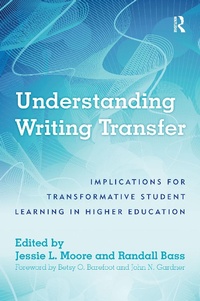
Understanding Writing Transfer
Implications for Transformative Student Learning in Higher Education
1st Edition
Published on 3. July 2023
178 pages
978-1-000-97341-9 (ISBN)
Description

While education is based on the broad assumption that what one learns here can transfer over there- across critical transitions - what do we really know about the transfer of knowledge?The question is all the more urgent at a time when there are pressures to "unbundle" higher education to target learning particular subjects and skills for occupational credentialing to the detriment of integrative education that enables students to make connections and integrate their knowledge, skills and habits of mind into a adaptable and critical stance toward the worldThis book - the fruit of two-year multi-institutional studies by forty-five researchers from twenty-eight institutions in five countries - identifies enabling practices for, and five essential principles about, writing transfer that should inform decision-making by all higher education stakeholders about how to generally promote the transfer of knowledge.This collection concisely summarizes what we know about writing transfer and explores the implications of writing transfer research for universities' institutional decisions about writing across the curriculum requirements, general education programs, online and hybrid learning, outcomes assessment, writing-supported experiential learning, e-portfolios, first-year experiences, and other higher education initiatives. This volume makes writing transfer research accessible to administrators, faculty decision makers, and other stakeholders across the curriculum who have a vested interest in preparing students to succeed in their future writing tasks in academia, the workplace, and their civic lives, and offers a framework for addressing the tensions between competency-based education and the integration of knowledge so vital for our society.
Reviews / Votes
"Much has been made of the fact that many students enter American universities without the writing skills they will need to succeed, and universities often address these skill deficiencies early through undergraduate coursework designed to develop these writing skills. How do students understand the expectations for writing in various contexts? How can first year writing courses better prepare students for their remaining years of post-secondary education?These are just some of the questions this text seeks to address by reporting on the results of studies by 45 researchers from 28 institutions across five countries. The text is focused on the idea of writing transfer, the ability to extend one's writing skills from one context to another, or in this case, to also transfer skills gained in writing courses to other contexts at the university. It argues that the ability to transfer these skills has an important impact on students' ultimate writing success at a university. The text begins by introducing five essential principles for fostering writing transfer in higher education, and the remaining chapters are organized into two groups.
Taken in its entirety, Understanding Writing Transfer, offers a variety of tools and ideas for those looking to encourage writing transfer for university students. [It] avoids academic jargon throughout, it would be useful to any individual seeking guidance on how to best support post-secondary students' writing. It is a handbook-like guide and a useful springboard for delving into issues of writing transfer in higher education."
Teachers College Record
"I felt inspired as I read this book, finding myself scribbling in the margins of nearly every chapter the names of campus colleagues who will want to read and discuss this work. Not only does Understanding Writing Transfer include a wealth of superb empirical research, it also offers a capacious vision of the importance of writing transfer within the future of higher education. These essays invite readers to think critically about their own pedagogical practices (on personal and institutional levels) and to reimagine the possibilities for intentional, integrative teaching and learning."
Rebecca Nowacek, Associate Professor, and Director of the Norman H. Ott Memorial Writing Center
Marquette University
"Understanding Writing Transfer can be an important tool in helping colleges and universities develop a clearer vision for their goals for student writing not only in the first year, but also across the entire span of undergraduate education. While those goals may differ to some degree by institutional type, the book itself offers a template for any campus to use in cross-campus conversations about writing in the 21st century. These conversations could be designed to develop institution-wide goals for writing, to address issues of technology, to determine appropriate strategies for writing instruction for non-native English speakers, to expose campus employees to existing writing resources on campus, and to explore the importance of connecting writing to high-impact practices such as undergraduate research, study abroad or away, learning communities, internships, and of course, the first-year seminar. Cross-campus conversations can also be a site for sharing what works-the strategies instructors across disciplines are using to help students understand appropriate writing in specific disciplinary and professional contexts. This book offers a number of such strategies that can be valuable to readers."
Betsy O. Barefoot and John N. Gardner
John N. Gardner Institute for Excellence in Higher Education
More details
Edition
1. Auflage
Language
English
Place of publication
London
United Kingdom
Publishing group
Taylor & Francis Ltd
Target group
College/higher education
ISBN-13
978-1-000-97341-9 (9781000973419)
Copyright in bibliographic data and cover images is held by Nielsen Book Services Limited or by the publishers or by their respective licensors: all rights reserved.
Schweitzer Classification
Other editions
Additional editions
Randall Bass | Jessie L. Moore
Understanding Writing Transfer
Implications for Transformative Student Learning in Higher Education
Book
02/2017
1st Edition
Stylus Publishing
€205.90
Shipment within 3-4 weeks
Randall Bass | Jessie L. Moore
Understanding Writing Transfer
Implications for Transformative Student Learning in Higher Education
Book
01/2017
1st Edition
Stylus Publishing
€50.70
Shipment within 3-4 weeks
Persons
Randall Bass is Vice Provost for Education and Professor of English at Georgetown University, where he leads the Designing the Future(s) initiative and the Red House incubator for curricular transformation. For 13 years he was the Founding Executive Director of Georgetown's Center for New Designs in Learning and Scholarship (CNDLS). He has been working at the intersections of new media technologies and the scholarship of teaching and learning for nearly thirty years, including serving as Director and Principal Investigator of the Visible Knowledge Project, a five-year scholarship of teaching and learning project involving 70 faculty on 21 university and college campuses. In January 2009, he published a collection of essays and synthesis of findings from the Visible Knowledge Project under the title, "The Difference that Inquiry Makes," (co-edited with Bret Eynon) in the digital journal Academic Commons (January 2009: http://academiccommons.org). Bass is the author and editor of numerous books, articles, and electronic projects, including recently, "Disrupting Ourselves: the Problem of Learning in Higher Education" (Educause Review, March/April 2012). He is currently a Senior Scholar with the American Association for Colleges and Universities.
Jessie L. Moore is Director of the Center for Engaged Learning and Associate Professor of English: Professional Writing & Rhetoric. She leads planning, implementation, and assessment of the Center's research seminars, which support multi-institutional inquiry on high-impact pedagogies and other focused engaged learning topics. Her recent research examines transfer of writing knowledge and practices, multi-institutional research and collaborative inquiry, writing residencies for faculty writers, the writing lives of university students, and high-impact pedagogies. She co-edited Critical Transitions: Writing and the Question of Transfer (2016). She currently serves as the elected Secretary of the Conference on College Composition and Communication.
Dr. John N. Gardner is an undergraduate student success thought leader and a social justice advocate. He is Chief Executive Officer and Chair of the non-profit, the John N. Gardner Institute for Excellence in Undergraduate Education, co-founded by him and his wife, Betsy O. Barefoot, in 1999. John is also Distinguished Professor Emeritus and Senior Fellow, University of South Carolina at Columbia. He was also the Founding Executive Director of both the National Resource Center for the First-Year Experience and Students in Transition, and the University 101 Programs. He also served as Vice Chancellor for Academic Affairs for the University's five Regional Campuses. Subscribe to the Office Hours with John Gardner: Innovation in Higher Education podcast.
Betsy O. Barefoot is Vice President & Senior Scholar at the Gardner Institute for Excellence in Undergraduate Education.
Jessie L. Moore is Director of the Center for Engaged Learning and Associate Professor of English: Professional Writing & Rhetoric. She leads planning, implementation, and assessment of the Center's research seminars, which support multi-institutional inquiry on high-impact pedagogies and other focused engaged learning topics. Her recent research examines transfer of writing knowledge and practices, multi-institutional research and collaborative inquiry, writing residencies for faculty writers, the writing lives of university students, and high-impact pedagogies. She co-edited Critical Transitions: Writing and the Question of Transfer (2016). She currently serves as the elected Secretary of the Conference on College Composition and Communication.
Dr. John N. Gardner is an undergraduate student success thought leader and a social justice advocate. He is Chief Executive Officer and Chair of the non-profit, the John N. Gardner Institute for Excellence in Undergraduate Education, co-founded by him and his wife, Betsy O. Barefoot, in 1999. John is also Distinguished Professor Emeritus and Senior Fellow, University of South Carolina at Columbia. He was also the Founding Executive Director of both the National Resource Center for the First-Year Experience and Students in Transition, and the University 101 Programs. He also served as Vice Chancellor for Academic Affairs for the University's five Regional Campuses. Subscribe to the Office Hours with John Gardner: Innovation in Higher Education podcast.
Betsy O. Barefoot is Vice President & Senior Scholar at the Gardner Institute for Excellence in Undergraduate Education.
Content
Foreword-Betsy O. Barefoot and John N. Gardner 1. Five Essential Principles About Writing Transfer-Jessie L. Moore Part One. Critical Sites of Impact 2. Transfer and Educational Reform in the Twenty-First Century. College and Career Readiness and the Common Core Standards-Linda Adler-Kassner 3. Pedagogy and Learning in a Digital Ecosystem-Rebecca Frost Davis 4. Writing, Transfer, and ePortfolios. A Possible Trifecta in Supporting Student Learning-Kathleen Blake Yancey 5. Writing High-Impact Practices. Developing Proactive Knowledge in Complex Contexts-Peter Felten 6. Diversity, Global Citizenship, and Writing Transfer-Brooke Barnett, Woody Pelton, Francois Masuka, Kevin Morrison, and Jessie L. Moore 7. Telling Expectations About Academic Writing. If Not Working, What About Knotworking?-Carmen M. Werder Part Two. Principles at Work. Implications for Practice Case Studies 8. Rethinking the Role of Higher Education in College Preparedness and Success From the Perspective of Writing Transfer-Alison Farrell, Sandra Kane, Cecilia Dube, and Steve Salchak 9. Teaching for Transfer-Liane Robertson and Kara Taczak 10. Student Drafting Behaviors in and Beyond the First-Year Seminar-Diane E. Boyd 11. Cueing and Adapting First-Year Writing Knowledge. Support for Transfer Into Disciplinary Writing-Gwen Gorzelsky, Carol Hayes, Ed Jones, and Dana Lynn Driscoll 12. Promoting Cross-Disciplinary Transfer. A Case Study in Genre Learning-Mary Goldschmidt 13. "The Hardest Thing With Writing Is Not Getting Enough Instruction". Helping Educators Guide Students Through Writing Challenges-Elizabeth Wardle and Nicolette Mercer Clement 14. Coda-Randall Bass About the Editors and Contributors Index
