

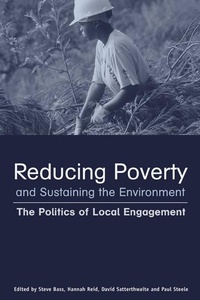
Reducing Poverty and Sustaining the Environment
The Politics of Local Engagement
1st Edition
Published on 17. June 2013
256 pages
978-1-136-55896-2 (ISBN)
Description

'A valuable contribution to our collective knowledge about governance, poverty and the environment' Frances Seymour, World Resources Institute
'Detailed and realistic documentation of contemporary development and governance relationships and trends' Melissa Leach, Institute of Development Studies
There are growing signs that development work by governments, aid agencies and non-government organisations ignores the fact that environmental quality matters to the poor. There are also indications that some environmental work is pushing 'people-out' protection methodologies. Yet recently, an extensive range of project, programme and policy level activities has focused attention on the important links between poverty and the environment, and the benefit of entrenching these links in policy-making processes at all levels. The role that politics plays in all of this is of overriding importance. This volume is the first to address the role of politics in environmental issues that matter to the poor through a series of case studies. It describes experiences at regional, national and local levels in low and middle income countries including China, Tanzania, Nigeria, South Africa, Pakistan, Colombia, Peru, India, Saint Lucia and countries in East Africa.
Ultimately the book demonstrates how understanding the national and local political context is crucial for addressing poverty-environment issues such as environmental health, access to natural resources for livelihoods and security, and coping with environmental disasters. The editors advocate ways in which political processes can be used to make positive changes - from the perspectives of both poverty reduction and the environment.
'Detailed and realistic documentation of contemporary development and governance relationships and trends' Melissa Leach, Institute of Development Studies
There are growing signs that development work by governments, aid agencies and non-government organisations ignores the fact that environmental quality matters to the poor. There are also indications that some environmental work is pushing 'people-out' protection methodologies. Yet recently, an extensive range of project, programme and policy level activities has focused attention on the important links between poverty and the environment, and the benefit of entrenching these links in policy-making processes at all levels. The role that politics plays in all of this is of overriding importance. This volume is the first to address the role of politics in environmental issues that matter to the poor through a series of case studies. It describes experiences at regional, national and local levels in low and middle income countries including China, Tanzania, Nigeria, South Africa, Pakistan, Colombia, Peru, India, Saint Lucia and countries in East Africa.
Ultimately the book demonstrates how understanding the national and local political context is crucial for addressing poverty-environment issues such as environmental health, access to natural resources for livelihoods and security, and coping with environmental disasters. The editors advocate ways in which political processes can be used to make positive changes - from the perspectives of both poverty reduction and the environment.
More details
Language
English
Place of publication
London
United Kingdom
Publishing group
Taylor & Francis Ltd
Target group
College/higher education
File size
4,19 MB
ISBN-13
978-1-136-55896-2 (9781136558962)
Copyright in bibliographic data and cover images is held by Nielsen Book Services Limited or by the publishers or by their respective licensors: all rights reserved.
Schweitzer Classification
Other editions
Additional editions
Stephen Bass | Hannah Reid | David Satterthwaite
Reducing Poverty and Sustaining the Environment
The Politics of Local Engagement
Book
08/2005
1st Edition
Earthscan Ltd
€74.46
Shipment within 3-4 weeks

Stephen Bass | Hannah Reid | David Satterthwaite
Reducing Poverty and Sustaining the Environment
The Politics of Local Engagement
Book
07/2005
Earthscan Ltd
€119.04
Article exhausted; check different version
Persons
Stephen Bass is Head of Environment at DFID and co-author of Policy that Works for People (2004) and The Sustainable Forestry Handbook (2004).
Hannah Reid is a Research Associate at IIED.
David Satterthwaite is a Senior Fellow at IIED, co-author of Empowering Squatter Citizen (2004) and winner of the 2004 Volvo Environment Prize.
Paul Steele is an environmental economist focusing on political analysis and currently based in Sri Lanka. Published with IIED
Hannah Reid is a Research Associate at IIED.
David Satterthwaite is a Senior Fellow at IIED, co-author of Empowering Squatter Citizen (2004) and winner of the 2004 Volvo Environment Prize.
Paul Steele is an environmental economist focusing on political analysis and currently based in Sri Lanka. Published with IIED
Content
Introduction * The focus of this book * The case studies: Political change in Africa, Asia and Latin America and the Caribbean * Mapping power relationships * What do we mean by poverty? * How political change can support pro-poor environmental outcomes * Part I, Creating Space for Civil Society in an Impoverished Environment in Pakistan * AKRSP's approach: 'Social organization' tackles poverty and natural resource degradation * Improving governance: AKRSP as a complement to government, not a substitute * Maturing institutions get to grips with environmental issues and influence policy * Influencing national policy on rural development * Part II, The Bioplan: Decreasing Poverty in Manizales, Colombia, through Shared Environmental Management * The context: Urban and rural poverty in Colombia and Manizales * The Bioplan in action * Experiences * Part III, Environment-Poverty Linkages: Managing Natural Resources in China * Improving environment-poverty projects * Participatory assessments * Poverty reduction, environment and participation * Part IV, The Evolving Roles of Environmental Management Institutions in East Africa: From Conservation to Poverty Reduction * Some reflections on governance in the context of the East African Community * Current trends in governance * National environmental governance in the context of poverty eradication * Looking to the future * Part V, Stories on the Environment and Conflict from Northern Nigeria * The Hadejia-Nguru Wetlands * Bringing the stories together * Part VI, The Sea is our Garden: Coastal Resource Management and Local Governance in the Caribbean * A small island and its internal politics * The case study: Context and stakeholders * Promoting sustainable coastal livelihoods * Lessons learned: Local governance and institutional arrangements for coastal conservation and management * Part VII'Working for Water' in a Democratic South Africa * What is 'Working for Water'? * The political environment: Time for action * Is everything rosy? * Outcomes * Part VIII, People, Perspectives and Reality: Usangu Myths and Other Stories, Tanzania * Prologue: The stage is set, the actors announced * Act 1: The players reveal their agendas; international, national and local stages are revealed * Act 2: A circle of blame in Usangu benefits a collusion of interests *
Act 3: Misleading answers in a climate of self-interest * Finale * Part IX, Community-designed, built and managed Toilet Blocks in Indian Cities * The inadequacies in providing sanitation * What people wanted and what they could do themselves * The community toilet programme in Pune * New opportunities for community toilets in Mumbai * Innovations in community toilets * Why did the alliance take on community toilet blocks? * The art of gentle negotiation * Community toilets add to the poor's repertoire * Part X, Concertaci?n (Reaching Agreement) and Planning for Sustainable Development in Ilo, Peru * The birth of the experience * The achievements, 1980-2003 * The coordinating agency and stages in the process * Tangible results * The current situation * Factors that favour the process of reaching agreement * Limitations of the experience * Conclusions * Context: The political underpinnings of poverty and environmental degradation * How political changes have achieved pro-poor environmental outcomes * How donors must change the way they do
Act 3: Misleading answers in a climate of self-interest * Finale * Part IX, Community-designed, built and managed Toilet Blocks in Indian Cities * The inadequacies in providing sanitation * What people wanted and what they could do themselves * The community toilet programme in Pune * New opportunities for community toilets in Mumbai * Innovations in community toilets * Why did the alliance take on community toilet blocks? * The art of gentle negotiation * Community toilets add to the poor's repertoire * Part X, Concertaci?n (Reaching Agreement) and Planning for Sustainable Development in Ilo, Peru * The birth of the experience * The achievements, 1980-2003 * The coordinating agency and stages in the process * Tangible results * The current situation * Factors that favour the process of reaching agreement * Limitations of the experience * Conclusions * Context: The political underpinnings of poverty and environmental degradation * How political changes have achieved pro-poor environmental outcomes * How donors must change the way they do
