

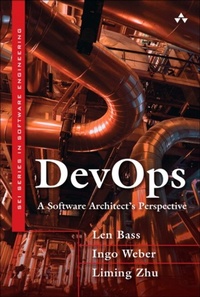
DevOps
A Software Architect's Perspective
1st Edition
Published on 8. May 2015
352 pages
978-0-13-404987-8 (ISBN)
Description

The First Complete Guide to DevOps for Software Architects
DevOps promises to accelerate the release of new software features and improve monitoring of systems in production, but its crucial implications for software architects and architecture are often ignored.
In DevOps: A Software Architect's Perspective, three leading architects address these issues head-on. The authors review decisions software architects must make in order to achieve DevOps' goals and clarify how other DevOps participants are likely to impact the architect's work. They also provide the organizational, technical, and operational context needed to deploy DevOps more efficiently, and review DevOps' impact on each development phase. The authors address cross-cutting concerns that link multiple functions, offering practical insights into compliance, performance, reliability, repeatability, and security.
This guide demonstrates the authors' ideas in action with three real-world case studies: datacenter replication for business continuity, management of a continuous deployment pipeline, and migration to a microservice architecture.
Comprehensive coverage includes
* Why DevOps can require major changes in both system architecture and IT roles
* How virtualization and the cloud can enable DevOps practices
* Integrating operations and its service lifecycle into DevOps
* Designing new systems to work well with DevOps practices
* Integrating DevOps with agile methods and TDD
* Handling failure detection, upgrade planning, and other key issues
* Managing consistency issues arising from DevOps' independent deployment models
* Integrating security controls, roles, and audits into DevOps
* Preparing a business plan for DevOps adoption, rollout, and measurement
DevOps promises to accelerate the release of new software features and improve monitoring of systems in production, but its crucial implications for software architects and architecture are often ignored.
In DevOps: A Software Architect's Perspective, three leading architects address these issues head-on. The authors review decisions software architects must make in order to achieve DevOps' goals and clarify how other DevOps participants are likely to impact the architect's work. They also provide the organizational, technical, and operational context needed to deploy DevOps more efficiently, and review DevOps' impact on each development phase. The authors address cross-cutting concerns that link multiple functions, offering practical insights into compliance, performance, reliability, repeatability, and security.
This guide demonstrates the authors' ideas in action with three real-world case studies: datacenter replication for business continuity, management of a continuous deployment pipeline, and migration to a microservice architecture.
Comprehensive coverage includes
* Why DevOps can require major changes in both system architecture and IT roles
* How virtualization and the cloud can enable DevOps practices
* Integrating operations and its service lifecycle into DevOps
* Designing new systems to work well with DevOps practices
* Integrating DevOps with agile methods and TDD
* Handling failure detection, upgrade planning, and other key issues
* Managing consistency issues arising from DevOps' independent deployment models
* Integrating security controls, roles, and audits into DevOps
* Preparing a business plan for DevOps adoption, rollout, and measurement
All prices
More details
Series
Edition
1. Auflage
Language
English
Place of publication
Boston
United States
Publishing group
Pearson Education (US)
Target group
College/higher education
ISBN-13
978-0-13-404987-8 (9780134049878)
Copyright in bibliographic data and cover images is held by Nielsen Book Services Limited or by the publishers or by their respective licensors: all rights reserved.
Schweitzer Classification
Other editions
Additional editions
Book
06/2015
Addison Wesley
€37.50
Shipment within 15-20 days
Persons
Len Bass is a senior principal researcher at National ICT Australia Ltd. (NICTA). He joined NICTA in 2011 after 25 years at the Software Engineering Institute (SEI) at Carnegie Mellon University. He is the coauthor of two award-winning books in software architecture-Software Architecture in Practice, Third Edition (Addison-Wesley 2013) and Documenting Software Architectures: Views and Beyond, Second Edition (Addison-Wesley 2011)-as well as several other books and numerous papers in computer science and software engineering on a wide range of topics. Len has more than 50 years' experience in software development and research, which has resulted in papers on operating systems, database man-agement systems, user interface software, software architecture, product line sys-tems, and computer operations. He has worked or consulted in multiple domains, including scientific analysis, embedded systems, and information and financial systems.
Ingo Weber is a senior researcher in the Software Systems Research Group at NICTA in Sydney, Australia, as well as an adjunct senior lecturer at CSE at the University of New South Wales (UNSW). Prior to NICTA, Ingo held posi-tions at UNSW and at SAP Research Karlsruhe, Germany. His research interests include cloud computing, DevOps, business process management, and artificial intelligence (AI). He has published over 60 peer-reviewed papers, and served as a reviewer or program committee member for many prestigious scientific jour-nals and conferences. Ingo holds a Ph.D. and a Diploma from the University of Karlsruhe, and an MSc from the University of Massachusetts at Amherst.
Liming Zhu is a research group leader and principal researcher at NICTA. He holds conjoint positions at the University of New South Wales (UNSW) and the University of Sydney. Liming has published over 80 peer-reviewed papers. He formerly worked in several technology lead positions in the software industry before obtaining a Ph.D. in software engineering from UNSW. He is a committee member of the Standards Australia IT-015 (system and software engineering), contributing to ISO/SC7. Liming's research interests include software architec-ture and dependable systems.
Ingo Weber is a senior researcher in the Software Systems Research Group at NICTA in Sydney, Australia, as well as an adjunct senior lecturer at CSE at the University of New South Wales (UNSW). Prior to NICTA, Ingo held posi-tions at UNSW and at SAP Research Karlsruhe, Germany. His research interests include cloud computing, DevOps, business process management, and artificial intelligence (AI). He has published over 60 peer-reviewed papers, and served as a reviewer or program committee member for many prestigious scientific jour-nals and conferences. Ingo holds a Ph.D. and a Diploma from the University of Karlsruhe, and an MSc from the University of Massachusetts at Amherst.
Liming Zhu is a research group leader and principal researcher at NICTA. He holds conjoint positions at the University of New South Wales (UNSW) and the University of Sydney. Liming has published over 80 peer-reviewed papers. He formerly worked in several technology lead positions in the software industry before obtaining a Ph.D. in software engineering from UNSW. He is a committee member of the Standards Australia IT-015 (system and software engineering), contributing to ISO/SC7. Liming's research interests include software architec-ture and dependable systems.
Content
Part I: Background
Chapter 1: What Is DevOps?
Chapter 2: The Cloud as a Platform
Chapter 3: Operations
Part II: The Deployment Pipeline
Chapter 4: Overall Architecture
Chapter 5: Building and Testing
Chapter 6: Deployment
Part III: Crosscutting Concerns
Chapter 7: Monitoring
Chapter 8: Security and Security Audits
Chapter 9: Other
Chapter 10: Business Considerations
Part IV: Case Studies
Chapter 11: Supporting Multiple Datacenters
Chapter 12: Implementing a Continuous Deployment Pipeline for Enterprises
Chapter 13: Migrating to Microservices
Part V: Moving into the Future
Chapter 14: Operations as a Process
Chapter 16: The Future of DevOps
References
About the Authors
Index
Chapter 1: What Is DevOps?
Chapter 2: The Cloud as a Platform
Chapter 3: Operations
Part II: The Deployment Pipeline
Chapter 4: Overall Architecture
Chapter 5: Building and Testing
Chapter 6: Deployment
Part III: Crosscutting Concerns
Chapter 7: Monitoring
Chapter 8: Security and Security Audits
Chapter 9: Other
Chapter 10: Business Considerations
Part IV: Case Studies
Chapter 11: Supporting Multiple Datacenters
Chapter 12: Implementing a Continuous Deployment Pipeline for Enterprises
Chapter 13: Migrating to Microservices
Part V: Moving into the Future
Chapter 14: Operations as a Process
Chapter 16: The Future of DevOps
References
About the Authors
Index
