

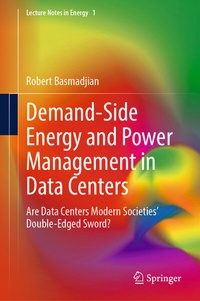
Demand-Side Energy and Power Management in Data Centers
Description

This book explains the principles, foundations and methodologies adopted in data centers to achieve demand-side energy and peak power management. It gives a brief introduction about Smart Grid, how the transition from legacy to Smart Grid is realized, the different approaches for demand-side management (DSM), and then discusses the opportunities of data centers to achieve DSM and highlight the different considered optimization criterion.
Data centers are the backbones in realizing digitization where they host ICT (information and communication technologies) resources like servers, storage devices and networking equipment. Despite their advantages in terms of providing numerous services to our modern society (e.g. social media, e-commerce, online learning), the major drawback is that data centers devour enormous amounts of energy. It is expected that the energy usage of data centers will increase in the next few years - expected to reach almost 25% of the world's overall consumption - due to the emerging and expanding technologies such as Blockchain and 5G.
More details
Other editions
Additional editions
Person
Robert Basmadjian holds a PhD in distributed data synchronization protocol from the University of Toulouse. After completing his doctorate, in 2009 he joined the University of Passau as a postdoctoral fellow, where he obtained his habilitation in 2019. Since then, he has been appointed as a Professor in the Department of Computer Science at the University of Passau and Clausthal University of Technology. He is currently a member of the College of Computing at UM6P as an Associate Professor and heading the Toubkal Supercomputer. He has more than 15 years of experience in the fields of teaching, research and development tackling methodologies and concepts of computer science from both classical and quantum computing perspectives. His main research interests are (1) modeling of performance-energy trade-off for HPC data centers using queuing theory methodology, (2) ML-based prediction modeling using peer-to-peer approach (use case of smart thermostats), (3) statistical and AI-based modeling for the percentage of renewables, (4) modeling, designing and optimizing quantum circuits (e.g. QRAM, arithmetic) using queuing theory, and (5) variational quantum algorithm design and quantum machine learning for renewable energy sources. He has more than 70 scientific publications in the fields of sustainable, green and quantum computing. He was a scientific and technical contributor to EU FP7 FIT4Green and ALL4 Green projects related to demand-response in data centers and also the technical coordinator of the -H2020 Electrific project.
Content
Introduction.- Power and Smart Grid.- Flexibility of Data Centers for DSM.- Methodologies and Models for Predictions.- Reduction of Energy Consumption.- Minimization of Peak Power Demand.- Integration of Renewable Energy Sources.- Conclusion.
