

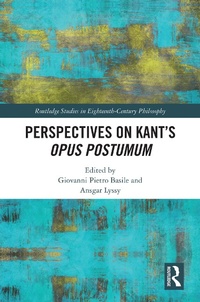
Perspectives on Kant's Opus postumum
1st Edition
Published on 18. November 2022
240 pages
978-1-000-78570-8 (ISBN)
Description

This book offers new perspectives on the theoretical elements of the Opus postumum (OP), Kant's project of a final work which remained unknown until eighty years after his death. The contributors read the OP as a central work in establishing the relation between Kant's transcendental philosophy, his natural philosophy, practical philosophy, philosophy of religion, metaphysics, and his broader epistemology.
Interpreting the OP is an important task because it helps reveal how Kant himself tried to correct and develop his critical philosophy. It also sheds light on the foundational role of the three Critiques for other philosophical inquiries, as well as the unified philosophical system that Kant sought to establish. The chapters in this volume address a range of topics relevant to the epistemological and theoretical problems raised in the OP, including the transition from the Metaphysical Foundations of Natural Science to physics as an answer to a deficiency in critical thought; the notion of ether and, more specifically, its transcendental deduction; self-affection and the self-positing of the subject; and the idea of God and the system of ideas in the highest standpoint of transcendental philosophy.
Perspectives on Kant's Opus postumum will be of interest to upper-level students and scholars working on Kant.
Interpreting the OP is an important task because it helps reveal how Kant himself tried to correct and develop his critical philosophy. It also sheds light on the foundational role of the three Critiques for other philosophical inquiries, as well as the unified philosophical system that Kant sought to establish. The chapters in this volume address a range of topics relevant to the epistemological and theoretical problems raised in the OP, including the transition from the Metaphysical Foundations of Natural Science to physics as an answer to a deficiency in critical thought; the notion of ether and, more specifically, its transcendental deduction; self-affection and the self-positing of the subject; and the idea of God and the system of ideas in the highest standpoint of transcendental philosophy.
Perspectives on Kant's Opus postumum will be of interest to upper-level students and scholars working on Kant.
Reviews / Votes
"This book deals with many issues at stake in Kant's Opus postumum in relation to his Critical Philosophy, physics and metaphysis. It provides a new step towards elucidating Kant's rather enigmatic last work." - Ernst-Otto Onnasch, Utrecht UniversityMore details
Series
Edition
1. Auflage
Language
English
Place of publication
London
United Kingdom
Publishing group
Taylor & Francis Ltd
Target group
College/higher education
Product notice
Reflowable
ISBN-13
978-1-000-78570-8 (9781000785708)
Copyright in bibliographic data and cover images is held by Nielsen Book Services Limited or by the publishers or by their respective licensors: all rights reserved.
Schweitzer Classification
Other editions
Additional editions
Giovanni Pietro Basile | Ansgar Lyssy
Perspectives on Kant's Opus postumum
Book
08/2024
1st Edition
Routledge
€63.30
Shipment within 15-20 days
Giovanni Pietro Basile | Ansgar Lyssy
Perspectives on Kant's Opus postumum
Book
11/2022
1st Edition
Routledge
€186.10
Shipment within 15-20 days
Persons
Giovanni Pietro Basile is currently associate professor in the Philosophy Department of Boston College. After completing studies in physics, theology, and philosophy, he earned his PhD in philosophy at the LMU Munich, where he also received the German Habilitation. He is a member of the Reviewers Panel of the journals Gregoriamum and Kant-Studien. Among his main publications are two books-Transcendance et finitude. La synthese transcendantale dans la Critique de la raison pure de Kant, Paris: L'Harmattan, 2005 and Kants Opus postumum und seine Rezeption, Berlin/Boston: De Gruyter, 2013-and several articles on Kant, Karl Jaspers, and Paul Ricoeur.
Ansgar Lyssy is currently researcher at the University of Heidelberg, working on a project on causality in Hegel, funded by a grant from the Thyssen Foundation. In 2020, he finished his Habilitationsschrift at LMU Munich, a yet unpublished monograph titled Humankind and Humanity in Kant. This research was funded by a research grant from the German Research Foundation. Notable publications include Kausalitaet und Teleologie bei G. W. Leibniz, Stuttgart: Franz-Steiner (Studia Leibnitiana, Special Issue No. 48), 2016, three anthologies on Kant and the philosophy of the eighteenth century, and several papers on Leibniz, Kant, Hegel, and other related thinkers.
Ansgar Lyssy is currently researcher at the University of Heidelberg, working on a project on causality in Hegel, funded by a grant from the Thyssen Foundation. In 2020, he finished his Habilitationsschrift at LMU Munich, a yet unpublished monograph titled Humankind and Humanity in Kant. This research was funded by a research grant from the German Research Foundation. Notable publications include Kausalitaet und Teleologie bei G. W. Leibniz, Stuttgart: Franz-Steiner (Studia Leibnitiana, Special Issue No. 48), 2016, three anthologies on Kant and the philosophy of the eighteenth century, and several papers on Leibniz, Kant, Hegel, and other related thinkers.
Content
Introduction Giovanni Pietro Basile & Ansgar Lyssy
1. Kant's Paradoxical Reception of Lavoisier Henry Blomme
2. Filling Out Space: The Ether and the Dispositions of Matter in Kant's Opus postumum Ansgar Lyssy
3. Physics as System in Fascicles X/XI of Kant's Opus postumum Stephen Howard
4. The Analogical Use of Schematism from the Critique of Pure Reason to the Opus postumum Lara Scaglia
5. The Forms of "Composition" and the Role of Mediating Concepts in Kant's Opus postumum Gualtiero Lorini
6. Self-Affection in Kant's Opus postumum and in the Critique of Pure Reason Dina Emundts
7. A Kantian Answer to Aenesidemus: Appropriating Kant's Doctrine of Self-Positing in the Opus postumum Bryan Hall
8. Fichte or Baumgarten? On Kant's Use of "Positing" in the Selbstsetzungslehre Lorenzo Sala
9. Kant's "Deification" of Reason in the Opus Postumum: An Attempt at Reconciling God and Autonomy Anna Tomaszewska
10. Francois Marty's Interpretation of Kant's Opus postumum Giovanni Pietro Basile
1. Kant's Paradoxical Reception of Lavoisier Henry Blomme
2. Filling Out Space: The Ether and the Dispositions of Matter in Kant's Opus postumum Ansgar Lyssy
3. Physics as System in Fascicles X/XI of Kant's Opus postumum Stephen Howard
4. The Analogical Use of Schematism from the Critique of Pure Reason to the Opus postumum Lara Scaglia
5. The Forms of "Composition" and the Role of Mediating Concepts in Kant's Opus postumum Gualtiero Lorini
6. Self-Affection in Kant's Opus postumum and in the Critique of Pure Reason Dina Emundts
7. A Kantian Answer to Aenesidemus: Appropriating Kant's Doctrine of Self-Positing in the Opus postumum Bryan Hall
8. Fichte or Baumgarten? On Kant's Use of "Positing" in the Selbstsetzungslehre Lorenzo Sala
9. Kant's "Deification" of Reason in the Opus Postumum: An Attempt at Reconciling God and Autonomy Anna Tomaszewska
10. Francois Marty's Interpretation of Kant's Opus postumum Giovanni Pietro Basile
