

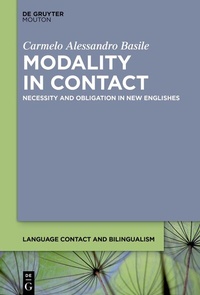
Modality in Contact
Description

This book explores the evolution of modal constructions of necessity and obligation in New Englishes. Focusing on Singapore English, analysis of corpus data reveals lower levels of grammaticalization compared to its lexifier, British English. This trend is explained through the lenses of a "pan-stratist" model, which considers a spectrum of forces influencing the dynamics of contact. On the one hand, cognitive mechanisms seem to favour the selection of less grammaticalized (and more transparent) variants from the lexifier. On the other hand, the substrate is positioned as a background force, actively contributing to the selection of new material to address functional gaps in the system.
More details
Other editions
Additional editions
Person
Carmelo Alessandro Basile, Université Sorbonne Nouvelle and Université Paris Cité, Paris, France.
Content
- Intro
- Acknowledgements
- Contents
- List of illustrations
- List of abbreviations
- 1 Introduction
- 2 The genesis of contact languages: An account of different hypotheses
- 3 Modality: Necessity and obligation in English
- 4 New Englishes and modality: Different history, different scenarios
- 5 Theoretical and methodological implications
- 6 Corpus data meet survey data: Overview of the results
- 7 Discussion of the results: A pan-stratist approach
- 8 Conclusion
- Appendices
- List of the analysed or cited corpora
- References
- Index
