

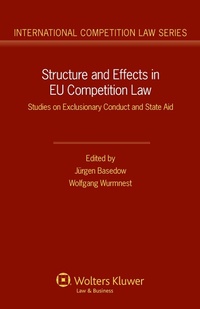
Structure and Effects in EU Competition Law
Studies on Exclusionary Conduct and State Aid
Published on 24. March 2011
366 pages
978-90-411-7199-3 (ISBN)
Description

During the last decade the European Commission has progressively adopted what is called a 'more economic' approach towards competition policy. This approach, which draws on US antitrust policy, puts greater emphasis on possible welfare effects of business practices and is less concerned with competitive market structures. Under this school of thought, concentration cannot be said to impede effective competition to the extent that efficiency gains outweigh market distortions.
In order to stimulate the debate on this basic reorientation, in January 2009 the Max Planck Institute for Comparative and International Private Law in Hamburg convened economists, legal scholars, and practitioners for an exchange of views on these 'new' methodological foundations of EU competition policy and competition law. Two especially controversial elements were chosen for in-depth discussion: the prohibition of abuses of dominant positions and the review of State aid. This book reproduces fourteen papers from this conference, representing the considered views of prominent European lawyers, economists, academics, policymakers, and enforcement officials in the competition field on matters such as:
- - the objectives of EU competition law;
- - the current enforcement guidelines of the European Commission regarding Article 102 TFEU;
- - measuring market power;
- - abusive low pricing strategies;
- - the economics of competition law enforcement;
- - recent developments in EU State aid law;
- - economic justifications for State aid.
A critical assessment of the European Commission's State aid action plan by the German Monopolies Commission is appended in English.
Applying law and economics theory to competition law, this book shows that the 'more economic' approach is exerting a considerable impact on various sectors of competition law. The authors clearly demonstrate the progress that can be made when lawyers and economists take notice of and respect the characteristics of each other's discipline. Moreover, the authors show how new insights of economic theory may be integrated into the relevant legal analysis. The book will therefore be appreciated by academics, practitioners, and officials representing both fields.
In order to stimulate the debate on this basic reorientation, in January 2009 the Max Planck Institute for Comparative and International Private Law in Hamburg convened economists, legal scholars, and practitioners for an exchange of views on these 'new' methodological foundations of EU competition policy and competition law. Two especially controversial elements were chosen for in-depth discussion: the prohibition of abuses of dominant positions and the review of State aid. This book reproduces fourteen papers from this conference, representing the considered views of prominent European lawyers, economists, academics, policymakers, and enforcement officials in the competition field on matters such as:
- - the objectives of EU competition law;
- - the current enforcement guidelines of the European Commission regarding Article 102 TFEU;
- - measuring market power;
- - abusive low pricing strategies;
- - the economics of competition law enforcement;
- - recent developments in EU State aid law;
- - economic justifications for State aid.
A critical assessment of the European Commission's State aid action plan by the German Monopolies Commission is appended in English.
Applying law and economics theory to competition law, this book shows that the 'more economic' approach is exerting a considerable impact on various sectors of competition law. The authors clearly demonstrate the progress that can be made when lawyers and economists take notice of and respect the characteristics of each other's discipline. Moreover, the authors show how new insights of economic theory may be integrated into the relevant legal analysis. The book will therefore be appreciated by academics, practitioners, and officials representing both fields.
More details
Other editions
Additional editions
Jurgen Basedow | Wolfgang Wurmnest
Structure and Effects in EU Competition Law
Studies on Exclusionary Conduct and State Aid
Book
03/2011
1st Edition
Kluwer Law International
€218.38
Shipment within 10-20 days
Content
- Cover
- Half Title Page
- Editorial Board
- Title Page
- Copyright Page
- PREFACE
- SUMMARY OF CONTENTS
- TABLE OF CONTENTS
- CONTRIBUTORS
- PART I: THE MORE ECONOMIC APPROACH IN EU COMPETITION LAW
- INTRODUCTION
- I. Four stages of competition law development
- II. The more economic approach
- III. Programme and issues of the symposium
- IV. Interdisciplinary research in economics and law
- THE MORE ECONOMIC APPROACH PARADIGM - AN EFFECTS-BASED APPROACH TO EU COMPETITION POLICY
- I. Introduction
- II. The progressive adoption of an effects-based approach to EU competition law
- A. Reform of vertical restraints policy
- B. Guidelines on the application of Article 81(3) EC/101(3) TFEU
- C. The new merger control regime
- D. Turning towards an effects-based approach in abuse control
- 1. What is the Enforcement Communication about?
- 2. What is the focus of the Enforcement Communication?
- III. The effects-based approach
- IV. Effects-based approach vs. protecting competition
- V. What next?
- PROTECTION OF COMPETITION v. MAXIMIZING (CONSUMER) WELFARE
- I. Legislative objectives
- II. Assessment of the 'more economic approach'
- III. Conclusion
- IV. Prospects
- THE EUROPEAN COMMISSION'S PRIORITIES FOR ENFORCEMENT OF ARTICLE 102 TFEU
- I. Introduction
- II. Market power and dominance
- III. Anti-competitive foreclosure
- IV. Specific forms of abuses
- A. Exclusive dealing
- B. Rebates having similar effects as exclusive dealing
- C. Tying and bundling
- D. Predation
- E. Refusal to deal
- DISCUSSION
- PART II: STUDIES ON ARTICLE 102 TFEU
- THE DOMINANCE THRESHOLD IN ARTICLE 102 TFEU
- I. Introduction
- II. Thresholds
- A. What kind of threshold for abuse of dominance cases?
- B. Threshold-scepticism
- C. The Commission's approach
- III. Dominance
- A. The power to exclude versus the power to exploit
- B. A shift in policy
- C. Implications for the measurement of dominance and for enforcement
- 1. For the measurement of dominance
- 2. For enforcement
- IV. Conclusions
- THE DOMINANCE THRESHOLD: A COMMENT
- I. Introduction
- II. Economics as the route-map
- III. The scalier between economics and law: policy discretion
- IV. Legal 'regulating screws': standard of proof and the role of legal institutions
- V. Conclusion
- DISCUSSION
- PREDATORY PRICING: FROM PRICE/COST-COMPARISONS TO POST-CHICAGO THINKING
- I. Introduction
- II. Brief outline of the case law on predatory pricing
- A. The AKZO-rules
- 1. Basic concept
- 2. Refinements
- a) Adjustments of the price/cost-comparisons
- b) Proving predatory intent
- B. Above-cost predation
- C. Recoupment
- 1. Basic economic concept
- 2. US antitrust law
- a) Background of the debate
- b) Stringent liability standards to avoid false positives
- c) Recoupment as a tool for cutting back the powers of the jury
- 3. European Competition law
- a) Tetra Pak II: rejection of the recoupment requirement
- b) France Télécom: recoupment as one factor to show predatory intent
- III. The Enforcement Communication
- A. Sacrifice
- B. Anti-competitive foreclosure
- 1. Price/cost-considerations and recoupment of losses
- a) General principle
- b) No strict recoupment test
- 2. Market structure and context
- a) Structural factors
- b) Strategic considerations
- C. Objective justifications
- IV. Assessment
- A. Sacrifice
- 1. Establishing AAC as a baseline-test for sacrificed profits
- 2. Sacrifice and above-cost predation
- B. Anti-competitive foreclosure
- 1. Market structure and strategic theory
- 2. The as efficient competitor test
- 3. Recoupment
- C. Pricing below AAC is not always anti-competitive
- V. Conclusion
- PREDATORY PRICING: A COMMENT
- I. Introduction
- II. Providing guidance on Article 102 TFEU enforcement: a challenging task
- III. General standards for exclusionary conduct
- IV. The central role of time
- V. Cost tests as 'screening devices'
- VI. Predation
- VII. Squeeze and refusal to deal
- VIII. Rebates
- IX. Bundling
- X. Conclusion
- DISCUSSION
- PART III: STUDIES ON STATE AID
- EUROPEAN STATE AID CONTROL - THE STATE AID ACTION PLAN
- I. Introduction
- II. State aid control as an integral part of competition policy
- A. Legal foundations of State aid control
- B. Economic foundations of State aid control
- C. Previous practice
- III. The SAAP
- A. Objectives of the SAAP
- 1. More effective procedures, better enforcement, higher predictability and enhanced transparency
- 2. Shared responsibility between European Commission and Member States
- 3. A refined economic approach
- 4. Form-based vs. effects-based approach
- B. The balancing test
- 1. Positive effects of State aid (stages 1 and 2 of the test)
- 2. Adverse effects of State aid and balancing (stage 3 of the test)
- 3. The relevant welfare standard
- IV. Conceptual problems of the refined economic approach
- A. Financing of State aid
- B. Second-best problems
- V. The implementation of the SAAP - some examples
- A. The de minimis Regulation
- B. The GBER
- C. The CFRDI
- VI. Conclusion
- THE GENERAL BLOCK EXEMPTION FOR STATE AID
- I. Introduction
- II. The State Aid Action Plan
- III. The General Block Exemption Regulation
- A. Introduction
- B. Chapter I: Common provisions
- C. Chapter II: Specific provisions for the different categories of aid
- D. Chapter III: Transitional provisions
- IV. Comment
- DISCUSSION
- PART IV: ROUND TABLE ON STATE AID
- THE NEED FOR A MORE ECONOMIC APPROACH
- I. Introduction
- II. The notion of State aid
- A. Case review by the Court and proof that there is an advantage - the necessity for a more economic approach at the level of the notion of State aid
- B. A more economic reflection on the application of the criterion 'State resources'
- C. A stricter and more economic approach to the criteria of 'distortion of competition' and 'trade between Member States'?
- III. Exceptions from the prohibition of State aids
- IV. Outlook
- SOME REMARKS FROM A JUDICIAL POINT OF VIEW
- I. Introduction
- II. GC's scope of control
- A. General remarks
- B. Scope of judicial control in State aid matters
- 1. Variations according to the specific legal basis applied
- 2. Examples from recent case law
- III. Possible future consequences of the 'new approach' for the judicial practice
- TOWARDS A MORE ECONOMIC CONTROL OF STATE AID IN EUROPE
- I. Introduction
- II. SAAP and the 'aid balancing test'
- III. The R&D&I Framework 2006
- IV. The refined economic approach in regional aid
- V. The General Block Exemption Regulation
- VI. SAAP and the balancing test under Article 106(2) TFEU
- VII. Outlook from a practitioner's perspective
- VIII. Conclusion
- EU STATE AID POLICY, ECONOMIC APPROACH, BAILOUTS, AND MERGER POLICY: TWO COMMENTS
- I. Introduction
- II. What do we want EU State aid policy do for us?
- III. State aid, bailout problem, and merger policy
- ANNEX: MONOPOLKOMMISSION: The "More Economic Approach" in European State Aid Control
- INDEX
- Back Cover
