

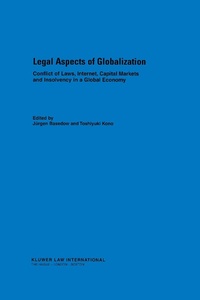
Legal Aspects of Globalisation
Conflicts of Law, Internet, Capital Markets and Insolvensy in a Global Economy
Published on 1. January 2000
246 pages
978-90-411-7974-6 (ISBN)
Description

The phenomenon of increased interconnectedness of the world's societies, generally referred to as `globalisation', is not only changing our everyday life, it also influences the legal framework we are living in. The challenges brought about by this process are especially great in fields of law which are by their very nature international such as Private International Law, the Law of Capital Markets, International Insolvency Law or the Law of the Internet.
Can, for example, established conflict-of-law rules survive in a globalised world? What options exist for regulating capital markets in the era of globalisation? Are national laws on international insolvencies prepared for the increasing number of cross-border insolvency proceedings or does the UNCITRAL Model Law on Cross-Border Insolvency show the way? How can national or international legislators react to the new forms of torts and copyright infringements via the World Wide Web?
These are some of the questions which eminent scholars from Japan and Germany try to answer in this volume. All essays are based on contributions to a symposium which took place in Fukuoka, Japan, on 28-29 March, 1999.
Can, for example, established conflict-of-law rules survive in a globalised world? What options exist for regulating capital markets in the era of globalisation? Are national laws on international insolvencies prepared for the increasing number of cross-border insolvency proceedings or does the UNCITRAL Model Law on Cross-Border Insolvency show the way? How can national or international legislators react to the new forms of torts and copyright infringements via the World Wide Web?
These are some of the questions which eminent scholars from Japan and Germany try to answer in this volume. All essays are based on contributions to a symposium which took place in Fukuoka, Japan, on 28-29 March, 1999.
More details
Other editions
Additional editions
Jurgen Basedow
Legal Aspects of Globalisation:Conflicts of Laws, Internet, Capital Markets and Insolvency in a Global Economy
Conflicts of Law, Internet, Capital Markets and Insolvensy in a Global Economy
Book
01/2000
1st Edition
Kluwer Law International
€65.27
Shipment within 10-20 days
Content
- Cover
- Half Title Page
- Title Page
- Copyright Page
- PREFACE
- Table of Contents
- CONTRIBUTORS
- ABBREVIATIONS
- THE EFFECTS OF GLOBALIZATION ON PRIVATE INTERNATIONAL LAW
- A. Introduction
- B. Globalization: Concept and Origins
- C. The Impact on Governance
- D. Consequences for Private International Law in General
- I. New Problems
- II. Uniform Law and Principles
- III. Party Autonomy and lex fori
- E. Consequences for Specific Areas of Private International Law
- I. Personal Status and the Nationality Principle
- II. Economic Regulation
- Part 1: The Internet, Private Law and International Private Law
- ELECTRONIC MONEY AND INFORMATION SOCIETY
- A. Introduction
- B. The Position of Payment Instruments and Electronic Money
- C. Internet Finance
- D. Borderless Enterprise
- E. Capital or Information?
- F. The Conflict of Development of Information Communication Technology and Law
- PRIVATE LAW IN THE ERA OF INTERNET
- A. Introduction
- B. Impacts of Internet on States, Communities and People
- C. Optimism of Revolutionists and Optimism of Conservatives
- D. How to Cope with the Problems
- E. Conclusion
- ELECTRONIC COMMERCE AND LAW SOME FRAGMENTARY THOUGHTS ON THE FUTURE OF INTERNET REGULATION FROM A GERMAN PERSPECTIVE
- A. Introduction
- B. Dematerialization, Deterritorialization and Detemporalization of Law
- C. Self-Regulation instead of State Regulation
- D. Data Protection and Depersonalization
- E. Technology instead of Law
- F. Electronic Commerce and the Problem of Trust
- G. Summary
- LAW APPLICABLE TO TORTS AND COPYRIGHT INFRINGEMENT THROUGH THE INTERNET
- A. Introduction
- B. Torts through the Internet
- C. Copyright Infringement through the Internet
- D. Conclusion
- Part 2: The Law and International Finance
- GLOBALIZATION OF CAPITAL MARKETS: A PERSPECTIVE FROM JAPAN
- A. Introduction
- B. Overview of Japan's Big Bang Program
- C. Impact on the Legal System in Japan
- D. Conclusion: Where Will the Japanese System Go?
- GLOBALIZING CAPITAL MARKETS AND POSSIBLE REGULATORY RESPONSES
- A. Globalization of Capital Markets in Perspective
- B. Regulatory Challenge
- C. Non-cooperative Strategies
- D. Partly Cooperative Strategies
- E. Truly Cooperative Strategies
- F. Conclusion
- References
- GLOBALIZATION OF FINANCE: HOW TO DEAL WITH MANDATORY RULES
- A. Introduction
- B. The Forum's Mandatory Rules
- C. The Applicable Law And Mandatory Rules
- D. Conclusion
- Part 3: International Insolvency and International Private Law
- UNCITRAL MODEL LAW AND THE COMPREHENSIVE REFORM OF JAPANESE INSOLVENCY LAWS
- A. Introduction
- B. UNCITRAL Model Law on Cross-Border Insolvency
- C. Comprehensive Reform of Japanese Insolvency Laws and International Insolvency Issues
- D. Conclusion
- E. Appendix A: Current Japanese insolvency proceedings (see Table 1 through 4 for overview)
- F. Appendix B: Excerpt from 'The First Questionnaire' (translated by Junichi Matsushita)
- INTERNATIONAL BANKRUPTCY FROM THE VIEWPOINT OF PRIVATE INTERNATIONAL LAW AND INTERNATIONAL CIVIL PROCEDURE
- A. Introduction
- B. Japanese Studies of 'International Bankruptcy Law'
- C. International Bankruptcy from the Viewpoint of Private International Law and International Civil Procedure
- D. Conclusion
- GERMAN INTERNATIONAL INSOLVENCY LAW UNDER THE NEW INSOLVENCY CODE: CONTINUITY AND EVOLUTION
- A. Introduction
- B. Tendencies of International Insolvency Law
- C. Basic Lines of German International Insolvency Law under the Insolvency Code
- D. Domestic Insolvency Proceedings with an International Element
- E. Recognition of Foreign Insolvency Proceedings
- F. Coordination of Parallel Insolvency Proceedings
- G. Resume
- CHOICE OF LAW IN INTERNATIONAL INSOLVENCIES-A PROPOSAL FOR REFORM
- A. Introduction
- B. Status Quo
- C. Analytical Framework
- D. Conclusions
- THE RECOGNITION OF FOREIGN INSOLVENCY PROCEEDINGS AND PRIVATE INTERNATIONAL LAW
- A. Introduction
- B. International Private Law in the Context of Insolvency in Japan
- C. The Effects Regulated under the Model Law and the Law of the Country of the Court Applied to
- D. Other Effects and Applicable Laws:
- E. Conclusion
- F. Appendix: UNCITRAL Model Law on Cross-Border Insolvency
- INDEX
- Back Cover
