

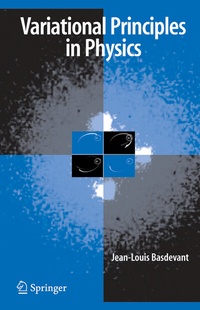
Variational Principles in Physics
Description

Optimization under constraints is an essential part of everyday life. Indeed, we routinely solve problems by striking a balance between contradictory interests, individual desires and material contingencies. This notion of equilibrium was dear to thinkers of the enlightenment, as illustrated by Montesquieu's famous formulation: "In all magistracies, the greatness of the power must be compensated by the brevity of the duration."
Astonishingly, natural laws are guided by a similar principle. Variational principles have proven to be surprisingly fertile. For example, Fermat used variational methods to demonstrate that light follows the fastest route from one point to another, an idea which came to be known as Fermat's principle, a cornerstone of geometrical optics. Variational Principles in Physics explains variational principles and charts their use throughout modern physics. The heart of the book is devoted to the analytical mechanics of Lagrange and Hamilton, the basic tools of any physicist. Prof. Basdevant also offers simple but rich first impressions of Einstein's General Relativity, Feynman's Quantum Mechanics, and more revealing and amazing interconnections between various fields of physics.
Reviews / Votes
From the reviews:
"This book is based on a course given by Professor Basdevant at the Ecole Polytechnique, near Paris. . it would be an excellent basis for a course, provided one has the right collection of undergraduates. The book could also be used at a more advanced level in many ways . . For anyone with radical tendencies in this direction, Basdevant's book will provide an elegant launching point." (L. S. Schulman, SIAM Review, Vol. 49 (4), 2007)
"It invites the reader onto the vessel 'variational principles' to embark on a journey through a variety of different areas and regions of physics. . In general . independent of individual preferences, Basdevant's book provides a well-balanced overview of various old and new areas of theoretical physics based on an approach by variational principles. Not only will students profit from this book, but also more advanced readers might get captivated by it." (H. Hogreve, Mathematical Reviews, Issue 2009 f)
More details
Other editions
Additional editions
Person
A graduate of the Ecole Normale Superieure, Jean-Louis Basdevant is Professor and Chair of the Department of Physics at the Ecole Polytechnique, and Director of Research for the CNRS. Specializing in the theoretical physics of elementary particles, quantum field theory and astrophysics, Prof. Basdevant works in the Leprince-Ringuet Laboratory at the Ecole Polytechnique.
