

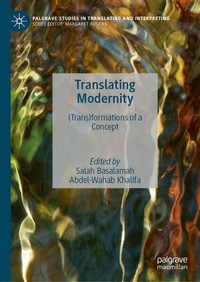
Translating Modernity
Description

This edited book examines three main understandings of the concept of modernity in relation to translation: "modernity as translation" (transformational process where modernity itself is conceptualized through translation), "translation of modernity" (object of transformation; that is, modernity as the object being translated across different contexts), and "modernity in translation" (contrastive modernities existing within ongoing translation processes). With these three axes of reflection in mind, the authors address two main sets of questions regarding modernity.
On one hand, despite the advent of post-modernity, they ask why modernity is still such a prolific concept epitomizing novelty and originality? Why is modernity so attractive in postcolonial and non-western locales, considered synonymous with progress, knowledge advancement and wealth? What are the modern concepts and ideas that have travelled and were exported from the west to different parts of the world and vice versa?
On the other hand, they ask in what capacity is translation an effective concept to represent and problematize the notion of modernity? How does the concept of translation encompass the course of a moving and widely diffused idea such as modernity? What may be the effects of the application of an analytical prism such as translation upon modernity throughout the world and throughout modern history?
This book is primarily focused on translation studies, but it also relates directly to disciplines including intellectual history, political and social philosophy, religious studies, (inter)cultural studies, postcolonial studies, literature, communication, and artificial intelligence, and it will also be of interest to readers in these fields.
More details
Other editions
Additional editions
Persons
Salah Basalamah is Professor at the School of Translation and Interpretation, University of Ottawa, Canada. His fields of research include the Philosophy of Translation, Translation Rights, Social and Political Philosophy, Postcolonial, Cultural and Religious Studies, as well as western Islam and Muslims.
Abdel-Wahab Khalifa is a Senior Lecturer (Associate Professor) in Translation and Interpreting at Queen's University Belfast, UK. His research interests span the intersection of translation studies with history, Arabic literature, soft power, the publishing and creative industries, and the sociology of culture. He also serves on the editorial boards of The Translator and Encounters in Translation .
Content
There's No Such Thing as Modernity? Introducing Modernity in Translation Studies - Salah Basalamah and Abdel-Wahab Khalifa.- Part I - Modernity as Translation.- 1. "The Missing Hyphens Between the Two Worlds". Rethinking the Relationship of Modernity and Translation - Rainer Guldin.- 2. Translation as Metonymic Cultural Transmission: The Case of the Istanbul Archaeology Museums - Luc Van Doorslaer and Irmak Mertens.- 3. Steiner's Metaphorical History of the West: The Hermeneutic Motion of Translation as Historical Allegory - Douglas Robinson.- Part II - Translation of Modernity.- 4. Embracing the Tradosphere: A Translational Epistemology for Liberation - Alexandre Dubé-Belzile.- 5. Modernity and Islam: Overview of the Place of Reason in Contemporary Islamic Reformist Thought - Gaafar Sadek.- 6. Translating Modernity into an Arab/Muslim Paradigm for an Ethics of Liberation - Salah Basalamah.- Part III - Modernity in Translation.- 7. Scholarly Publishing as an Example of Modernity in Translation - Lynne Bowker.- 8. Anglocentrism, Profit, and Digital Colonialism: Online Contexts and (non-)translation - Renée Desjardins.- Afterword: Translating Modernity - Piotr Blumczynski.
