

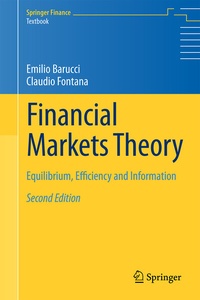
Financial Markets Theory
Equilibrium, Efficiency and Information
2nd Edition
Published on 8. June 2017
XV, 836 pages
978-1-4471-7322-9 (ISBN)
Description

This work, now in a thoroughly revised second edition, presents the economic foundations of financial markets theory from a mathematically rigorous standpoint and offers a self-contained critical discussion based on empirical results. It is the only textbook on the subject to include more than two hundred exercises, with detailed solutions to selected exercises.
Financial Markets Theory covers classical asset pricing theory in great detail, including utility theory, equilibrium theory, portfolio selection, mean-variance portfolio theory, CAPM, CCAPM, APT, and the Modigliani-Miller theorem. Starting from an analysis of the empirical evidence on the theory, the authors provide a discussion of the relevant literature, pointing out the main advances in classical asset pricing theory and the new approaches designed to address asset pricing puzzles and open problems (e.g., behavioral finance). Later chapters in the book contain more advanced material, including on the role of information in financial markets, non-classical preferences, noise traders and market microstructure.
This textbook is aimed at graduate students in mathematical finance and financial economics, but also serves as a useful reference for practitioners working in insurance, banking, investment funds and financial consultancy. Introducing necessary tools from microeconomic theory, this book is highly accessible and completely self-contained.
Advance praise for the second edition:
"Financial Markets Theory is comprehensive, rigorous, and yet highly accessible. With their second edition, Barucci and Fontana have set an even higher standard!" Darrell Duffie, Dean Witter Distinguished Professor of Finance, Graduate School of Business, Stanford University
"This comprehensive book is a great self-contained source for studying most major theoretical aspects of financial economics. What makes the book particularly useful is that it provides a lot of intuition, detailed discussions of empirical implications, a very thorough survey of the related literature, and many completely solved exercises. The second edition covers more ground and provides many more proofs, and it will be a handy addition to the library of every student or researcher in the field." Jaksa Cvitanic, Richard N. Merkin Professor of Mathematical Finance, Caltech
"The second edition of Financial Markets Theory by Barucci and Fontana is a superb achievement that knits together all aspects of modern finance theory, including financial markets microstructure, in a consistent and self-contained framework. Many exercises, together with their detailed solutions, make this book indispensable for serious students in finance." Michel Crouhy, Head of Research and Development, NATIXIS
Financial Markets Theory covers classical asset pricing theory in great detail, including utility theory, equilibrium theory, portfolio selection, mean-variance portfolio theory, CAPM, CCAPM, APT, and the Modigliani-Miller theorem. Starting from an analysis of the empirical evidence on the theory, the authors provide a discussion of the relevant literature, pointing out the main advances in classical asset pricing theory and the new approaches designed to address asset pricing puzzles and open problems (e.g., behavioral finance). Later chapters in the book contain more advanced material, including on the role of information in financial markets, non-classical preferences, noise traders and market microstructure.
This textbook is aimed at graduate students in mathematical finance and financial economics, but also serves as a useful reference for practitioners working in insurance, banking, investment funds and financial consultancy. Introducing necessary tools from microeconomic theory, this book is highly accessible and completely self-contained.
Advance praise for the second edition:
"Financial Markets Theory is comprehensive, rigorous, and yet highly accessible. With their second edition, Barucci and Fontana have set an even higher standard!" Darrell Duffie, Dean Witter Distinguished Professor of Finance, Graduate School of Business, Stanford University
"This comprehensive book is a great self-contained source for studying most major theoretical aspects of financial economics. What makes the book particularly useful is that it provides a lot of intuition, detailed discussions of empirical implications, a very thorough survey of the related literature, and many completely solved exercises. The second edition covers more ground and provides many more proofs, and it will be a handy addition to the library of every student or researcher in the field." Jaksa Cvitanic, Richard N. Merkin Professor of Mathematical Finance, Caltech
"The second edition of Financial Markets Theory by Barucci and Fontana is a superb achievement that knits together all aspects of modern finance theory, including financial markets microstructure, in a consistent and self-contained framework. Many exercises, together with their detailed solutions, make this book indispensable for serious students in finance." Michel Crouhy, Head of Research and Development, NATIXIS
Reviews / Votes
"The book concerns the most important and discussed issues of the modern financial markets theory. It provides a detailed and comprehensive review of theories, models, puzzles and open problems discussed in the literature concerning quantitative finance. . the book presents also a broad survey of empirical literature, including the most recent findings. The list of references contains more than one and half thousand positions." (Pawel Kliber, zbMATH 1390.91001, 2018)More details
Series
Edition
2nd ed. 2017
Language
English
Place of publication
London
United Kingdom
Publishing group
Springer London
Target group
Primary & secondary/elementary & high school
Product notice
Reflowable
Illustrations
XV, 836 p. 16 illus.
File size
10,83 MB
ISBN-13
978-1-4471-7322-9 (9781447173229)
DOI
10.1007/978-1-4471-7322-9
Schweitzer Classification
Other editions
Additional editions
Book
06/2017
2nd Edition
Springer
€128.39
Shipment within 15-20 days
Persons
Emilio Barucci is full professor of financial mathematics at the Politecnico di Milano, Italy. He holds a Laurea degree from the University of Florence, Italy. His research interests include financial markets, portfolio optimization, and banking. He has extensive experience in working as an independent director in the financial sector.
Claudio Fontana is assistant professor at Paris Diderot University (Paris VII), France. He holds a Master of Advanced Studies in Finance from the ETH Zurich and the University of Zurich, Switzerland, and a PhD in Mathematical Sciences from the University of Padua, Italy. His research focuses on mathematical finance as well as the applications of stochastic processes.
Claudio Fontana is assistant professor at Paris Diderot University (Paris VII), France. He holds a Master of Advanced Studies in Finance from the ETH Zurich and the University of Zurich, Switzerland, and a PhD in Mathematical Sciences from the University of Padua, Italy. His research focuses on mathematical finance as well as the applications of stochastic processes.
Content
Prerequisites.- Choices under Risk.- Portfolio, Insurance and Saving Decisions.- General Equilibrium Theory and No-arbitrage.- Factor Asset Pricing Models: CAPM and APT.- Multi-period Models: Portfolio Choice, Equilibrium and No-arbitrage.- Multi-period Models: Empirical Tests.- Information and Financial Markets.- Uncertainty, Rationality and Heterogeneity.- Financial Markets Microstructure.- Solutions of Selected Exercises.
