

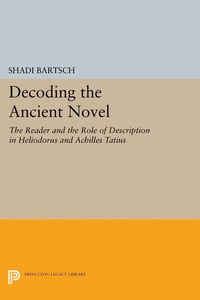
Decoding the Ancient Novel
The Reader and the Role of Description in Heliodorus and Achilles Tatius
1st Edition
Published on 14. July 2014
212 pages
978-1-4008-6048-7 (ISBN)
Description

Using a reader-oriented approach, Shadi Bartsch reconsiders the role of detailed descriptive accounts in the ancient Greek novels of Heliodorus and Achilles Tatius and in so doing offers a new view of the genre itself. Bartsch demonstrates that these passages, often misunderstood as mere ornamental devices, form in fact an integral part of the narrative proper, working to activate the audience's awareness of the play of meaning in the story. As the crucial elements in the evolution of a relationship in which the author arouses and then undermines the expectations of his readership, these passages provide the key to a better understanding and interpretation of these two most sophisticated of the ancient Greek romances.
In many works of the Second Sophistic, descriptions of visual conveyors of meaning--artworks and dreams--signaled the presence of a deeper meaning. This meaning was revealed in the texts themselves through an interpretation furnished by the author. The two novels at hand, however, manipulate this convention of hermeneutic description by playing upon their readers' expectations and luring them into the trap of incorrect exegesis. Employed for different ends in the context of each work, this process has similar implications in both for the relationship between reader and author as it arises out of the former's involvement with the text.
Originally published in 1989.
The Princeton Legacy Library uses the latest print-on-demand technology to again make available previously out-of-print books from the distinguished backlist of Princeton University Press. These editions preserve the original texts of these important books while presenting them in durable paperback and hardcover editions. The goal of the Princeton Legacy Library is to vastly increase access to the rich scholarly heritage found in the thousands of books published by Princeton University Press since its founding in 1905.
In many works of the Second Sophistic, descriptions of visual conveyors of meaning--artworks and dreams--signaled the presence of a deeper meaning. This meaning was revealed in the texts themselves through an interpretation furnished by the author. The two novels at hand, however, manipulate this convention of hermeneutic description by playing upon their readers' expectations and luring them into the trap of incorrect exegesis. Employed for different ends in the context of each work, this process has similar implications in both for the relationship between reader and author as it arises out of the former's involvement with the text.
Originally published in 1989.
The Princeton Legacy Library uses the latest print-on-demand technology to again make available previously out-of-print books from the distinguished backlist of Princeton University Press. These editions preserve the original texts of these important books while presenting them in durable paperback and hardcover editions. The goal of the Princeton Legacy Library is to vastly increase access to the rich scholarly heritage found in the thousands of books published by Princeton University Press since its founding in 1905.
More details
Other editions
Additional editions
Shadi Bartsch
Decoding the Ancient Novel
The Reader and the Role of Description in Heliodorus and Achilles Tatius
Book
04/2016
Princeton University Press
€70.70
Article not available at the moment
Shadi Bartsch
Decoding the Ancient Novel
The Reader and the Role of Description in Heliodorus and Achilles Tatius
Book
07/2014
Princeton University Press
€30.80
Shipment within 10-20 days

Shadi Bartsch
Decoding the Ancient Novel
The Reader and the Role of Description in Heliodorus and Achilles Tatius
Book
10/1989
Princeton University Press
€43.33
Article exhausted; check different version
Person
Shadi Bartsch
Content
FrontMatter, pg. i
Contents, pg. vii
Preface, pg. ix
ONE. Description and Interpretation in the Second Sophistic, pg. 3
TWO. Pictorial Description: Clues, Conventions, Girls, and Gardens, pg. 40
THREE. Dreams, Oracles, and Oracular Dreams: Misinterpretation and Motivation, pg. 80
FOUR. Descriptions of Spectacles: The Reader as Audience, the Author as Playwright, pg. 109
FIVE. The Other Descriptions: Relation to Narrative and Reader, pg. 144
SIX. The Role of Description, pg. 171
APPENDIX. Summaries of Leucippe and Clitophon and the Aethiopica, pg. 179
Bibliography, pg. 185
Index Locorum, pg. 191
General Index, pg. 196
Contents, pg. vii
Preface, pg. ix
ONE. Description and Interpretation in the Second Sophistic, pg. 3
TWO. Pictorial Description: Clues, Conventions, Girls, and Gardens, pg. 40
THREE. Dreams, Oracles, and Oracular Dreams: Misinterpretation and Motivation, pg. 80
FOUR. Descriptions of Spectacles: The Reader as Audience, the Author as Playwright, pg. 109
FIVE. The Other Descriptions: Relation to Narrative and Reader, pg. 144
SIX. The Role of Description, pg. 171
APPENDIX. Summaries of Leucippe and Clitophon and the Aethiopica, pg. 179
Bibliography, pg. 185
Index Locorum, pg. 191
General Index, pg. 196
