

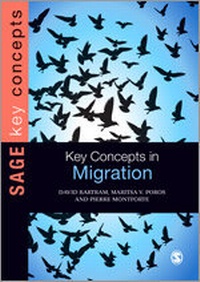
Key Concepts in Migration
1st Edition
Published on 14. April 2014
184 pages
978-1-4739-0546-7 (ISBN)
Description

"Demonstrates that the study of international migration has really come of age. From acculturation to undocumented immigration, the authors consider more than three dozen concepts at the heart of migration studies. Clearly written in a highly readable style, the book is a valuable resource for students and scholars alike."
- Nancy Foner, City University of New York
"This very useful and authoritative compendium explicates thirty-eight concepts central to analysis of international migration. It is accessible to undergraduate students and even can enrich graduate courses. It nicely complements books like The Age of Migration or Exceptional People. Concision is a virtue!"
- Mark J. Miller, University of Delaware
This book provides lucid and intuitive explanations of the most important migration concepts as used in classrooms, among policymakers, and in popular and academic discourse. Arguing that there is a clear need for a better public understanding of migration, it sets out to clarify the field by exploring relevant concepts in a direct and engaging way. Each concept:
Includes an easy to understand definition
Provides real-world examples
Gives suggestions for further reading
Is carefully cross-referenced to other related concepts
It is an ideal resource for undergraduate and post-graduate students studying migration in sociology, politics, development and throughout the social sciences, as well as scholars in the field and practitioners in governmental and non-governmental organizations.
- Nancy Foner, City University of New York
"This very useful and authoritative compendium explicates thirty-eight concepts central to analysis of international migration. It is accessible to undergraduate students and even can enrich graduate courses. It nicely complements books like The Age of Migration or Exceptional People. Concision is a virtue!"
- Mark J. Miller, University of Delaware
This book provides lucid and intuitive explanations of the most important migration concepts as used in classrooms, among policymakers, and in popular and academic discourse. Arguing that there is a clear need for a better public understanding of migration, it sets out to clarify the field by exploring relevant concepts in a direct and engaging way. Each concept:
Includes an easy to understand definition
Provides real-world examples
Gives suggestions for further reading
Is carefully cross-referenced to other related concepts
It is an ideal resource for undergraduate and post-graduate students studying migration in sociology, politics, development and throughout the social sciences, as well as scholars in the field and practitioners in governmental and non-governmental organizations.
Reviews / Votes
This migration compendium of key terms and concepts offers students a wonderfully accessible and authoritative resource. It will both satisfy their need for a ready-reference volume and stimulate their curiosity to read more and dig deeper. -- Russell King Key Concepts in Migration demonstrates that the study of international migration has really come of age. From acculturation to undocumented immigration, the authors consider more than three dozen concepts at the heart of migration studies. Clearly written in a highly readable style, the book is a valuable resource for students and scholars alike. -- Nancy Foner This very useful and authoritative compendium explicates thirty-eight concepts central to analysis of international migration. It is accessible to undergraduate students and even can enrich graduate courses. It nicely complements books like The Age of Migration or Exceptional People. Concision is a virtue! -- Mark J. Miller An essential introduction to 'Migration' that is international in scope and rigorous in its attention to the scholars, nuances and debates in the field. -- Maggie O'Neill It is impressive how the authors can bring out the most central scholarly debates on, for instance, a concept of 'ethnicity' in just a few pages. It draws on most of the revenant scholars within the field... This is a very good and useful tool. The sections are furthermore ended with a number of suggestions for further key readings that overall include much of the relevant literature. . -- Martin Bak Jorgensen, Aalborg UniversityAll prices
More details
Series
Edition
First Edition
Language
English
Place of publication
London
United Kingdom
Target group
College/higher education
ISBN-13
978-1-4739-0546-7 (9781473905467)
Copyright in bibliographic data and cover images is held by Nielsen Book Services Limited or by the publishers or by their respective licensors: all rights reserved.
Schweitzer Classification
Other editions
Additional editions
David Bartram | Maritsa Poros | Pierre Monforte
Key Concepts in Migration
Book
05/2014
1st Edition
SAGE Publications Ltd
€76.10
Shipment within 15-20 days
David Bartram | Maritsa Poros | Pierre Monforte
Key Concepts in Migration
Book
05/2014
1st Edition
SAGE Publications Ltd
€172.33
Shipment within 15-20 days
Persons
David's primary research focuses on international migration. His current work explores the relationship between immigration and happiness, investigating whether (as many would assume) migration to a wealthy country is advantageous to the immigrants themselves in the sense that it brings them greater happiness. Articles emerging from this research have been published in Migration Studies, Social Indicators Research, Journal of Happiness Studies, and International Studies Review, among others. He has done consulting work on this topic for the International Organization for Migration in Geneva. He has also held a grant from the Economic and Social Research Council to investigate the UK "citizenship process".
David is currently Senior Lecturer in Sociology at the University of Leicester. He gained a PhD from the University of Wisconsin-Madison and a BA from Kenyon College. He is also on the board of RC31, the International Sociological Association's section on the sociology of migration. Maritsa V. Poros is Associate Professor of Sociology at the City College of the City University of New York and appointed in Sociology at the Graduate Center of CUNY. She specializes in international migration. Her other research interests include social networks, inequalities, international development, race and ethnicity, feminism and urban studies. Her work has addressed the role of migrant networks in shaping labor market processes, the formation and influence of ethnic communities, migrant mobilization in southern Europe and forced migration studies. In 2011, Stanford University Press published her book, Modern Migrations: Gujarati Indian Networks in New York and London, which proposes a relational account of migration and migrant networks. Her book, with co-authors David Bartram and Pierre Monforte, Key Concepts in Migration was published by SAGE in 2014. Her work has been funded by the National Science Foundation and she has held previous posts in academia and government at the University of East London, the Illinois Institute of Technology and the U.S. Census Bureau. Pierre Monforte is Lecturer in Sociology at the University of Leicester. He received his PhD from the European University Institute in Florence (Italy) and was a post-doctoral fellow at the Universite de Montreal. His research explores the dynamics of protest for migrants' rights in France, Germany, Canada and the UK.
David is currently Senior Lecturer in Sociology at the University of Leicester. He gained a PhD from the University of Wisconsin-Madison and a BA from Kenyon College. He is also on the board of RC31, the International Sociological Association's section on the sociology of migration. Maritsa V. Poros is Associate Professor of Sociology at the City College of the City University of New York and appointed in Sociology at the Graduate Center of CUNY. She specializes in international migration. Her other research interests include social networks, inequalities, international development, race and ethnicity, feminism and urban studies. Her work has addressed the role of migrant networks in shaping labor market processes, the formation and influence of ethnic communities, migrant mobilization in southern Europe and forced migration studies. In 2011, Stanford University Press published her book, Modern Migrations: Gujarati Indian Networks in New York and London, which proposes a relational account of migration and migrant networks. Her book, with co-authors David Bartram and Pierre Monforte, Key Concepts in Migration was published by SAGE in 2014. Her work has been funded by the National Science Foundation and she has held previous posts in academia and government at the University of East London, the Illinois Institute of Technology and the U.S. Census Bureau. Pierre Monforte is Lecturer in Sociology at the University of Leicester. He received his PhD from the European University Institute in Florence (Italy) and was a post-doctoral fellow at the Universite de Montreal. His research explores the dynamics of protest for migrants' rights in France, Germany, Canada and the UK.
Content
Introduction
Migration
Acculturation
Alien/Foreigner
Assimilation
Borders
Brain Drain/Gain/Circulation
Chain Migration
Circular Migration
Citizenship
Cumulative Causation
Denizens
Deportation
Diaspora
Displacement and Internally Displaced Persons
Ethnic Enclaves and Ethnic Economies
Ethnicity and Ethnic Minorities
Family Migration and Reunification
Forced Migration
Gendered Migration
Guestworkers
Human Trafficking and Smuggling
Integration
Internal/Domestic Migration
Labour Migration
Migrant Networks
Migration Stocks and Flows
Multiculturalism
Refugees and Asylum Seekers
Regional Integration and Migration
Remittances
Restrictionism vs. Open Borders
Return Migration
Second Generation
Selectivity
Social Capital
Social Cohesion
Transnationalism
Undocumented (Illegal) Migration
Migration
Acculturation
Alien/Foreigner
Assimilation
Borders
Brain Drain/Gain/Circulation
Chain Migration
Circular Migration
Citizenship
Cumulative Causation
Denizens
Deportation
Diaspora
Displacement and Internally Displaced Persons
Ethnic Enclaves and Ethnic Economies
Ethnicity and Ethnic Minorities
Family Migration and Reunification
Forced Migration
Gendered Migration
Guestworkers
Human Trafficking and Smuggling
Integration
Internal/Domestic Migration
Labour Migration
Migrant Networks
Migration Stocks and Flows
Multiculturalism
Refugees and Asylum Seekers
Regional Integration and Migration
Remittances
Restrictionism vs. Open Borders
Return Migration
Second Generation
Selectivity
Social Capital
Social Cohesion
Transnationalism
Undocumented (Illegal) Migration
