

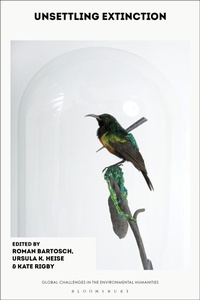
Unsettling Extinction
Published on 28. May 2026
288 pages
978-1-350-59849-2 (ISBN)
Description

Featuring contributions from key names in the field alongside some of the most exciting new voices, this collection presents cutting-edge work on species extinction from a wide variety of perspectives across the environmental humanities.
Biodiversity loss threatens to transform the ecological foundations of all biological life on the planet, yet solutions to this crisis are fiercely contested. This book addresses extinction - along with climate change, the most urgent environmental crisis of the twenty-first century - by exploring species decline and conservation with a particular emphasis on divergent cultural framings, temporal scales, and media.
Contributors explore what ethical guidelines underlie acceptable and unacceptable ways of interacting with plants and animals, what social, aesthetic, and affective perceptions and meanings are attributed to particular species, how human-nonhuman relations are construed as part of a particular social order and which species are considered worth conserving, and at what cost.
Drawing on the disciplines of anthropology, cultural geography, environmental history, philosophy, literary studies, media studies, and studies of religion, this book explores how the engagement with biodiversity loss challenges basic assumptions in these disciplines and opens up new avenues of thought and activism for shaping the multispecies communities of the future.
Biodiversity loss threatens to transform the ecological foundations of all biological life on the planet, yet solutions to this crisis are fiercely contested. This book addresses extinction - along with climate change, the most urgent environmental crisis of the twenty-first century - by exploring species decline and conservation with a particular emphasis on divergent cultural framings, temporal scales, and media.
Contributors explore what ethical guidelines underlie acceptable and unacceptable ways of interacting with plants and animals, what social, aesthetic, and affective perceptions and meanings are attributed to particular species, how human-nonhuman relations are construed as part of a particular social order and which species are considered worth conserving, and at what cost.
Drawing on the disciplines of anthropology, cultural geography, environmental history, philosophy, literary studies, media studies, and studies of religion, this book explores how the engagement with biodiversity loss challenges basic assumptions in these disciplines and opens up new avenues of thought and activism for shaping the multispecies communities of the future.
More details
Series
Language
English
Place of publication
London
United Kingdom
Publishing group
Bloomsbury Publishing PLC
Target group
College/higher education
Illustrations
11 bw illus
File size
2,64 MB
ISBN-13
978-1-350-59849-2 (9781350598492)
Copyright in bibliographic data and cover images is held by Nielsen Book Services Limited or by the publishers or by their respective licensors: all rights reserved.
Schweitzer Classification
Other editions
Additional editions
Roman Bartosch | Ursula K. Heise | Kate Rigby
Unsettling Extinction
Book
approx. 06/2026
Bloomsbury Academic
€31.50
Not yet published
Persons
Roman Bartosch is Full Professor of Teaching Anglophone Literatures and Cultures and Director of the Interdisciplinary Research Centre for Teaching in the Humanities at the University of Cologne, Germany.
Ursula K. Heise is Distinguished Professor in the Department of English and the Institute of the Environment and Sustainability at UCLA, USA.
Kate Rigby is Alexander von Humboldt Professor of Environmental Humanities and Director of the research hub for Multidisciplinary Environmental Studies in the Humanities at the University of Cologne, Germany.
Ursula K. Heise is Distinguished Professor in the Department of English and the Institute of the Environment and Sustainability at UCLA, USA.
Kate Rigby is Alexander von Humboldt Professor of Environmental Humanities and Director of the research hub for Multidisciplinary Environmental Studies in the Humanities at the University of Cologne, Germany.
Content
Introduction
Roman Bartosch (University of Cologne, Germany), Ursula Heise (UCLA, USA) Kate Rigby(University of Cologne, Germany)
Section 1: Unsettling Histories
1. Our Ancestors' Dystopia Now, Kyle Powys White(University of Michigan, USA)
2. Military Snails, Thom van Dooren (University of Sydney, Australia)
3. Extinction as Cultural Heritage, Dolly Jørgensen(University of Stavanger, Norway)
Section 2: Unsettling Narratives
4. Extinction and Experience in Digital Eco-Games, Roman Bartosch (University of Cologne, Germany) and Julia Hoydis (University of Graz, Austria)
5. Coextinction? The Southern Resident Killer Whales in Culture and Science, Greg Garrard(UBC Okanagan, Canada)
6. Will Revery Alone Do? A (Mono)cultural Narrative of Bee Decline, Eline Tabak (University of Oulu, Finland)
Section 3: Unsettling Boundaries
7. Speaking in Spores, Sicily Fiennes (University of Leeds, UK), Graham Huggan (University of Leeds, UK), Stefan Skrimshire (University of Leeds, UK), and Serena Turton-Hughes (University of Leeds, UK)
8. Multispecies Influenza, Natasha Fijn (The Australian National University, Australia)
9. Animal domestication, genealogies of exile, and the long Anthropocene, Linda Williams (Royal Melbourne Institute of Technology, Australia)
Section 4: Unsettling Ethics
10. 'Bees for Peace', Carrie Dohe (University of Cologne, Germany) and Kate Rigby (University of Cologne, Germany)
11. Detectives on an Alien Planet, Ursula Heise (UCLA, USA)
12. Should Humanity Live Forever? Human Extinction and Biodiacritics, Ted Toadvine (Pennsylvania State University, USA)
Afterword
Richard Kerridge(Bath Spa University, UK)
Roman Bartosch (University of Cologne, Germany), Ursula Heise (UCLA, USA) Kate Rigby(University of Cologne, Germany)
Section 1: Unsettling Histories
1. Our Ancestors' Dystopia Now, Kyle Powys White(University of Michigan, USA)
2. Military Snails, Thom van Dooren (University of Sydney, Australia)
3. Extinction as Cultural Heritage, Dolly Jørgensen(University of Stavanger, Norway)
Section 2: Unsettling Narratives
4. Extinction and Experience in Digital Eco-Games, Roman Bartosch (University of Cologne, Germany) and Julia Hoydis (University of Graz, Austria)
5. Coextinction? The Southern Resident Killer Whales in Culture and Science, Greg Garrard(UBC Okanagan, Canada)
6. Will Revery Alone Do? A (Mono)cultural Narrative of Bee Decline, Eline Tabak (University of Oulu, Finland)
Section 3: Unsettling Boundaries
7. Speaking in Spores, Sicily Fiennes (University of Leeds, UK), Graham Huggan (University of Leeds, UK), Stefan Skrimshire (University of Leeds, UK), and Serena Turton-Hughes (University of Leeds, UK)
8. Multispecies Influenza, Natasha Fijn (The Australian National University, Australia)
9. Animal domestication, genealogies of exile, and the long Anthropocene, Linda Williams (Royal Melbourne Institute of Technology, Australia)
Section 4: Unsettling Ethics
10. 'Bees for Peace', Carrie Dohe (University of Cologne, Germany) and Kate Rigby (University of Cologne, Germany)
11. Detectives on an Alien Planet, Ursula Heise (UCLA, USA)
12. Should Humanity Live Forever? Human Extinction and Biodiacritics, Ted Toadvine (Pennsylvania State University, USA)
Afterword
Richard Kerridge(Bath Spa University, UK)
