

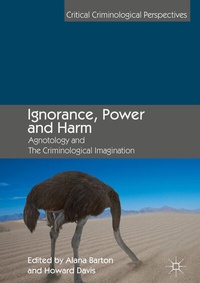
Ignorance, Power and Harm
Description

This book discusses the concept of 'agnosis' and its significance for criminology through a series of case studies, contributing to the expansion of the criminological imagination. Agnotology - the study of the cultural production of ignorance, has primarily been proposed as an analytical tool in the fields of science and medicine. However, this book argues that it has significant resonance for criminology and the social sciences given that ignorance is a crucial means through which public acceptance of serious and sometimes mass harms is achieved. The editors argue that this phenomenon requires a systematic inquiry into ignorance as an area of criminological study in its own right.
Through case studies on topics such as migrant detention, historical institutionalised child abuse, imprisonment, environmental harm and financial collapse, this book examines the construction of ignorance, and the power dynamics that facilitate and shape that construction in a range of different contexts. Furthermore, this book addresses the relationship between ignorance and the achievement of 'manufactured consent' to political and cultural hegemony, acquiescence in its harmful consequences and the deflection of responsibility for them.
More details
Other editions
Additional editions
Persons
Alana Barton is Reader in Criminology at Edge Hill University. She has previously worked at the University of Central Lancashire and Liverpool John Moores University. Alana is the author of Fragile Moralities and Dangerous Sexualities (Ashgate, 2005) and co-editor of Expanding the Criminological Imagination (Willan, 2007).
Howard Davis is Senior Lecturer in Criminology at Edge Hill University. He had a previous career as a social worker, working in the fields of child protection, trauma and bereavement. He has published in a range of journals including the British Journal of Social Work, Disasters, and the British Journal of Criminology.
Content
Chapter 1. Introduction; Alana Barton and Howard Davis.- Chapter 2. Agnotology and the Criminological Imagination; Alana Barton, Howard Davis and Holly White.- Chapter 3. Counterinsurgency, Empire and Ignorance; Mark McGovern.- Chapter 4. The Ideology and Mechanics of Ignorance: Child Abuse in Ireland, 1922-1973; Anthony Keating.- Chapter 5. Framing the Crisis: Private Capital to the Rescue; Steve Tombs.- Chapter 6. Managing Ignorance about Maori Imprisonment; Riki Mihaere and Elizabeth Stanley.- Chapter 7. Border (Mis)management, Ignorance and Denial; Victoria Canning.- Chapter 8. Climate Change Denial: 'Making Ignorance Great Again'; Reece Walters.- Chapter 9. Spectacular Law and Order: Photography, Social Harm and the Production of Ignorance; Alex Dymock.- Chapter 10. Penal Agnosis and Historical Denial: Problematising 'Common Sense' Understandings of Prison Officers and Violence in Prison; David Scott.
