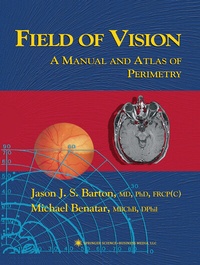
Field of Vision
Description

Reviews / Votes
From the reviews:
Field of Vision: A Manual and Atlas of Perimetry is written by Jason J.S. Barton, a neurologist/neuro-ophthalmologist and Michael Benatar, a clinical neurologist, in response to a correctly perceived need. The book begins with a chapter on the importance and principles of perimetry and the normal visual field. This is followed by chapters on the functional anatomy of the visual system and the techniques for performing perimetry in the office and at the bedside. The final two didactic chapters detail the use of the two most important instruments: the Goldmann perimeter and the Humphrey automated field analyzer. After the five didactic chapters, there is an impressive 120 case atlas complete with relevant histories, neuroimaging, and detailed explanations of the pathophysiology of the visual field disturbances. All of the major disorders that cause visual field disturbances are covered by this beautiful atlas. - Martin A. Samuels, MD
Neurologist-in-Chief, Brigham and Women's Hospital Boston, MA
"...a welcome addition to the basic texts for all those who practice clinical neurology, as well as those training in the area...I enjoyed reading it from beginning to end and will undoubtedly refer back to it in the future."-Martin A. Samuels, MD
Neurologist-in-Chief, Brigham and Women's Hospital Boston, MA
"This book is packed with high-resolution photographs and visual field charts. this book is appropriate for medical libraries and large academic libraries supporting programs on vision research." - E-STREAMS
"This is a comprehensive overview of the use of perimetric devices and bedside testing of visual fields. The authors focus only on the clinically relevant points, providing enough technical detail and anatomic knowledge for the physician to competently interpret visual field defects. To develop the clinician's skills in interpretation, the authors include an impressive atlas of 120 cases. The superb integration ofclinical and technical material will make this book a valuable teaching reference for all involved in the management of visual disorders." - J Neuro-Opthalmol
"Field of Vision: A Manual and Atlas of Perimetry is a welcome addition to the already vast array of neurology and opthalmology texts. Field of Vision fills a void in the visual field literature: a text and atlas that meld together to teach perimetry and functional visual anatomy effectively to the clinician. It is a text that will instruct students at all levels and enhance the clinical acumen of any practicing neurologist." -Neurology
"...an excellent addition to the world of visual field texts...should be obtained by every neurologic and ophthalmologic teaching library...highly recommended for any clinicianwho has an interest in the visual system and disorders." - Le Journal Des Sciences Neurologiques
"This textbook is one of the most interesting books in visual fields that I have yet come across. . In conclusion, I believe this is must buy text for neurologists as well as all ophthalmologists from the posterior segment ophthalmologist to the anterior segment ophthalmologist. It is also an excellent text for medical students and residents. . I therefore rate this as a must buy text and give it a four star rating. This text is a virtual gold mine for the visual field enthusiast." (Dinnis Denick, Annals of Ophthalmology, Vol. 37 (3), 2005)
More details
Other editions
Additional editions