


Educating Young Children with Autism Spectrum Disorders
A Guide for Teachers, Counselors, and Psychologists
1st Edition
Published on 7. January 2014
336 pages
978-1-62873-854-4 (ISBN)
Description

According to the CDC, one in fifty American children is diagnosed as having an autism spectrum disorder. This means more school-aged children are entering classrooms with ASDs and teachers are being called upon to help facilitate their learning. Educating Young Children with Autism Spectrum Disorders is aimed at providing strategies for teachers, school counselors, and psychologists to help address the needs of children on the spectrum, as well as their families. Erin E. Barton and Beth Harn draw on current research and practices to discuss the possible causes of autism and to help prepare educators not only for teaching children in the classroom but also for providing families with the tools necessary to continue the educational process at home. Included are topics such as:
Including forms, charts, and a range of classroom activities, this is the only resource you will need to gain the insight and tools for making a difference in the educational lives of young children with autism.
- Improving communication and socialization
- Developing instructive lessons
- Assessing students' progress
- Including families in educational goals
- Finding students' special interests and using those to help facilitate learning
- Managing challenging behavior
- And more
Including forms, charts, and a range of classroom activities, this is the only resource you will need to gain the insight and tools for making a difference in the educational lives of young children with autism.
More details
Other editions
Additional editions
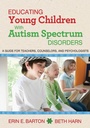
Erin E. Barton | Beth Harn
Educating Young Children with Autism Spectrum Disorders
A Guide for Teachers, Counselors, and Psychologists
Book
01/2014
Skyhorse Publishing
€16.50
Shipment within 3-4 weeks
Content
- Intro
- Title Page
- Copyright
- Contents
- Acknowledgments
- About the Authors
- 1. Classification of Autism in Young Children
- Erin E. Barton
- Diagnostic Classification
- Prevalence
- Etiology of Autism
- Conclusions and Future Directions
- 2. Early Detection and Medical Classification
- Erin E. Barton
- Introduction
- The Importance of Early Detection
- Selecting a Screening Measure
- Administering and Communicating Screening Results
- Diagnostic Procedures
- Diagnostic Tools
- Diagnosis Versus Eligibility
- Conclusions and Future Directions
- Learning Activities
- Resources
- 3. Educational Eligibility
- Erin E. Barton and Beth Harn
- Eligibility Versus Diagnosis
- Learning Activities
- 4. Writing Effective Educational Goals
- Dylan S. Carelli and Erin E. Barton
- Who Is on the Team?
- Writing Family-Guided Goals
- Focusing on Functional Skills
- Using Autism-Specific Curricula
- Addressing Academic Skills
- Future Directions
- Learning Activities
- Resources
- 5. Essential Components of Educational Programs
- Erin E. Barton
- Core Curricular Content
- Highly Structured Teaching Environments
- Predictability and Routines
- Commitment to Evidence-Based Practices
- Functional Approach to Problem Behaviors
- Transitions
- Family Involvement
- Mechanism for Ongoing Program Evaluation
- Future Directions
- Learning Activities
- Resources
- 6. Designing and Evaluating Instruction Based on Student Skills and Responses
- Beth Harn, Shanna Dee Davis, and Erin E. Barton
- Considerations in Assessment to Lead to Improved Outcomes
- Evaluating Progress and Response to Intervention
- Considerations in Intervention Modification
- Future Directions
- Learning Activities
- Resources
- 7. Evidence-Based Strategies for Teaching Children With Autism Spectrum Disorders: Skill Acquisition and Fluency
- Brian Reichow and Terrell Reichow
- Teaching New Skills and Behaviors
- Using Response Prompting Strategies to Teach New Skills and Behaviors
- Teaching Chained Behaviors
- Modifying Instructional Arrangements to Increase the Efficiency of Learning
- Future Directions
- Learning Activities
- Resources
- 8. Evidence-Based Strategies for Maintenance, Generalization, and Self-Management
- Sarah E. Pinkelman and Erin E. Barton
- Maintenance of New Skills
- Programming for Generalization
- Self-Management
- Future Directions
- Learning Activities
- Resources
- 9. Evidence-Based Practices for Communication Skill Acquisition
- Matt Tincani and Jessica Zawacki
- What Is Communication? Augmentative and Alternative Communication Programming
- Picture Exchange Communication System (PECS)
- Voice Output Communication Aides (VOCAs)
- Pivotal Response Treatment
- Functional Communication Training
- Comprehensive Treatment Models
- Future Directions
- Learning Activities
- Resources
- 10. Evidence-Based Practices for Social Skill Acquisition
- Summer Ferreri and Joshua Plavnick
- Peer-Mediated Instruction
- Social Skills Training
- Pivotal Response Treatment
- Future Directions
- Learning Activities
- Resources
- 11. Designing Instruction and Supports to Prevent and Decrease Problem Behavior
- Kathleen Strickland-Cohen and Beth Ham
- Positive Behavioral Interventions and Supports
- Functional Behavioral Assessment
- How Will We Change Behavior? Developing Behavior Support Plans
- Evaluation Plan
- Future Directions
- Learning Activities
- Resources
- 12. Maximizing Implementation of Evidence-Based Strategies in the Classroom
- Lois Pribble and Erin E. Barton
- Collaborating Within the Interdisciplinary Team
- Effective Consultation and Coaching
- Barriers to Implementation
- Future Directions
- Learning Activities
- Resources
- Master List of Acronyms
- References
- Index
