

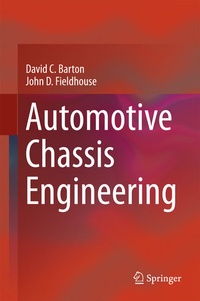
Automotive Chassis Engineering
1st Edition
Published on 15. March 2018
XIII, 327 pages
978-3-319-72437-9 (ISBN)
Description

Written for students and practicing engineers working in automotive engineering, this book provides a fundamental yet comprehensive understanding of chassis systems and requires little prior knowledge on the part of the reader. It presents the material in a practical and realistic manner, using reverse engineering as a basis for examples to reinforce understanding of the topics. The specifications and characteristics of vehicles currently on the market are used to exemplify the theory's application, and care is taken to connect the various topics covered, so as to clearly demonstrate their interrelationships.
The book opens with a chapter on basic vehicle mechanics, which include the forces acting on a vehicle in motion, assuming a rigid body. It then proceeds to a chapter on steering systems, which provides readers with a firm understanding of the principles and forces involved under static and dynamic loading. The next chapter focuses on vehicle dynamicsby considering suspension systems-tyres, linkages, springs, dampers etc. The chapter on chassis structures and materials includes analysis tools (typically, finite element analysis) and design features that are used to reduce mass and increase occupant safety in modern vehicles. The final chapter on Noise, Vibration and Harshness (NVH) includes a basic overview of acoustic and vibration theory and makes use of extensive research investigations and practical experience as a means of addressing NVH issues. In all subject areas the authors take into account the latest trends, anticipating the move towards electric vehicles, on-board diagnostic monitoring, active systems and performance optimisation. The book features a number of worked examples and case studies based on recent research projects. All students, including those on Master's level degree courses in Automotive Engineering, and professionals in industry who want to gain a better understanding of vehicle chassis engineering, will benefit from this book.
The book opens with a chapter on basic vehicle mechanics, which include the forces acting on a vehicle in motion, assuming a rigid body. It then proceeds to a chapter on steering systems, which provides readers with a firm understanding of the principles and forces involved under static and dynamic loading. The next chapter focuses on vehicle dynamicsby considering suspension systems-tyres, linkages, springs, dampers etc. The chapter on chassis structures and materials includes analysis tools (typically, finite element analysis) and design features that are used to reduce mass and increase occupant safety in modern vehicles. The final chapter on Noise, Vibration and Harshness (NVH) includes a basic overview of acoustic and vibration theory and makes use of extensive research investigations and practical experience as a means of addressing NVH issues. In all subject areas the authors take into account the latest trends, anticipating the move towards electric vehicles, on-board diagnostic monitoring, active systems and performance optimisation. The book features a number of worked examples and case studies based on recent research projects. All students, including those on Master's level degree courses in Automotive Engineering, and professionals in industry who want to gain a better understanding of vehicle chassis engineering, will benefit from this book.
More details
Series
Language
English
Place of publication
Cham
Switzerland
Publishing group
Springer International Publishing
Target group
Primary & secondary/elementary & high school
Product notice
Reflowable
Illustrations
XIII, 327 p.
File size
14,29 MB
ISBN-13
978-3-319-72437-9 (9783319724379)
DOI
10.1007/978-3-319-72437-9
Schweitzer Classification
Other editions
New editions
David C. Barton | John D. Fieldhouse
Automotive Chassis Engineering
E-Book
06/2024
2nd Edition
Springer
€106.99
Available for download
Additional editions
David C. Barton | John D. Fieldhouse
Automotive Chassis Engineering
Book
03/2018
1st Edition
Springer
€117.69
Article exhausted; check for reprint
Persons
Professor David Barton
was awarded a First Class Honours Bachelor's degree in Mechanical Engineering from the University of Bristol in 1974. After gathering industrial experience, he completed his MSc in Applied Mechanics at the University of Manchester in 1978, followed by a PhD in composite materials for pressure vessels in 1981. Prior to joining Leeds as a lecturer in 1985, Professor Barton had five years experience as a structural analyst in the nuclear power industry mainly concerned with high temperature and aseismic assessment of reactor structures. His research interests at Leeds have centred around the experimental derivation and numerical implementation of complex models of material and structural behaviour, particularly in relation to high strain rate deformation (including crashworthiness of vehicles), durability assessment and tribological interfaces in automotive engineering (brakes, gearbox synchronisers) and biomedical applications (total artificial joints, impact biomechanics). He has authored over 190 publications on these topics and was awarded a Chair in Solid Mechanics in 1999. His teaching interests include automotive chassis engineering, finite element analysis and design/manufacture.
John Fieldhouse is a National Teaching Fellow and an apprentice trained engineer with 19 years industrial experience in Research and Development. He completed his BSc (First Class Honours) degree at the University of Leeds and his PhD at the University of Huddersfield. After entering academic life he maintained his links with industry, completing some 23 "turnkey" design and development projects. His research has always been industrially driven and he has undertaken numerous automotive braking research projects with industrial partners. He has published over 150 journal and conference papers on brake NVH (Noise, Vibration, and Harshness), design, education and alternative fuels. He has over 30 years of academic experience, which have instilled a teaching approach based on "learning by doing". During his career he has developed an advanced design studio/learning centre and conceived and developed an automotive research/teaching "centre of excellence". These initiatives were decisive in him being elected as a UK National Teaching Fellow.
In 2010 he was appointed to the position Professor of Automotive Engineering T&L at the University of Huddersfield and in 2012 appointed Visiting Professor at the University of Bradford. For over 15 years he has taught automotive engineering subjects at the University of Leeds. His interests extend to the education of automotive engineers at an international level.
John Fieldhouse is a National Teaching Fellow and an apprentice trained engineer with 19 years industrial experience in Research and Development. He completed his BSc (First Class Honours) degree at the University of Leeds and his PhD at the University of Huddersfield. After entering academic life he maintained his links with industry, completing some 23 "turnkey" design and development projects. His research has always been industrially driven and he has undertaken numerous automotive braking research projects with industrial partners. He has published over 150 journal and conference papers on brake NVH (Noise, Vibration, and Harshness), design, education and alternative fuels. He has over 30 years of academic experience, which have instilled a teaching approach based on "learning by doing". During his career he has developed an advanced design studio/learning centre and conceived and developed an automotive research/teaching "centre of excellence". These initiatives were decisive in him being elected as a UK National Teaching Fellow.
In 2010 he was appointed to the position Professor of Automotive Engineering T&L at the University of Huddersfield and in 2012 appointed Visiting Professor at the University of Bradford. For over 15 years he has taught automotive engineering subjects at the University of Leeds. His interests extend to the education of automotive engineers at an international level.
Content
Vehicle Mechanics.- Steering Systems.- Suspension Systems & Components.- Noise, Vibration & Harshness (Nvh).- Chassis Structures.
