

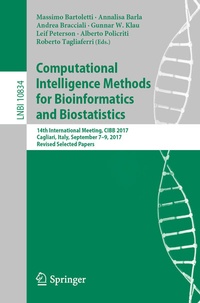
Computational Intelligence Methods for Bioinformatics and Biostatistics
Description

The 19 revised full papers presented were carefully reviewed and selected from 44 submissions. The papers deal with the application of computational intelligence to open problems in bioinformatics, biostatistics, systems and synthetic biology, medical informatics, computational approaches to life sciences in general.
More details
Other editions
Additional editions
Persons
Content
An open-source tool for managing time-evolving variant annotation.- Extracting few representative reconciliations with host-switches.- A quantitative and qualitative characterization of k-mer based alignment-free phylogeny construction.- Cancer mutational signatures identification with sparse dictionary learning.- Icing: Large-scale inference of immunoglobulin clonotypes.- Adenine: a HPC-oriented tool for biological data exploration.- Disease-genes must guide fata dource integration in the gen prioritization process.- Ensembling fescendant term classifiers to improve gene - Abnormal phenotype predictions.- GP-based grammatical inference for classification of amyloidogenic sequences.- Estimation of kinetic reaction constants: Exploiting reboot strategies to improve PSO's performance.- Haplotype and repeat separation in long reads.- Tumor subclonal progression model for cancer hallmark acquisition.- GIMLET: Identifying biological modulators in context-specific gene regulation using local energy statistics.- Structural features of a DPPG liposome layer adsorbed on a rough surface.- Chemical exchanges and actuation in liposome-based synthetic cells: Interaction with biological cells.- A nano communication system for CTC detection in blood vessels.- Experimental evidences suggest high between-vesicle diversity of articial vesicle populations: Results, models and implications.- Towards the synthesis of photo-autotrophic protocells.- Hierarchical block matrix approach for multi-view clustering.
