

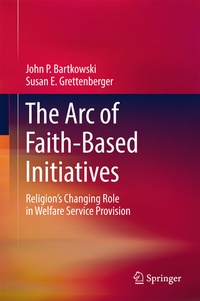
The Arc of Faith-Based Initiatives
Description

This volume offers an in-depth examination of a diverse range of faith-based programs implemented in three different geographical locales: family support in rural Mississippi, transitional housing in Michigan, and addiction recovery in the Pacific Northwest (Washington-Oregon). Various types of religious service providers-faith-intensive and faith-related-are carefully examined, and secular organizations also serve as an illuminating point of comparison. Among other insights, this book reveals how the "three C's" of social service provision-programmatic content, organizational culture, and ecological context-all combine to shape the delivery of welfare services in the nonprofit world. This book warns against simplistic generalizations about faith-based organizations. Faith-based providers exhibit considerable diversity and, quite often, remarkable resilience in the face of challenging social circumstances. An appreciation of these nuances is critical as policies concerning faith-based organizations continue to evolve.
More details
Other editions
Additional editions
Persons
John P. Bartkowski is Professor of Sociology at the University of Texas at San Antonio. His research focuses on the intersection of religion, gender, family, and social welfare. He has published over 100 articles, book chapters, and research reports. His research has been supported by the National Science Foundation, National Institutes of Health, Lilly Endowment, Kellogg Foundation, and other competitive funding agencies. His previous books include Remaking the Godly Marriage (2001), Charitable Choices (2003, with co-author Helen Regis), and The Promise Keepers (2004).
Susan E. Grettenberger is Professor of Social Work at Central Michigan University. Her research and practice experience includes the areas of HIV/AIDS, child welfare, domestic violence, and substance abuse. Her human service work has been primarily on Latino communities in Michigan and Chicago. Her research has been published in various prominent social work journals.
Content
Chapter 1-Faith-Based Persistence and Permutations.- Chapter 2-Faith-Based Initiatives Reconsidered: The Complicated Relationship Between Religion and Social Welfare Service Provision.- Chapter 3-Faith-based versus Secular Support for Fragile Families: Parent Education in the Rural South.- Chapter 4-Across the Continuum of Care: Transitional Housing Programs in the Midwest.- Chapter 5-Addiction Recovery: Residential Drug and Alcohol Treatment Programs in the Pacific Northwest (Steven Rathgeb Smith with Bejamina Menashe).- Chapter 6- Does Faith Matter? Client Transformation in Parenting, Housing, and Addiction Recovery Programs.- Conclusion-Promising Partners or Strange Bedfellows? Faith-Based Providers and Government Funders after Welfare.- Appendix A: Methods in Brief.- Appendix B: Research Instruments.- Appendix C: Descriptions of Programs and Agencies.
