

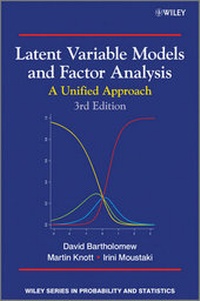
Latent Variable Models and Factor Analysis
A Unified Approach
3rd Edition
Published on 23. May 2011
296 pages
978-1-119-97059-0 (ISBN)
Description

Latent Variable Models and Factor Analysis provides a comprehensive and unified approach to factor analysis and latent variable modeling from a statistical perspective. This book presents a general framework to enable the derivation of the commonly used models, along with updated numerical examples. Nature and interpretation of a latent variable is also introduced along with related techniques for investigating dependency.
This book:
* Provides a unified approach showing how such apparently diverse methods as Latent Class Analysis and Factor Analysis are actually members of the same family.
* Presents new material on ordered manifest variables, MCMC methods, non-linear models as well as a new chapter on related techniques for investigating dependency.
* Includes new sections on structural equation models (SEM) and Markov Chain Monte Carlo methods for parameter estimation, along with new illustrative examples.
* Looks at recent developments on goodness-of-fit test statistics and on non-linear models and models with mixed latent variables, both categorical and continuous.
No prior acquaintance with latent variable modelling is pre-supposed but a broad understanding of statistical theory will make it easier to see the approach in its proper perspective. Applied statisticians, psychometricians, medical statisticians, biostatisticians, economists and social science researchers will benefit from this book.
Reviews / Votes
"Latent Variable Models and Factor Analysis provides acomprehensive and unified approach to factor analysis and latentvariable modeling from a statistical perspective." (Mathematical Reviews, 2012)"Statistical techniques to study the nature and interpretation of alatent variable should be highly useful for researchers andpractitioners across several fields. The third edition of this bookis comprehensive and provides a solid foundation for understandingthese techniques, and is strongly recommended." (Book Pleasures,2012)More details
Other editions
Additional editions
David J. Bartholomew | Martin Knott | Irini Moustaki
Latent Variable Models and Factor Analysis
A Unified Approach
Book
07/2011
3rd Edition
Wiley
€95.00
Shipment within 10-20 days
Software
06/2011
Wiley
€88.05
No shipping information available
Persons
David Bartholomew, Martin Knott and Irini Moustaki, Department of Statistics, The London School of Economics and Political Science, London, UK
Content
- Intro
- Latent Variable Models and Factor Analysis
- Contents
- Preface
- Acknowledgements
- 1 Basic ideas and examples
- 1.1 The statistical problem
- 1.2 The basic idea
- 1.3 Two examples
- 1.3.1 Binary manifest variables and a single binary latent variable
- 1.3.2 A model based on normal distributions
- 1.4 A broader theoretical view
- 1.5 Illustration of an alternative approach
- 1.6 An overview of special cases
- 1.7 Principal components
- 1.8 The historical context
- 1.9 Closely related fields in statistics
- 2 The general linear latent variable model
- 2.1 Introduction
- 2.2 The model
- 2.3 Some properties of the model
- 2.4 A special case
- 2.5 The sufficiency principle
- 2.6 Principal special cases
- 2.7 Latent variable models with non-linear terms
- 2.8 Fitting the models
- 2.9 Fitting by maximum likelihood
- 2.10 Fitting by Bayesian methods
- 2.11 Rotation
- 2.12 Interpretation
- 2.13 Sampling error of parameter estimates
- 2.14 The prior distribution
- 2.15 Posterior analysis
- 2.16 A further note on the prior
- 2.17 Psychometric inference
- 3 The normal linear factor model
- 3.1 The model
- 3.2 Some distributional properties
- 3.3 Constraints on the model
- 3.4 Maximum likelihood estimation
- 3.5 Maximum likelihood estimation by the E-M algorithm
- 3.6 Sampling variation of estimators
- 3.7 Goodness of fit and choice of q
- 3.7.1 Model selection criteria
- 3.8 Fitting without normality assumptions: least squares methods
- 3.9 Other methods of fitting
- 3.10 Approximate methods for estimating
- 3.11 Goodness of fit and choice of q for least squares methods
- 3.12 Further estimation issues
- 3.12.1 Consistency
- 3.12.2 Scale-invariant estimation
- 3.12.3 Heywood cases
- 3.13 Rotation and related matters
- 3.13.1 Orthogonal rotation
- 3.13.2 Oblique rotation
- 3.13.3 Related matters
- 3.14 Posterior analysis: the normal case
- 3.15 Posterior analysis: least squares
- 3.16 Posterior analysis: a reliability approach
- 3.17 Examples
- 4 Binary data: latent trait models
- 4.1 Preliminaries
- 4.2 The logit/normal model
- 4.3 The probit/normal model
- 4.4 The equivalence of the response function and underlying variable approaches
- 4.5 Fitting the logit/normal model: the E-M algorithm
- 4.5.1 Fitting the probit/normal model
- 4.5.2 Other methods for approximating the integral
- 4.6 Sampling properties of the maximum likelihood estimators
- 4.7 Approximate maximum likelihood estimators
- 4.8 Generalised least squares methods
- 4.9 Goodness of fit
- 4.10 Posterior analysis
- 4.11 Fitting the logit/normal and probit/normal models: Markov chain Monte Carlo
- 4.11.1 Gibbs sampling
- 4.11.2 Metropolis-Hastings
- 4.11.3 Choosing prior distributions
- 4.11.4 Convergence diagnostics in MCMC
- 4.12 Divergence of the estimation algorithm
- 4.13 Examples
- 5 Polytomous data: latent trait models
- 5.1 Introduction
- 5.2 A response function model based on the sufficiency principle
- 5.3 Parameter interpretation
- 5.4 Rotation
- 5.5 Maximum likelihood estimation of the polytomous logit model
- 5.6 An approximation to the likelihood
- 5.6.1 One factor
- 5.6.2 More than one factor
- 5.7 Binary data as a special case
- 5.8 Ordering of categories
- 5.8.1 A response function model for ordinal variables
- 5.8.2 Maximum likelihood estimation of the model with ordinal variables
- 5.8.3 The partial credit model
- 5.8.4 An underlying variable model
- 5.9 An alternative underlying variable model
- 5.10 Posterior analysis
- 5.11 Further observations
- 5.12 Examples of the analysis of polytomous data using the logit model
- 6 Latent class models
- 6.1 Introduction
- 6.2 The latent class model with binary manifest variables
- 6.3 The latent class model for binary data as a latent trait model
- 6.4 K latent classes within the GLLVM
- 6.5 Maximum likelihood estimation
- 6.6 Standard errors
- 6.7 Posterior analysis of the latent class model with binary manifest variables
- 6.8 Goodness of fit
- 6.9 Examples for binary data
- 6.10 Latent class models with unordered polytomous manifest variables
- 6.11 Latent class models with ordered polytomous manifest variables
- 6.12 Maximum likelihood estimation
- 6.12.1 Allocation of individuals to latent classes
- 6.13 Examples for unordered polytomous data
- 6.14 Identifiability
- 6.15 Starting values
- 6.16 Latent class models with metrical manifest variables
- 6.16.1 Maximum likelihood estimation
- 6.16.2 Other methods
- 6.16.3 Allocation to categories
- 6.17 Models with ordered latent classes
- 6.18 Hybrid models
- 6.18.1 Hybrid model with binary manifest variables
- 6.18.2 Maximum likelihood estimation
- 7 Models and methods for manifest variables of mixed type
- 7.1 Introduction
- 7.2 Principal results
- 7.3 Other members of the exponential family
- 7.3.1 The binomial distribution
- 7.3.2 The Poisson distribution
- 7.3.3 The gamma distribution
- 7.4 Maximum likelihood estimation
- 7.4.1 Bernoulli manifest variables
- 7.4.2 Normal manifest variables
- 7.4.3 A general E-M approach to solving the likelihood equations
- 7.4.4 Interpretation of latent variables
- 7.5 Sampling properties and goodness of fit
- 7.6 Mixed latent class models
- 7.7 Posterior analysis
- 7.8 Examples
- 7.9 Ordered categorical variables and other generalisations
- 8 Relationships between latent variables
- 8.1 Scope
- 8.2 Correlated latent variables
- 8.3 Procrustes methods
- 8.4 Sources of prior knowledge
- 8.5 Linear structural relations models
- 8.6 The LISREL model
- 8.6.1 The structural model
- 8.6.2 The measurement model
- 8.6.3 The model as a whole
- 8.7 Adequacy of a structural equation model
- 8.8 Structural relationships in a general setting
- 8.9 Generalisations of the LISREL model
- 8.10 Examples of models which are indistinguishable
- 8.11 Implications for analysis
- 9 Related techniques for investigating dependency
- 9.1 Introduction
- 9.2 Principal components analysis
- 9.2.1 A distributional treatment
- 9.2.2 A sample-based treatment
- 9.2.3 Unordered categorical data
- 9.2.4 Ordered categorical data
- 9.3 An alternative to the normal factor model
- 9.4 Replacing latent variables by linear functions of the manifest variables
- 9.5 Estimation of correlations and regressions between latent variables
- 9.6 Q-Methodology
- 9.7 Concluding reflections of the role of latent variables in statistical modelling
- Software appendix
- References
- Author index
- Subject index
