

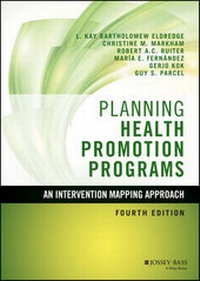
Planning Health Promotion Programs
Description

More details
Other editions
Additional editions
Persons
Content
Chapter 1
Overview of Intervention Mapping
Learning Objectives and Tasks
- Explain the rationale for a systematic approach to intervention development
- Describe ecological and systems approaches to intervention development
- Explain the causal logic of public health problems and solutions
- List the steps, tasks, and processes of Intervention Mapping
- Explain how to use theory and evidence in intervention development
Competency
- Choose and use a systematic approach to planning health promotion programs.
In this chapter we present the perspectives underlying Intervention Mapping and a preview of the program-planning framework. The purpose of Intervention Mapping is to provide health promotion program planners with a framework for effective decision making at each step in intervention planning, implementation, and evaluation. Health promotion has been defined as combinations of educational, political, regulatory, and organizational supports for behavior and environmental changes that are conducive to health (Green & Kreuter, 2005), and health education is a subset of health promotion applications that are primarily based on education. This book uses the terms health educator, health promoter, and program planner interchangeably to mean someone who is planning an intervention meant to produce health outcomes. One difficulty which planners may encounter is that of knowing exactly how to create health promotion or education programs that are based on theory, empirical findings from the literature, and data collected from a population. Existing literature, appropriate theories, and additional research data are basic tools for any health educator, but often it is unclear how and where these tools should be used in program planning. In Intervention Mapping, these tools are systematically applied in each step of program development.
Box 1.1: Mayor's Project
Imagine a health promoter in a city health department. The city's mayor, who has recently received strong criticism for inattention to a number of critical health issues, has now announced that a local foundation has agreed to work with the city to provide funding to address health issues. Youth violence, childhood obesity, adolescent smoking, and other substance abuse as well as the high incidence of HIV/AIDS are among the many issues competing for the mayor's attention. Not only does the allocated sum of money represent a gross underestimation of what is needed to address these issues, but also the city council is strongly divided on which health issue should receive priority. Council members do agree, however, that to dilute effort among the different issues would be a questionable decision, likely resulting in little or no impact on any single issue. As a response to increasing pressures, the mayor makes a bold political move and invites stakeholders who have advocated for these health issues and others to work with the health department to decide on the issue that should be chosen and to build and implement an intervention. The mayor agrees to help secure yearly funds, contingent on the project's effectiveness in producing significant, measurable improvements in the chosen issue at the end of each fiscal year.
The health promoter is to be the project lead from the city health department. Although she is apprehensive about the professional challenge as well as the complications inherent in facilitating a highly visible, political project, the health promoter feels encouraged by the prospect of working with community and public health leaders and is energized by the possibilities in the new project.
The first step the health promoter takes is to put together the planning group for the project. She considers the stakeholders concerned with health in the city. These are individuals, groups, or other entities that can affect or be affected by whatever project is chosen. She develops a list of community, health services, and public health leaders and invites these individuals to an initial meeting where they will discuss the project and make plans to expand this core group. She uses a "snowball" approach whereby each attendee suggests other community members who may be interested in this project. The superintendent of schools begins the process by suggesting interested parents, teachers, and administrators. After the first meeting, the health educator has a list of 25 people to invite to join the planning group.
Twenty-five people is a lot for one group, and the project lead knows that this multifaceted group will have to develop a common vocabulary and understanding, work toward consensus to make decisions, maintain respect during conflicts, and involve additional people throughout the community in the process. Members must be engaged, create working groups, believe that the effort is a partnership and not an involuntary mandate, and work toward sustainability of the project (Becker, Israel, & Allen, 2005; Cavanaugh & Cheney, 2002; Economos & Irish-Hauser, 2007; Faridi, Grunbaum, Gray, Franks, & Simoes, 2007).
The composition of the city's planning group is diverse, and group members are spurred by the mayor's challenge and enthusiastic to contribute their expertise. With this early momentum, the group devotes several weeks to a needs assessment, guided by the PRECEDE model (Green & Kreuter, 1999). The members consider the various quality-of-life issues relevant to each of the health problems, the segments of the population affected by each issue, associated environmental and behavioral risk factors for each health problem, and determinants of the risk factors.
Planning group members recognize the importance of all of the health issues discussed by the group, and they want to work with community members to ascertain what problem might be most relevant to the community and most feasible to address. Even though the planning group comprises many segments of the city's leadership, health sector, and neighborhoods, the members realize that they do not have a deep enough understanding of what health problems might be of most relevance in their community. A subgroup takes on the role of community liaison to meet with members of various communities within the city to discuss health problems. The community liaison group wants to understand community members' perceptions of their needs, but it is equally concerned with understanding the strengths of the communities and their unique potential contributions to a partnership to tackle a health problem. The subgroup invites members of each interested neighborhood to join the planning group. Jointly, the planning group, the communities, and the funders agree to select a problem as the focus of an intervention. The health promoter knows that with a group this large she will have to strategize about using smaller work groups for different tasks. However, knowing the history of the city and the feeling of some stakeholder groups that they are often excluded from initiatives, she welcomes all interested participants.
The group's initial work on the needs assessment identifies childhood obesity as an important problem, one that the community members could agree to work on, and one that disproportionately affects lower-income and minority children. This initial work facilitates group cohesion and cultivates even greater enthusiasm about generating a solution for the health problem; however, despite the considerable needs assessment work that remains to be done (see Mayor's Project, Chapter 4), several members of the group even begin to imagine the victory that would be had if the group were to produce a change in half the allotted time because so much of the needed background information has already been gathered. The project lead knows that there remains a lot of work to be done but is comfortable with the group's enthusiasm as well as their pace and productivity. Once the group decides which issue to address, it faces the challenge of moving to the program-planning phase. In her previous work the health promoter used Intervention Mapping to develop programs and felt fairly confident about scheduling the first planning meeting devoted specifically to intervention.
What the health promoter hasn't anticipated is that in the course of conducting the initial part of the needs assessment, each group member independently began to conceive of the next step in the planning process as well as to visualize the kind of intervention that would be most suitable to address the problem. The day of the meeting arrives, and on the agenda is a discussion of how the group should begin program planning. What follows is a snapshot of dialogue from the planning group that illustrates several differing perspectives.
- School Board Member: As we see from the work of our community liaison group, parents are concerned about obesity in children. According to community development techniques, we have to start where the people are. I think we should begin by conducting a series of focus groups with parents and have them tell us what to do.
- City Council Representative: But we also heard a lot about the barriers to eating good food and exercising. Some of these barriers are environmental. I think we ought to develop a program for the Department of Parks and Recreation.
- Community Member Parent: Well, I think a school-based program is most important. Our children need to learn...
