

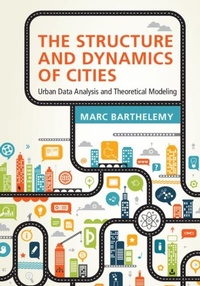
The Structure and Dynamics of Cities
Urban Data Analysis and Theoretical Modeling
Published on 23. November 2016
978-1-316-79753-2 (ISBN)
Description

With over half of the world's population now living in urban areas, the ability to model and understand the structure and dynamics of cities is becoming increasingly valuable. Combining new data with tools and concepts from statistical physics and urban economics, this book presents a modern and interdisciplinary perspective on cities and urban systems. Both empirical observations and theoretical approaches are critically reviewed, with particular emphasis placed on derivations of classical models and results, along with analysis of their limits and validity. Key aspects of cities are thoroughly analyzed, including mobility patterns, the impact of multimodality, the coupling between different transportation modes, the evolution of infrastructure networks, spatial and social organisation, and interactions between cities. Drawing upon knowledge and methods from areas of mathematics, physics, economics and geography, the resulting quantitative description of cities will be of interest to all those studying and researching how to model these complex systems.
Reviews / Votes
'Every so often along comes a book that attempts a grand synthesis. Marc Barthelemy has put together many ideas from statistical physics with theory in urban economics, fashioning an approach that demonstrates its essential logic and empirical relevance. A book that must be absorbed by urbanists of every persuasion and used to advance our science of cities.' Michael Batty, University College London 'Collective effects are often counterintuitive and defeat our imagination. We need specific models to anticipate financial crashes, traffic jams, mass panics. The spontaneous organization of cities falls in the same category of phenomena created by ourselves, humans, but that -- paradoxically - we struggle to understand. This wonderful book summarizes a large number of data and ideas about how cities grow and self-organize, sometimes not in the most efficient way. In his plea for a new science for cities, Marc Barthelemy musters methods from statistical physics for a problem that concerns an ever-growing fraction of humanity.' Jean-Philippe Bouchaud, Capital Fund Management, Paris '... a multi-disciplinary effort to describe and understand the numerous structural aspects of cities and their evolution ... This book makes an effort to bring these different points of view together, to find a common scientific language, and to look at cities as systems that show typical features such as complexity, self-organisation and emergence which can be described in the language of statistical physics. ...The whole text is a well-written scientific essay and fully referenced to scientific publications from a broad range of disciplines. The data and models are presented with mathematical rigour and illustrated by numerous black-and-white figures. The book is highly interesting for its multi-disciplinary approach as well as for the data presented, and can be recommended to a wide interested readership with a general understanding of mathematics and statistical physics.' Manuel Vogel, Contemporary Physics 'Marc Barthelemy refreshes ideas and opens new avenues for further research in urban/economic quantitative geography. Without ignoring 'Founding Fathers' in geography, he suggests inspiring ideas anchored in physics for modelling urban realities. A path toward multidisciplinary analysis, which has still a long way to go before success.' Isabelle Thomas, Universite catholique de LouvainMore details
Language
English
Place of publication
Cambridge
United Kingdom
Publishing group
Cambridge University Press
Target group
Professional and scholarly
Illustrations
Worked examples or Exercises; 7 Tables, black and white; 68 Halftones, black and white; 44 Line drawings, black and white
File size
17,26 MB
ISBN-13
978-1-316-79753-2 (9781316797532)
Copyright in bibliographic data and cover images is held by Nielsen Book Services Limited or by the publishers or by their respective licensors: all rights reserved.
Schweitzer Classification
Other editions
Additional editions
Book
11/2016
Cambridge University Press
€93.00
Shipment within 15-20 days
Person
Marc Barthelemy is a senior researcher at the Institute of Theoretical Physics in Saclay (CEA) and a member of the Center of Social Analysis and Mathematics (EHESS). He has worked on applications of statistical physics to complex networks, epidemiology, and more recently, spatial networks, and is the co-author, with Alain Barrat and Alessandro Vespignani, of Dynamical Processes on Complex Networks (2008). Focusing on both data analysis and modeling, he is currently working on various aspects of the emerging science of cities.
Content
Preface; Acknowledgements; 1. Urban systems; 2. Models and methods; 3. The spatial organization of cities; 4. Infrastructure networks; 5. Mobility patterns; 6. Multimodality in cities; 7. Socio-economical aspects; 8. Systems of cities; 9. Towards a new science of cities; References; Index.
