

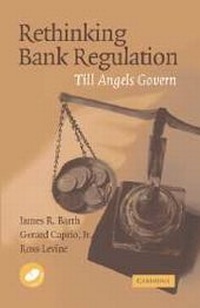
Rethinking Bank Regulation
Till Angels Govern
1st Edition
Published on 29. November 2006
978-0-511-13402-9 (ISBN)
Description

This volume assembles and presents a database on bank regulation in over 150 countries (included also on CD). It offered the first comprehensive cross-country assessment of the impact of bank regulation on the operation of banks, and assesses the validity of the Basel Committee's influential approach to bank regulation. The treatment also provides an empirical evaluation of the historic debate about the proper role of government in the economy by studying bank regulation and analyzes the role of politics in determining regulatory approaches to banking. The data also indicate that restrictions on the entry of banks, government ownership of banks, and restrictions on bank activities hurt banking system performance. The authors find that domestic political factors shape both regulations and their effectiveness.
Reviews / Votes
'This well-written and compelling book shakes the conventional wisdom about banking regulation to its foundations. It is also a model of how to do judicious analysis of an important policy question, then apply it to give real world recommendations. Nobody involved with financial and banking policies, or for that matter with economic policy in developing countries in general, can afford NOT to read this book.' William Easterly, New York University '...an important book. It provides striking evidence (using a unique data set created at the World Bank) that strengthening the discretionary powers of prudential supervisors in countries with weak institutional environments leads to lower level of bank development, greater corruption in lending and banks that are less safe and sound. Following the Basel II recommendation of strengthening supervisory powers, therefore, may do more harm than good in developing countries, unless it is accompanied by substantial progress in institutional development. This book provides an important warning to policy makers that what works for advanced countries may not work for developing countries.' Frederic Mishkin, Columbia University 'Rethinking Bank Regulation is a thought provoking study, attacking the current practice of bank regulation and supervision. Using data from more than 150 countries, the authors conclude that strengthening capital standards or empowering supervisors does not boost bank efficiency, reduce corruption in lending, or lower banking system fragility. They urge reforms that would emphasize greater disclosure and transparency in the banking sector as well as better private sector monitoring of banks. This is a must read for all those interested in banking sector reform. It will also be fascinating for students of political economy. Raghuram Rajan, International Monetary Fund Rethinking Bank Regulation is the best work available on assessing the actual impact of regulatory policies on banks. Its major conclusion, based on data from 150 countries, is striking-that developing countries need to place far more emphasis on policies that promote market discipline, like disclosure requirements, than on command and control regulations that often translate into discretionary abuse.' Hal Scott, Harvard Law School 'This is more than just a handbook for all bank regulators, researchers and policy-makers to delve in. It covers not only the theory and practice of bank regulation, but also more importantly, its political economy. Barth, Caprio, and Levine have not only seen the forest through the trees, but also the soul of bank regulation.' Andrew Sheng, Chairman, Securities and Futures Commission, Hong Kong ' ... extremely well written ... accessible to non-specialists ... comprehensive in its treatment of the subject matter, is incisive in its analysis and makes a major contribution to the literature by broadening our understanding of the forces which are likely to determine the outcome of banking regulatory policy ...I thoroughly recommend the book to students of bank regulation and supervision and practitioners alike.' EconomicaMore details
Language
English
Place of publication
Cambridge
United Kingdom
Publishing group
Cambridge University Press
Target group
Professional and scholarly
Illustrations
Worked examples or Exercises; 30 Tables, unspecified; 30 Plates, unspecified
File size
2,02 MB
ISBN-13
978-0-511-13402-9 (9780511134029)
Copyright in bibliographic data and cover images is held by Nielsen Book Services Limited or by the publishers or by their respective licensors: all rights reserved.
Schweitzer Classification
Other editions
Additional editions
Book
05/2008
Cambridge University Press
€57.70
Shipment within 15-20 days
Book
12/2005
Cambridge University Press
€65.00
Shipment within 15-20 days
Persons
James R. Barth is the Lowder Eminent Scholar in Finance at Auburn University and a Senior Finance Fellow at the Milken Institute. He has also been Professor of Economics at George Washington University, Associate Director of the economics program at the National Science Foundation, and Shaw Foundation Professor of Banking and Finance at Nanyang Technological University. Professor Barth was an appointee of Presidents Ronald Reagan and George H. W. Bush as Chief Economist of the Office of Thrift Supervision and previously as Chief Economist of the Federal Home Loan Bank Board. Most recently, he served as leader of an international team advising the People's Bank of China on banking reform from Fall 2002 to Spring 2004. He has authored more than 100 articles in professional journals and has written and edited several books. His research focuses on financial institutions and capital markets, both domestic and global, with special emphasis on regulatory issues. Gerard Caprio, Jr. is Professor of Economics at Williams College. Until 2006 he worked at the World Bank, most recently as Director for Policy in the Financial Sector Vice Presidency, previously serving as Manager, Financial Sector Research, in the Bank's Development Research Group. He was the senior Bank spokesperson on financial markets and financial sector regulation, development, and reform. Prior to joining the Bank in 1988, Professor Caprio was Vice President and Head of Global Economics at JP Morgan, previously holding economist positions at the Federal reserve Board, the IMF, and also teaching at George Washington University. His current research explores the links between financial sector regulation and supervision and the performance of financial institutions, as well as financial crises. He has worked on financial sectors in numerous countries around the world, including Africa, South and East Asia, Eastern Europe, and Latin America. Professor Caprio has authored or edited 11 volumes and over 50 papers on financial sector issues. Ross Levine is Professor of Economics at Brown University. After receiving his Ph. D. in economics and working at the Board of Governors of the Federal Reserve System, Professor Levine moved to the World Bank. There he participated and managed a number of research and operational programs. In 1997 Professor Levine joined the University of Virginia, before moving to the finance department of the Carlson School of Management at the University of Minnesota in 1999. His work focuses on the links between financial sector policies, the operation of financial systems, and economic growth. Professor Levine has published articles in well-known journals such as the American Economic Review, Quarterly Journal of Economics, Journal of Finance, Journal of Monetary Economics, Journal of Financial Intermediation, Journal of Money, Credit, and Banking, Journal of Banking and Finance, Journal of Economic Perspectives, and the Journal of Economic Literature. He also co-authored Financial Structure and Economic Growth: A Cross-Country Comparison of Banks, Markets, and Development (2001).
Content
1. Introduction: 1.A Motivation; 1.B Objectives and contributions; 1.C Key findings: a brief synopsis; 1.D Guide to the book; 2. Contrasting approaches to bank regulation: 2.A Two approaches to bank regulation: 2.A.1 Public interest approach; 2.A.2 Private interest view of regulation; 2.B Bank regulation: how; 2.C The Basel Committee and regulatory convergence; 2.D Conclusion; 3. How are banks regulated and supervised around the world?: 3.A Overview; 3.B Structure, scope and independence of regulation and supervision; 3.C What is a 'bank'?; 3.D Entry into banking, capital requirements and supervisory powers; 3.E Explicit deposit insurance schemes; 3.F Private monitoring and external governance; 3.G Does bank ownership type affect the choice of regulations and supervisory practices?; 3.H Forces for greater harmonization of regulation and supervision among countries; 4. What works best: 4.A Goals and boundaries; 4.B Bank regulation and supervision and bank development; 4.C Bank supervision, regulation, and stability; 4.D Bank supervision, regulation, and bank efficiency; 4.E Bank supervision, regulation, and bank lending; 4.F Supervision, regulation, and bank governance; 4.G Summary of results; 5. Choosing bank regulations; 5.A Recap and motivation; 5.B Motivating example: Mexico and the United States; 5.C Conceptual framework; 5.D Empirical framework and data; 5.E Summary remarks; 6. Rethinking bank regulation: 6.A Approach and context; 6.B Lessons and implications.
