

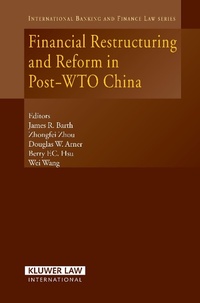
Financial Restructuring and Reform in Post-WTO China
Published on 7. November 2006
408 pages
978-90-411-5085-1 (ISBN)
Description

This book addresses the on-going process of financial restructuring and reform
in post-WTO China from a legal perspective. Chapter 1 provides an overview of
the impact of the WTO on China's financial markets and financial law systems.
Chapter 2 discusses reform of banking law and regulation in post-WTO China.
Chapter 3 addresses the role of the central bank in China's financial system,
focusing on issues of independence and accountability of the People's Banking
of China (PBOC), China's central bank. Chapter 4 analyses China's compliance
with WTO obligations in the area of banking. Chapter 5 discusses the role of
asset management companies (AMCs) in China's on-going banking restructuring
and liberalization. Chapter 6 analyses the development of securities markets
in China, the challenges being faced and the impact of the WTO. Chapter 7
describes insurance and its development in China, focusing on the role of the
WTO in liberalization. A new topic in China, i.e., financial conglomerates, is
discussed in chapter 8, building upon the discussions in the previous
chapters. Chapter 9 in turn studies the issue of financial institution
insolvency and restructuring as noted in previous chapters, key issues in
China. Chapter 10 discusses the double impact of the WTO and one of China's
regional trade agreements, CEPA, on China's banking law.
in post-WTO China from a legal perspective. Chapter 1 provides an overview of
the impact of the WTO on China's financial markets and financial law systems.
Chapter 2 discusses reform of banking law and regulation in post-WTO China.
Chapter 3 addresses the role of the central bank in China's financial system,
focusing on issues of independence and accountability of the People's Banking
of China (PBOC), China's central bank. Chapter 4 analyses China's compliance
with WTO obligations in the area of banking. Chapter 5 discusses the role of
asset management companies (AMCs) in China's on-going banking restructuring
and liberalization. Chapter 6 analyses the development of securities markets
in China, the challenges being faced and the impact of the WTO. Chapter 7
describes insurance and its development in China, focusing on the role of the
WTO in liberalization. A new topic in China, i.e., financial conglomerates, is
discussed in chapter 8, building upon the discussions in the previous
chapters. Chapter 9 in turn studies the issue of financial institution
insolvency and restructuring as noted in previous chapters, key issues in
China. Chapter 10 discusses the double impact of the WTO and one of China's
regional trade agreements, CEPA, on China's banking law.
More details
Other editions
Additional editions
James R. Barth | Zhongfei Zhou
Financial Restructuring and Reform in Post-WTO China
Book
11/2006
Kluwer Law International
€361.00
Shipment within 10-20 days
Content
- Cover
- Half Title Page
- Editorial Board
- Title Page
- Copyright Page
- Table of Contents
- Editors and Contributors
- Foreword
- Preface
- Chapter 1 The WTO and Financial Restructuring in China
- I. CHINA'S GATS/WTO COMMITMENTS IN FINANCIAL SERVICES
- I.A. Horizontal Commitments
- I.B. Specific Commitments in Financial Services
- I.B.1. Banking
- I.B.2. Insurance
- I.B.3. Securities
- II. CHINA'S FINANCIAL REGULATORY SYSTEM
- II.A. Overview of China's Legal Structure
- II.A.1. Laws
- II.A.2. Administrative Regulations
- II.A.3. Local Regulations
- II.A.4. Autonomous Regulations and Separate Regulations
- II.A.5. Rules of Departments
- II.A.6. Rules of Local Governments
- II.B. Financial Law and Regulation in China
- III. BANKING
- III.A. Development of China's Banking Institutions
- III.B. Development of Banking Laws and Regulations
- IV. SECURITIES
- IV.A. Development of Securities Markets
- IV.B. Structure of the PRC Securities Legal System
- IV.B.1. Share Classification System in The Chinese Securities Market
- IV.B.2. Overview of China's Securities Legal System
- IV.B.2.a. Securities laws
- IV.B.2.b. Securities regulations
- IV.B.2.c. Securities rules
- V. INSURANCE
- V.A. Insurance Law
- V.B. Insurance Rules
- VI. CONCLUSION
- Chapter 2 Banking Regulatory Law Reforms in China: A Long Way to Go Towards International Standards
- I. BANKING REGULATORY SYSTEM
- I.A. PBOC's Role in Banking Regulation
- I.B. CBRC's Role in Banking Regulation
- I.B.1. Regulatory Objectives
- I.B.2. CBRC's Independence and Accountability
- I.B.3. CBRC's Rule-Making Power
- I.B.4. CBRC's Enforcement Powers
- II. REGULATION OF BANK ENTRY
- II.A. Entry Requirements
- II.B. Application Procedures
- II.C. Permissible Activities
- III. ONGOING REGULATION
- III.A. Capital Adequacy
- III.B. Risk Concentrations
- III.C. Provisioning
- III.D. On and Off-site Examinations
- IV. DEALING WITH PROBLEM BANKS
- IV.A. Handling Unexpected Events
- IV.B. Early Interventions
- IV.C. Conservatorship and Reorganization
- IV.D. Suspension for Internal Rectification
- IV.E. Bank Closure
- V. CONCLUDING REMARKS
- Chapter 3 Independence and Accountability of the People's Bank of China: A Legal Perspective
- I. INTRODUCTION
- II. INDEPENDENCE OF THE PBOC
- II.A. Functional Independence
- II.A.1. Monetary Policy
- II.A.2. Other Functions of the PBOC
- II.B. Personal Independence
- II.B.1. Qualification Requirements
- II.B.2. Appointment
- II.B.3. Dismissal
- II.B.4. Term of office
- II.B.5. Conflict of Interest
- II.C. Financial Independence
- III. ACCOUNTABILITY OF THE PBOC
- III.A. Performance Accountability
- III.B. Institutional Accountability
- III.C. Instrument Accountability
- IV. CONCLUDING REMARKS
- Chapter 4 Implementation of China's WTO Commitments: The Compliance Issue in Banking
- I. INTRODUCTION
- II. IMPLEMENTATION OF THE WTO AGREEMENTS IN CHINA
- III. CHINA'S BANKING LAW FRAMEWORK
- III.A. Banking Laws
- III.B. Banking Administrative Regulations
- III.C. Banking Rules
- III.D. Other Banking Normative Documents
- IV. COMPLIANCE WITH WTO OBLIGATIONS IN BANKING
- IV.A. Compliance with Market Access and National Treatment: New Development of China's Banking Law under the WTO
- IV.A.1. Five Announcements since 2001
- IV.A.2. Revision of the FFFI Regulation in 2001
- IV.A.3. Revision of DRI in 2004
- IV.B. Compliance with WTO Transparency Obligations
- IV.C. Economic Needs Test
- V. WTO TRANSITIONAL REVIEW OF CHINA'S BANKING LAW
- V.A. Issues Raised in the TRM Meetings
- V.B. China's Responses: Prudential Carve-out
- VI. CONCLUSION
- Chapter 5 Financial Restructuring and China's Asset Management Companies
- I. INTRODUCTION
- II. BACKGROUND: AMCS IN CHINA
- II.A. Banking Reform in China
- II.B. The AMC Concept
- II.C. The Development of AMCs in China
- III. THE LEGAL FRAMEWORK OF CHINA'S AMCS
- III.A. The Mandates of the AMCs
- III.B. Legislative Forbearance
- III.C. The Regulatory Framework of the AMCs
- IV. CORPORATE GOVERNANCE OF AMCS
- V. STATE POLICY TOWARDS DISPOSING NPLS
- VI. PROPERTY RIGHTS OF TRANSFERRED AMC ASSETS
- VI.A. The Transfer of NPL Assets
- VI.B. Notice of Creditor
- VI.C. Transfer of Secured Interests
- VI.D. Creditor Rights of AMCs
- VI.D.1. Collection of Collateral
- VI.D.2. Litigation
- VI.E. The Provisions of Chinese Company Law
- VII. FOREIGN PARTICIPATION
- VIII. RESTRUCTURING STATE-OWNED ENTERPRISES
- IX. CONCLUSION
- Chapter 6 Liberalization and Reform of China's Securities Markets after WTO Accession
- I. INTRODUCTION
- II. CHINA'S SECURITIES SECTOR COMMITMENTS
- III. IMPLEMENTATION OF ITS SECURITIES SECTOR COMMITMENTS
- III.A. B-Share Business
- III.B. Special Membership on Chinese Stock Exchanges
- III.C. Joint Venture Securities Companies
- III.D. Fund Management with Foreign Equity
- IV. IMPLEMENTATION CHALLENGES
- V. EFFECT OF VOLUNTARY LIBERALIZATIONS
- VI. SEQUENCING OF LIBERALIZATION AND REFORM
- VI.A. Money Market
- VI.B. Foreign Exchange Market
- VI.C. Government Bond Market
- VI.D. Derivatives Market
- VI.E. Corporate Bond and Equity (Securities) Market
- VI.E.1. Building an Active Corporate Bond Market
- VI.E.2. Increasing the Float
- VI.E.3. Accounting, Auditing, and Disclosure Reform
- VI.E.4. Regulatory Capacity
- VI.E.5. Suspension and De-Listing of Listed Companies
- VII. ROLE OF INSTITUTIONAL INVESTORS
- VIII. ECONOMIC IMPACTS OF LIBERALIZATION
- IX. CONCLUSION
- Chapter 7 Insurance in China: Liberalization and Restructuring Post-WTO
- I. INTRODUCTION
- II. BASIC FRAMEWORK OF CHINA'S INSURANCE LEGISLATION
- II.A. Insurance Law
- II.B. Insurance Administrative Regulations
- II.C. Insurance Administrative Rules
- II.D. Bifurcated Regulatory Regime: Domestic vs. Foreign
- III. CHINA'S WTO OBLIGATIONS AND INSURANCE
- III.A. General Obligations
- III.B. China's Insurance Specific Commitments
- III.B.1. Form of Establishment
- III.B.2. Geographic Coverage
- III.B.3. Business Scope
- III.B.4. License
- III.B.5. National Treatment
- IV. CHINA'S INSURANCE LEGAL REGIME IN THE CONTEXT OF ITS WTO OBLIGATIONS
- IV.A. Legal Developments in the Call for WTO Compliance
- IV.B. Lingering Issues
- IV.B.1. Licensing
- IV.B.1.a. High Capital Requirements
- IV.B.1.b. Lengthy and Burdensome Licensing Procedure
- IV.B.2. Transparency Obligations
- IV.B.3. Rule by Law vs. Rule of Law
- IV.C. Recent Regulatory Trends: Deregulation and Consolidation
- V. CONCLUSION
- Chapter 8 Financial Conglomerates in the People's Republic of China
- I. INTRODUCTION
- II. CHINESE LAW AND PRACTICE
- II.A. Chinese Practice & Regulatory Framework with Financial Group
- II.A.1. The History of China's Financial Business: from Mixture to Separation
- II.A.2. China's Current Legal and Regulatory Regime With Respect of the Separation of Financial Business
- II.A.3. China's Current Financial Groups
- II.A.4. Problems and Risks in the Operations of China's Financial Groups
- III. INTERNATIONAL PRACTICE
- III.A. Conglomerate Advantages and Disadvantages
- III.B. International Regulatory Response
- III.C. Bank Holding and Financial Holding Company Rules
- III.D. Regulatory and Supervisory Revision
- III.D.1. Regulatory Revision
- III.D.1.a. Intra-Group Exposures
- III.D.1.b. Capital Calculation and Distribution
- III.D.1.c. Management Authority and Autonomy
- III.D.1.d. Systems and Controls and Conflict of Interest
- III.D.1.e. Crisis Management
- III.D.2. Supervisory Adjustment
- III.D.2.a. Consolidated Supervision
- III.D.2.b. Business Unit Supervision
- III.D.2.c. Conglomerate Supervision
- III.E. Conglomerate Law Models
- III.F. Institutional Relations and Structure
- III.F.1. Memorandum of Understanding
- III.F.2. Administrative law or Regulation
- III.F.3. Single Regulator
- IV. CHINESE CONGLOMERATE POLICY REVISION AND REFORM
- IV.A. General Policy
- IV.B. Financial Groups
- IV.C. Financial Groups
- IV.D. Consolidated and Conglomerate Supervision
- IV.E. Regulatory Revision
- IV.F. Agency Relations and Joint Committee
- V. CONCLUSION
- Chapter 9 Financial Institution Insolvency in the PRC
- I. INTRODUCTION
- II. FINANCIAL INSTITUTION INSOLVENCY
- II.A. Insolvency and Bank Insolvency Procedures
- II.B. Court and Administrative Based Systems
- II.C. Policy Options
- II.C.1. Conservation
- II.C.2. Administration
- II.C.3. Restructuring or Rehabilitation
- II.C.4. Liquidation
- II.C.4.a. Voluntary Liquidation
- II.C.4.b. Compulsory Liquidation
- II.C.5. Bankruptcy
- II.D. Support or Rescue Options
- II.D.1. Market Support (Lender of Last Resort)
- II.D.2. Restructuring or Rehabilitation (Regulatory Hearing or Regulatory Receivership)
- II.D.3. Secured Lending and Capital Injections
- II.D.4. Asset and Liability Transfers
- II.D.5. Share Transfers
- II.E. Supporting Statutory Provisions
- III. OVERVIEW OF CHINESE BANKRUPTCY LAW
- III.A. Introduction of Chinese Corporate Insolvency Law framework
- III.B. Introduction of Chinese Financial Institution Insolvency Law Framework
- III.C. Problems of Chinese financial institution insolvency framework
- IV. FINANCIAL INSTITUTION INSOLVENCY LAW REFORM IN CHINA
- IV.A. General Policy
- IV.B. Agency Responsibility
- IV.C. Joint Review Committee
- IV.D. Insolvency Mechanisms
- IV.E. Insolvency Procedures
- IV.F. Administration
- IV.G. Restructuring
- IV.H. Liquidation
- IV.I. Powers and Duties
- IV.J. Policy Coordination
- V. CONCLUDING OBSERVATIONS AND RECOMMENDATIONS
- Chapter 10 China's Banking Law and Free Trade Agreements: The Case of CEPA
- I. INTRODUCTION
- II. RELATIONS BETWEEN THE CEPA AND THE WTO
- II.A. WTO Mechanism of Examining Regional Trade Agreements
- II.B. Application of the Enabling Clause
- II.C. WTO-Consistency Issue
- II.D. Impact of the CEPA on China's WTO Commitments: Non-Application of Some Rules
- II.D.1. Anti-dumping and Countervailing
- II.D.2. Special Safeguard Measures
- III. CHINA'S SPECIFIC COMMITMENTS IN BANKING SERVICES UNDER THE CEPA
- III.A. Two Important Concepts in the CEPA
- III.A.1. Banking Service
- III.A.2. Banking Service Suppliers
- III.B. Market Access Commitments in Banking Services under the CEPA
- III.C. Financial Cooperation Commitments under the CEPA
- III.D. Relations of China's Banking Commitments under the WTO and the CEPA
- IV. IMPLEMENTATION OF THE CEPA IN CHINA
- IV.A. The State Council Notice
- IV.B. The CBRC Notice
- V. HOW TO ADJUST CHINA'S BANKING LAW UNDER THE CEPA AND WTO
- V.A. Conflicts between China's Banking Laws and the CEPA
- V.B. Two Approaches
- VI. CONCLUSION
- Back Cover
