

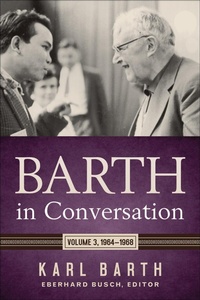
Barth in Conversation
Description

In recognition of Karl Barth's stature as a theologian and public figure in the life of Europe and the West, Swiss publisher Theologischer Verlag Zurich (TVZ) published Conversations, a collection of correspondence, articles, interviews, and other short-form writings by Barth. Collected in three volumes, Conversationsreveals the depth and breadth of Barth's theological thought as well as his humor and humanity. Now, for the first time in English, the third and final volume is offered here. Volume 3 covers the period from 1964 to 1968, the year of Barth's death. As such, it represents the culmination of the great theologian's thoughts on a broad range of subjects, from the challenges of living as the church in an increasingly secular world to the distinctive joys and challenges of the pastoral vocation.
More details
Other editions
Additional editions
Persons
Karl Barth (1886-1968) was Professor of Theology at the University of Basel, Switzerland. One of the greatest theologians and preachers of the twentieth century, he is best known for his monumental systematic theology, Church Dogmatics. He is widely regarded as the most important theologian of the twentieth century, and his observations about the church and its place in a modern world continue to engage scholars of religion more than fifty years after his death.
Content
- Intro
- Half Title
- Title Page
- Copyright
- Contents
- Foreword to the German Edition
- Translators' Foreword
- Translators and Assignments
- Abbreviations
- 1. Conversation with Students at the Ecumenical Institute in Bossey (January 18, 1964)
- 2. Interview with Carl Bringer and Dietmar Schmidt (February 18, 1964)
- 3. Interview with Dietmar Schmidt (February 18, 1964)
- 4. Interview with Heiner Lichtenstein (February 24, 1964)
- 5. Conversation in the Bruderholzkapelle (February 24, 1964)
- 6. Discussion with Students from the Tübingen Stift (March 2, 1964)
- 7. Response to Beat Hirt (April 16, 1964)
- 8. Interview by Hans A. Fischer-Barnicol (May 5, 1964)
- 9. Interview by Sven Findeisen (May 26, 1964)
- 10. Interview by Carl F. H. Henry (May 30, 1964)
- 11. Interview by Ulrich Hedinger (June 10, 1964)
- 12. Conversation with Pastors from St. Gallen (June 17, 1964)
- 13. Interview by George Puchinger (April 15, 1965)
- 14. Interview with Henri-Charles Tauxe (April 20, 1965)
- 15. Conversation with Students of Applied Arts (February 1, 1966)
- 16. Interview with Manfred Linz (March 23, 1966)
- 17. Interview with the German-Swiss Broadcasting Corporation (March 31, 1966)
- 18. Interview by Gottfried Edel (April 20, 1966)
- 19. Interview with Freddy Klopfenstein (April 30, 1966)
- 20. Interview by Heinz Knorr and Rudolf Rohlinger (May 2, 1966)
- 21. Interview with Wolfgang Pabst (beginning of May, 1966)
- 22. Conversation with a "Barth Working Group" (June 7, 1966)
- 23. Conversation in the Titus Congregation in Basel (June 21, 1966)
- 24. Conversation with Michael Wyschogrod (August 19, 1966)
- 25. Conversation with Milan Machovec (October 17, 1966)
- 26. Conversation with Hébert Roux, Jean Bosc, and Georges Casalis (November 2, 1966)
- 27. Conversation with the "Circle of Helpers" of the Titus Church in Basel (January 10, 1967)
- 28. Conversation with Students of the Ecumenical Institute in Bossey (January 23, 1967)
- 29. Conversation in the Bruder Klaus Parish in Basel (March 15, 1967)
- 30. Conversation with the Maria Stein Circle (June 14, 1967)
- 31. Conversation with Polish Christians (September 13, 1967)
- 32. Barth's Remarks during the "Parrhesia"-Conference (October 22/23, 1967)
- 33. Conversation with Representatives of the YMCA, Südbaden (October 30, 1967)
- 34. Conversation with Professor Kolping and Catholic Students (December 11, 1967)
- 35. Conversation with Mennonites (December 13, 1967)
- 36. Conversation at the Church Theological School in Basel (December 21, 1967)
- 37. Conversation in the Basel Brother Klaus Parish (April 3, 1968)
- 38. Conversation with Roman Catholic Vicars (April 24, 1968)
- 39. Interview with Werner Rings (June 24, 1968)
- 40. Conversation with Seigi Yoshinaga (June 24, 1968)
- 41. Conversation with the Titus Congregation in Basel (June 25, 1968)
- 42. Conversation with Wuppertal Theology Students (July 1, 1968)
- 43. Interview by Sergio Bologna (July 9, 1968)
- 44. Interview by Roswitha Schmalenbach (September 17, 1968)
- 45. Interview by Alfred Blatter (October 24, 1968)
- 46. Conversation with Albrecht Goes (November 29, 1968)
- 47. Conversation with Erich Leinert (December 9, 1968)
- 48. Conversation with Eduard Thurneysen (December 9, 1968)
- Index of Bible References
- Index of Names
- Index of Subjects
