

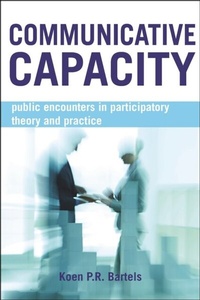
Communicative Capacity
Public Encounters in Participatory Theory and Practice
1st Edition
Published on 1. June 2016
304 pages
978-1-4473-3456-9 (ISBN)
Description

Participatory democracy has become an unshakable norm and its practice is widespread. Nowadays, public professionals and citizens regularly encounter each other in participatory practice to address shared problems. But while the frequency, pace and diversity of their public encounters has increased, communicating in participatory practice remains a challenging, fragile and demanding undertaking that often runs astray.
This unique book explores how citizens and public professionals communicate, why this is so difficult and what could lead to more productive conversations. Using timely, original empirical research to make a thorough comparative analysis of cases in the United Kingdom, the Netherlands and Italy it shows policy makers, practitioners, students and academics the value of communicative capacity.
This unique book explores how citizens and public professionals communicate, why this is so difficult and what could lead to more productive conversations. Using timely, original empirical research to make a thorough comparative analysis of cases in the United Kingdom, the Netherlands and Italy it shows policy makers, practitioners, students and academics the value of communicative capacity.
Reviews / Votes
"Advancing the communicative planning debate, Bartels examines neighbourhood case studies in Glasgow, Amsterdam and Bologna to show how diverse habits and presumptions in public encounters shape powerful practices of dialogue, debate and deliberation." John Forester, Cornell University "This book, which is both conceptually rich and practically useful, should be obligatory reading for citizens, public officials and policy analysts for years to come." Hendrik Wagenaar, The University of Sheffield.More details
Edition
First Edition
Language
English
Place of publication
Bristol
United Kingdom
Publishing group
Bristol University Press
Target group
Professional and scholarly
Illustrations
Not illustrated
File size
9,62 MB
ISBN-13
978-1-4473-3456-9 (9781447334569)
Copyright in bibliographic data and cover images is held by Nielsen Book Services Limited or by the publishers or by their respective licensors: all rights reserved.
Schweitzer Classification
Other editions
Additional editions
Book
07/2015
1st Edition
Policy Press
€102.90
Shipment within 15-20 days
E-Book
07/2015
1st Edition
Policy Press
€231.99
Available for download
Person
Koen Bartels is Lecturer in Management Studies at Bangor University (Wales), where he teaches courses in public administration and qualitative research. His research interests are social and democratic innovation, urban governance, participatory democracy, practice, communication, sociology of knowledge and interpretive policy analysis. He has published on public encounters, communicative capacity, practice, volunteering, leadership and action research in various public administration and public policy journals.
Content
Introduction: Communicating in participatory practice;
Public encounters in participatory democracy: toward communicative capacity;
Studying narratives of participatory practice;
Communicative patterns: what happens when public professionals and citizens meet;
Work in progress: engaging with the situation;
Struggling: discussing the substantive issues at hand;
Making connections: building and maintaining relationships;
Conclusion: communicative capacity in participatory theory and practice;
Recommendations: communicative capacity in practice and policy.
Public encounters in participatory democracy: toward communicative capacity;
Studying narratives of participatory practice;
Communicative patterns: what happens when public professionals and citizens meet;
Work in progress: engaging with the situation;
Struggling: discussing the substantive issues at hand;
Making connections: building and maintaining relationships;
Conclusion: communicative capacity in participatory theory and practice;
Recommendations: communicative capacity in practice and policy.
