

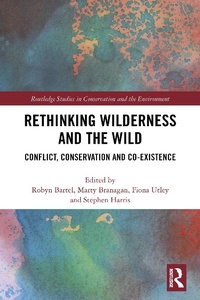
Rethinking Wilderness and the Wild
Conflict, Conservation and Co-existence
1st Edition
Published on 29. October 2020
316 pages
978-1-000-21507-6 (ISBN)
Description

Rethinking Wilderness and the Wild: Conflict, Conservation and Co-existence examines the complexities surrounding the concept of wilderness.
Contemporary wilderness scholarship has tended to fall into two categories: the so-called 'fortress conservation' and 'co-existence' schools of thought. This book, contending that this polarisation has led to a silencing and concealment of alternative perspectives and lines of enquiry, extends beyond these confines and in particular steers away from the dilemmas of paradise or paradox in order to advance an intellectual and policy agenda of plurality and diversity rather than of prescription and definition. Drawing on case studies from Australia, Aoteoroa/New Zealand, the United States and Iceland, and explorations of embodied experience, creative practice, philosophy, and First Nations land management approaches, the assembled chapters examine wilderness ideals, conflicts and human-nature dualities afresh, and examine co-existence and conservation in the Anthropocene in diverse ontological and multidisciplinary ways. By demonstrating a strong commitment to respecting the knowledge and perspectives of Indigenous peoples, this work delivers a more nuanced, ethical and decolonising approach to issues arising from relationships with wilderness. Such a collection is immediately appropriate given the political challenges and social complexities of our time, and the mounting threats to life across the globe. The abiding and uniting logic of the book is to offer a unique and innovative contribution to engender transformations of wilderness scholarship, activism and conservation policy. This text refutes the inherent privileging and exclusionary tactics of dominant modes of enquiry that too often serve to silence non-human and contrary positions. It reveals a multi-faceted and contingent wilderness alive with agency, diversity and possibility.
This book will be of great interest to students and scholars of conservation, environmental and natural resource management, Indigenous studies and environmental policy and planning. It will also be of interest to practitioners, policymakers and NGOs involved in conservation, protected environments and environmental governance.
Contemporary wilderness scholarship has tended to fall into two categories: the so-called 'fortress conservation' and 'co-existence' schools of thought. This book, contending that this polarisation has led to a silencing and concealment of alternative perspectives and lines of enquiry, extends beyond these confines and in particular steers away from the dilemmas of paradise or paradox in order to advance an intellectual and policy agenda of plurality and diversity rather than of prescription and definition. Drawing on case studies from Australia, Aoteoroa/New Zealand, the United States and Iceland, and explorations of embodied experience, creative practice, philosophy, and First Nations land management approaches, the assembled chapters examine wilderness ideals, conflicts and human-nature dualities afresh, and examine co-existence and conservation in the Anthropocene in diverse ontological and multidisciplinary ways. By demonstrating a strong commitment to respecting the knowledge and perspectives of Indigenous peoples, this work delivers a more nuanced, ethical and decolonising approach to issues arising from relationships with wilderness. Such a collection is immediately appropriate given the political challenges and social complexities of our time, and the mounting threats to life across the globe. The abiding and uniting logic of the book is to offer a unique and innovative contribution to engender transformations of wilderness scholarship, activism and conservation policy. This text refutes the inherent privileging and exclusionary tactics of dominant modes of enquiry that too often serve to silence non-human and contrary positions. It reveals a multi-faceted and contingent wilderness alive with agency, diversity and possibility.
This book will be of great interest to students and scholars of conservation, environmental and natural resource management, Indigenous studies and environmental policy and planning. It will also be of interest to practitioners, policymakers and NGOs involved in conservation, protected environments and environmental governance.
More details
Series
Edition
1. Auflage
Language
English
Place of publication
London
United Kingdom
Publishing group
Taylor & Francis Ltd
Target group
College/higher education
Illustrations
4 Tables, black and white; 2 Line drawings, black and white; 3 Halftones, black and white; 5 Illustrations, black and white
ISBN-13
978-1-000-21507-6 (9781000215076)
Copyright in bibliographic data and cover images is held by Nielsen Book Services Limited or by the publishers or by their respective licensors: all rights reserved.
Schweitzer Classification
Other editions
Additional editions
Robyn Bartel | Marty Branagan | Fiona Utley
Rethinking Wilderness and the Wild
Conflict, Conservation and Co-existence
Book
08/2022
1st Edition
Routledge
€65.80
Shipment within 15-20 days
Robyn Bartel | Marty Branagan | Fiona Utley
Rethinking Wilderness and the Wild
Conflict, Conservation and Co-existence
Book
10/2020
1st Edition
Routledge
€206.10
Shipment within 15-20 days
Rethinking Wilderness and the Wild
Conflict, Conservation and Co-Existence
Book
10/2020
Taylor & Francis
Unfortunately, price unknown
Available (delivery time upon request)
Persons
Robyn Bartel is an Associate Professor at the University of New England, Australia. She is the lead editor of Water Policy, Imagination and Innovation: Interdisciplinary Approaches (Routledge, 2018).
Marty Branagan is a Senior Lecturer at the University of New England, Australia. He is the author of Global Warming, Militarism and Nonviolence: The Art of Active Resistance (2013).
Fiona Utley is a Senior Lecturer at the University of New England, Australia. Her research, publications and international conference presentations explore phenomenological perspectives on identity, trauma, and embodiment.
Stephen Harris is a Lecturer at the University of New England, Australia. He is one of the co-editors of Water Policy, Imagination and Innovation: Interdisciplinary Approaches (Routledge, 2018).
Marty Branagan is a Senior Lecturer at the University of New England, Australia. He is the author of Global Warming, Militarism and Nonviolence: The Art of Active Resistance (2013).
Fiona Utley is a Senior Lecturer at the University of New England, Australia. Her research, publications and international conference presentations explore phenomenological perspectives on identity, trauma, and embodiment.
Stephen Harris is a Lecturer at the University of New England, Australia. He is one of the co-editors of Water Policy, Imagination and Innovation: Interdisciplinary Approaches (Routledge, 2018).
Content
Part 1. What is wilderness? The stories we tell 1. Wilderness in Literature and Culture: Changing perceptions of the relationship with 'country' 2. Evolving values of wilderness in the Age of Extinction: Environmental campaigning in Australia 3. Collaborative Wilderness Preservation and the Franklin River Campaign: Environmentalists, Aboriginal People and the Creative Arts 4. The Wilderness experience in National Parks: A case study of Boonoo Boonoo National Park 5. Aboriginal owned and jointly managed national parks: Caring for cultural imperatives and conservation outcomes 6. Changing Attitudes towards Wilderness in Aotearoa/New Zealand: From Disappointment to Glorification and Guardianship Part 2. The how of wilderness: Relationships and reciprocity 7. Reimagining wilderness and the wild in Australia in the wake of bushfires 8. Human Engagement in Place-Care: Back from the Wilderness 9. Botanical Wilderness Narratives: Plant Intelligence and Shifting Perceptions of the Botanical World 10. People as purposeful and conscientious resource stewards: Human Agency in a World Gone Wild 11. Exploring wilderness in Iceland: Charting meaningful encounters with uninhabited lands Part 3. The why of wilderness: New and different wilds 12. Wilderness Triumphant: Beyond Romantic Nature, Settlement and Agriculture 13. The future of wilderness in the Anthropocene and beyond: Wild machinations 14. Rewilding as an expression of love: philosophical perspectives on human engagement 15. From Wilderness Preservation to the Fight for Lawlands: Towards a Revisioning of Conservation 16. Rupturing the Western concept of wilderness: restoring human relationships with place and nature
