

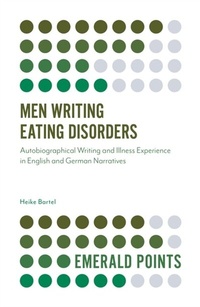
Men Writing Eating Disorders
Autobiographical Writing and Illness Experience in English and German Narratives
1st Edition
Published on 4. December 2020
184 pages
978-1-83909-922-9 (ISBN)
Description

Eating disorders are situated at the complex interface of biology, medicine, culture, society, and politics, and are seen differently from each perspective. This book brings together discussions of eating, food, gender, sexuality and mental health through analysis of published autobiographical narratives authored by men with experience of living with one of the main eating disorders (anorexia nervosa, bulimia nervosa and binge-eating disorder) as well as associated mental health problems such as body dysmorphic disorder and depression. Written by a literary scholar, the book speaks with authority on the value of literary narratives for much-needed qualitative research and training on the lived experience of eating disorders in men.
With its transnational and comparative focus on texts from the US, UK, Germany, and Austria, Men Writing Eating Disorders will appeal to readers working across the arts and humanities and science disciplines. Its interdisciplinary approach offers new insights for readers interested in autobiography, illness narratives, Gender Studies and Critical Masculinity Studies; for scholars keen to explore the nexus of the arts, humanities and sciences within the emerging disciplines of Health Humanities and Medical Humanities; and for healthcare professionals and clinical researchers who recognize the importance of personal narratives in training and practice.
With its transnational and comparative focus on texts from the US, UK, Germany, and Austria, Men Writing Eating Disorders will appeal to readers working across the arts and humanities and science disciplines. Its interdisciplinary approach offers new insights for readers interested in autobiography, illness narratives, Gender Studies and Critical Masculinity Studies; for scholars keen to explore the nexus of the arts, humanities and sciences within the emerging disciplines of Health Humanities and Medical Humanities; and for healthcare professionals and clinical researchers who recognize the importance of personal narratives in training and practice.
Reviews / Votes
I read this fascinating study in a single sitting. Heike Bartel's Men Writing Eating Disorders probes a little-known but devastating issue with superlative care: illuminating the link between autobiographical writing in English and German, and attempts by men to chart their experiences of eating disorders; but also showing the vital role that literature can play in uncovering this largely taboo illness. This text brings to our attention a striking modern literary corpus and shows what a powerful tool literary research can be in the growing field of Medical Humanities. -- Karen Leeder, Professor of Modern German Literature, Fellow of New College, University of Oxford, UK This important book challenges typical perspectives on eating disorders. It reveals the traps and opportunities in literature and language to represent or misrepresent those who suffer this distressing condition-men as well as women. Men Writing Eating Disorders unlocks an important door to a more inclusive gender perception. -- Professor Paul Crawford, Institute of Mental Health at the University of Nottingham, UK As an area often neglected and under-recognised, this book provides an in-depth look at male eating disorders in a way that blends psychology, arts and the voice of those who have lived with an eating disorder. A truly unique gem that captures a part of the eating disorder experience that is missing from many accounts already out there. -- Una Foye, Institute of Psychiatry, Psychology and Neuroscience at King's College London, UK This important book brings a transdisciplinary gaze to understanding eating disorders in men. The exploration of these experiences through the lens of 21 personal narratives illuminates the cultural, social and clinical implications of this neglected area. The gendered construction of eating disorders, the process of autobiographical writing and the links with illness narratives are all expertly discussed. The book advances the field of medical and health humanities, and will be of interest to literary scholars, narrative and identity researchers, and clinicians working with eating disorders. -- Professor Mike Slade, Professor of Mental Health Recovery & Social Inclusion at the University of Nottingham, UK 'Heike Bartel's Men Writing Eating Disorders: Autobiographical Writing and Illness Experience in English and German Narratives offers an exemplary model how the humanities - I prefer the term "the human sciences"- can engage with and, indeed, teach the nomological ("law-like") sciences and the practical pedagogy of biomedicine... [The book] will go a long way in teaching physicians, healthcare systems, and - perhaps most importantly - "individuals who are living with an eating disorder" and "also [their] brothers, fathers, friends, and lovers" that the pain and suffering that imbues their lives are real, command acknowledgment, and mandate therapies and treatment... I can think of no better achievement for the humanities than to contribute to our general well-being in the way that Men Writing Eating Disorders does with such mastery. It is a book that has the potential to enlarge our compassion, to learn from the suffering and joy of others, and to discover strategies to alleviate pain and foster a good life (the work of phronesis). It is a book that will make our world better.' -- Ronald SchleiferMore details
Series
Language
English
Place of publication
Bingley
United Kingdom
Target group
Professional and scholarly
File size
1,40 MB
ISBN-13
978-1-83909-922-9 (9781839099229)
Copyright in bibliographic data and cover images is held by Nielsen Book Services Limited or by the publishers or by their respective licensors: all rights reserved.
Schweitzer Classification
Other editions
Additional editions
Heike Bartel
Men Writing Eating Disorders
Autobiographical Writing and Illness Experience in English and German Narratives
Book
12/2020
Emerald Publishing Limited
€68.80
Shipment within 3-4 weeks
Person
Heike Bartel is Associate Professor of German at the University of Nottingham, UK. She has published extensively on eighteenth-century and contemporary literature and poetry, women's writing and narrative perspectives. Her interdisciplinary research focuses on narratives of lived experiences of illness. She is leading AHRC- and Wellcome-funded collaborative projects in the field.
Content
Chapter 1. Eating Disorders and Men
Chapter 2. Constructing Eating Disorders
Chapter 3. Written on the Body
Chapter 4. Autobiographical Writing
Chapter 5. Writing for Healthcare;
Chapter 2. Constructing Eating Disorders
Chapter 3. Written on the Body
Chapter 4. Autobiographical Writing
Chapter 5. Writing for Healthcare;
