

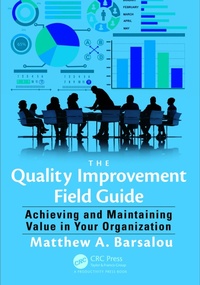
The Quality Improvement Field Guide
Achieving and Maintaining Value in Your Organization
Published on 28. September 2017
208 pages
978-1-040-18107-2 (ISBN)
Description

The Quality Improvement Field Guide: Achieving and Maintaining Value in Your Organization covers the key aspects that quality professionals must know to attain mastery in their field. After reading this book, readers will not only gain an understanding of the key quality improvement concepts, but will gain the practical insight required to implement them correctly.
The book starts with a brief history of quality and quality management, including the necessary quality documents. It describes key quality standards, including ISO 9001:2008, the upcoming ISO 9001:2015, and ISO 9004:2008. Next, it explores quality deployment concepts such as capturing the voice of the customer, the Kano model, quality function deployment, and quality policy deployment. SMART goals, SWOT analysis, and key process indicators are also addressed.
The book covers the seven classic quality tools: flowchart, Ishikawa diagram, Pareto diagram, scatter diagram, histogram, check sheet, and run chart. It also identifies the seven new management and planning tools: affinity diagram, tree diagram, process decision program chart, matrix diagram, prioritization matrix, interrelationship digraph, and activity network diagram.
Presenting methods for failure prevention and detection, the text explores measurement system analysis, gage repeatability and reproducibility studies, and the basics of maintaining a calibration system. It examines the various aspects of continuous quality improvement, complaints management, and the use of 8D reports for reporting on failures.
The book describes the four types of measurement scales and various measuring devices a quality professional may encounter and also contains a glossary that explains the basic quality-related terminology. Describing each quality method with sufficient detail so that readers can immediately apply them, this book is an ideal guide for anyone new to the field of quality as well as experienced quality professionals who need a quick overview.
The book starts with a brief history of quality and quality management, including the necessary quality documents. It describes key quality standards, including ISO 9001:2008, the upcoming ISO 9001:2015, and ISO 9004:2008. Next, it explores quality deployment concepts such as capturing the voice of the customer, the Kano model, quality function deployment, and quality policy deployment. SMART goals, SWOT analysis, and key process indicators are also addressed.
The book covers the seven classic quality tools: flowchart, Ishikawa diagram, Pareto diagram, scatter diagram, histogram, check sheet, and run chart. It also identifies the seven new management and planning tools: affinity diagram, tree diagram, process decision program chart, matrix diagram, prioritization matrix, interrelationship digraph, and activity network diagram.
Presenting methods for failure prevention and detection, the text explores measurement system analysis, gage repeatability and reproducibility studies, and the basics of maintaining a calibration system. It examines the various aspects of continuous quality improvement, complaints management, and the use of 8D reports for reporting on failures.
The book describes the four types of measurement scales and various measuring devices a quality professional may encounter and also contains a glossary that explains the basic quality-related terminology. Describing each quality method with sufficient detail so that readers can immediately apply them, this book is an ideal guide for anyone new to the field of quality as well as experienced quality professionals who need a quick overview.
Reviews / Votes
"New to quality? Read this."-Forrest Breyfogle III, Smatter Solutions, Inc.
"Matt Barsalou has added another 'must-have' text to the list of a quality professional's library of holdings. He has provided some highly-relevant topics not found in other quality texts and his inclusion of a 28-page ASQ glossary and six pages of references substantially add to the value of the book."
-Jack B. ReVelle, Ph.D., ReVelle Solutions, LLC
More details
Language
English
Place of publication
London
United Kingdom
Publishing group
Taylor & Francis Ltd
Target group
Professional and scholarly
File size
6,70 MB
ISBN-13
978-1-040-18107-2 (9781040181072)
Copyright in bibliographic data and cover images is held by Nielsen Book Services Limited or by the publishers or by their respective licensors: all rights reserved.
Schweitzer Classification
Other editions
Additional editions

Matthew A. Barsalou
The Quality Improvement Field Guide
Achieving and Maintaining Value in Your Organization
Book
09/2017
1st Edition
CRC Press
€267.85
Shipment within 10-20 days
Matthew A. Barsalou
The Quality Improvement Field Guide
Achieving and Maintaining Value in Your Organization
Book
11/2015
1st Edition
Productivity Press
€52.30
Shipment within 15-20 days
Content
An Introduction to Quality. Quality Management. Quality Deployment. Quality Tools. Failure Prevention and Detection. Measurement System Analysis. Statistics for Quality Control. Continuous Quality Improvement. Complaints Management. Measuring Devices. References. Glossary. Index.
