

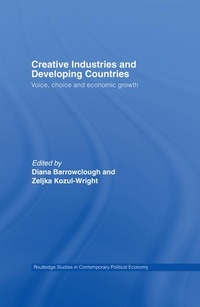
Creative Industries and Developing Countries
Voice, Choice and Economic Growth
1st Edition
Published on 12. November 2012
352 pages
978-1-136-79317-2 (ISBN)
Description

Pushing the frontiers of the new development paradigm, this book guides debates, clarifies new themes and illustrates how the cultural resources of the developing world can become a new way of integrating into the global economy - helping to raise the voices of developing countries, widening the range of creative choices and promoting cultural diversity and economic and human development.
Mixing theory, country case-studies and policy analysis this volume argues that developing countries can use their creative assets and energies as a source of economic growth - if they can better position themselves in the global economy, turning on its head the polarized debate about commerce and culture to take a fresh look at some traditional activities whose intrinsic cultural value has for too long hidden their economic worth.
It includes essays from economists, lawyers and industry experts on global trade trends; digital-technology; film in West Africa; audio visuals in India; the music industry in Brazil and the Caribbean; the copyright industry in Arab countries, and policy lessons from developed countries - including sources of finance, subsidies and the role of incubators and intermediaries.
Fresh and incisive, this policy lead book on one of the world's fastest growing sectors is an invaluable resource for to economists and policy-makers alike, as well as those with an interest in industrial organization, development policy, evolutionary economics and the creative industries.
Mixing theory, country case-studies and policy analysis this volume argues that developing countries can use their creative assets and energies as a source of economic growth - if they can better position themselves in the global economy, turning on its head the polarized debate about commerce and culture to take a fresh look at some traditional activities whose intrinsic cultural value has for too long hidden their economic worth.
It includes essays from economists, lawyers and industry experts on global trade trends; digital-technology; film in West Africa; audio visuals in India; the music industry in Brazil and the Caribbean; the copyright industry in Arab countries, and policy lessons from developed countries - including sources of finance, subsidies and the role of incubators and intermediaries.
Fresh and incisive, this policy lead book on one of the world's fastest growing sectors is an invaluable resource for to economists and policy-makers alike, as well as those with an interest in industrial organization, development policy, evolutionary economics and the creative industries.
Reviews / Votes
". . . the book provides important information . . . is undeniably an invaluable resource. I heartily recommend it to all: cultural professionals, economists and policy makers, as well as those interested in industrial organization, development policy, evolutionary economics and the creative industries."- Komlan Agbo, in Journal of Cultural Economics, 2009, Vol. 33
More details
Series
Language
English
Place of publication
London
United Kingdom
Publishing group
Taylor & Francis Ltd
Target group
College/higher education
Product notice
Reflowable
File size
4,34 MB
ISBN-13
978-1-136-79317-2 (9781136793172)
Copyright in bibliographic data and cover images is held by Nielsen Book Services Limited or by the publishers or by their respective licensors: all rights reserved.
Schweitzer Classification
Other editions
Additional editions

Diana Barrowclough | Zeljka Kozul-Wright
Creative Industries and Developing Countries
Voice, Choice and Economic Growth
Book
11/2011
1st Edition
Routledge
€72.10
Shipment within 15-20 days
Diana Barrowclough | Zeljka Kozul-Wright
Creative Industries and Developing Countries
Voice, Choice and Economic Growth
Book
09/2007
Routledge
€242.60
Shipment within 15-20 days
Persons
Diana Barrowclough and Zeljka Kozul-Wright are based at the United Nations Conference on Trade and Development (UNCTAD) in Geneva, Switzerland.
Content
Section 1: Voice, Choice and Growth 1. Voice, Choice and Growth through Creative Industries: Towards a New Development Agenda Section 2: Prospects and Perils 2. Opportunities Presented and Threats Posed by the Digital Production/Distribution Revolution 3. Financing Creative Industries in Developing Country Contexts 4. Film Culture and Industry in Burkina Faso 5. The Music Industry and its Potential Role in Local Economic Development: The Case of Senegal 6. The Sounds of Brazil: The Popular Music and the Music Industry 7. The Audio-visual Sector in India 8. Copyright-based Industries in Arab Countries 9. The IPRs and the Music Industry in the Caribbean Section 3: Policy Responses 10. Promoting Creative Industries: Public Policies in Support of Film, Music and Broadcasting 11. Targeting Creativity through the Intermediary: Regional and Local Approaches in the UK and Beyond 12. The Policy Parameters
