

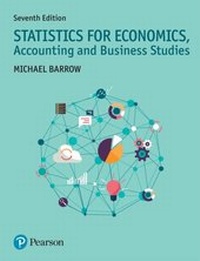
Statistics for Economics, Accounting and Business Studies eBook PDF
Description

Statistics for Economics, Accounting, and Business Studies, 7th Edition by Michael Barrow is a user-friendly, comprehensive introduction to the subject, offering a variety of statistical tools and techniques that will help you build your skills and knowledge in Mathematics and Economics.
Ideal for students of economics and the closely related disciplines of accountancy, finance, and business, this is an easy-to-follow text that does not require prior knowledge of Statistics. The book guides you through the essential principles of the field and provides a thorough analysis of statistical concepts and methods.
This latest edition will offer you new and updated content regarding topics, such as statistical reports, graphs, and hypothesis testing. The text also includes updates to demonstrate recent examples and real-life data.
With a plethora of features to support, practice, and test your understanding of the discipline, this essential learning resource will help you solve real-life economic problems, providing an insight into the relationship between statistical techniques and relevant concepts.
All prices
More details
Other editions
New editions
Additional editions
Person
Michael Barrow is a Senior Lecturer in Economics at the University of Sussex. He has acted as a consultant for major, industrial, commercial and government bodies
Content
- Descriptive statistics
- Learning outcomes
- Introduction
- Summarising data using graphical techniques
- Looking at cross-section data: wealth in the UK in 2005
- Summarising data using numerical techniques
- The box and whiskers diagram
- Time-series data: investment expenditures 1977-2009
- Graphing bivariate data: the scatter diagram
- Data transformations
- The information and data explosion
- Writing statistical reports
- Guidance to the student: how to measure your progress
- Chapter summary
- Key terms and concepts
- Problems
- Answers to Exercises
- Appendix 1A: S notation
- Problems on S notation
- Appendix 1B: E and V operators
- Appendix 1C: Using logarithms
- Problems on logarithms
- References
- Probability
- Learning outcomes
- Probability theory and statistical inference
- The definition of probability
- Probability theory: the building blocks
- Bayes' theorem
- Decision analysis
- Chapter summary
- Key terms and concepts
- Problems
- Answers to Exercises
- Probability distributions
- Learning outcomes
- Introduction
- Random variables
- The Binomial distribution
- The Normal distribution
- The distribution of the sample mean
- The relationship between the Binomial and Normal distributions
- The Poisson distribution
- Chapter summary
- Key terms and concepts
- Problems
- Answers to Exercises
- Estimation and confidence intervals
- Learning outcomes
- Introduction
- Point and interval estimation
- Rules and criteria for finding estimates
- Estimation with large samples
- Precisely what is a confidence interval?
- Estimation with small samples: the t distribution
- Chapter summary
- Key terms and concepts
- Problems
- Answers to Exercises
- Appendix: Derivations of sampling distributions
- Hypothesis testing
- Learning outcomes
- Introduction
- The concepts of hypothesis testing
- The Prob-value approach
- Significance, effect size and power
- Further hypothesis tests
- Hypothesis tests with small samples
- Are the test procedures valid?
- Hypothesis tests and confidence intervals
- Independent and dependent samples
- Issues with hypothesis testing
- Chapter summary
- Key terms and concepts
- Problems
- Answers to Exercises
- The c2 and F distributions
- Learning outcomes
- Introduction
- The c2 distribution
- The F distribution
- Analysis of variance
- Chapter summary
- Key terms and concepts
- Problems
- Answers to Exercises
- Appendix: Use of c2 and F distribution tables
- Correlation and regression
- Learning outcomes
- Introduction
- What determines the birth rate in developing countries?
- Correlation
- Regression analysis
- Inference in the regression model
- Chapter summary
- Key terms and concepts
- Problems
- Answers to Exercises
- References
- Multiple regression
- Learning outcomes
- Introduction
- Principles of multiple regression
- What determines imports into the UK?
- Finding the right model
- Chapter summary
- Key terms and concepts
- Problems
- Answers to Exercises
- References
- Data collection and sampling methods
- Learning outcomes
- Introduction
- Using secondary data sources
- Collecting primary data
- Random sampling
- Calculating the required sample size
- Collecting the sample
- Case study: the UK Living Costs and Food Survey
- Chapter summary
- Key terms and concepts
- Problems
- References
- Index numbers
- Learning outcomes
- Introduction
- A simple index number
- A price index with more than one commodity
- Using expenditures as weights
- Quantity and expenditure indices
- The Consumer Price Index
- Discounting and present values
- Inequality indices
- The Lorenz curve
- The Gini coefficient
- Concentration ratios
- Chapter summary
- Key terms and concepts
- Problems
- Answers to Exercises
- Appendix: deriving the expenditure share form of the
- Laspeyres price index
- References
- Seasonal adjustment of time series data
- Learning outcomes
- Introduction
- The components of a time series
- Isolating the trend
- Isolating seasonal factors
- Seasonal adjustment
- An alternative method for finding the trend
- Forecasting
- Further issues
- Chapter summary
- Key terms and concepts
- Problems
- Answers to Exercises
