

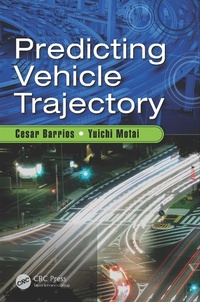
Predicting Vehicle Trajectory
Published on 3. March 2017
204 pages
978-1-138-03162-3 (ISBN)
Description

This book concentrates on improving the prediction of a vehicle's future trajectory, particularly on non-straight paths. Having an accurate prediction of where a vehicle is heading is crucial for the system to reliably determine possible path intersections of more than one vehicle at the same time. The US DOT will be mandating that all vehicle manufacturers begin implementing V2V and V2I systems, so very soon collision avoidance systems will no longer rely on line of sight sensors, but instead will be able to take into account another vehicle's spatial movements to determine if the future trajectories of the vehicles will intersect at the same time. Furthermore, the book introduces the reader to some improvements when predicting the future trajectory of a vehicle and presents a novel temporary solution on how to speed up the implementation of such V2V collision avoidance systems. Additionally, it evaluates whether smartphones can be used for trajectory predictions, in an attempt to populate a V2V collision avoidance system faster than a vehicle manufacturer can.
Reviews / Votes
"I found specifically very important in this book the research conducted by the authors to properly handle error accumulation from missing data from offline sensors, and running the system at the fastest rate possible greatly reducing the prediction errors in non-straight paths (which are the harder task to predict). Moreover, I found very interesting the idea of using every-day equipment (smartphones) as a temporary (yet effective) solution to enable older vehicles to V2V and V2I technologies. It is also very important that the evaluation revealed that, in some cases, the smartphone prediction errors are similar to more expensive sensors in V2I. This book addresses solutions specifically for improved trajectory prediction in traffic networks. There is no question that this short book may be a valuable handbook for engineers, especially those who work on the specific problem trying to engage as much as possible users/vehicles in the V2V or V2I ecosystem."-IEEE Intelligent Transportation Systems Magazine, Fall 2017
More details
Language
English
Place of publication
London
United Kingdom
Publishing group
Taylor & Francis Ltd
Target group
College/higher education
Professional and scholarly
Illustrations
21 s/w Tabellen, 8 s/w Photographien bzw. Rasterbilder, 2 Farbfotos bzw. farbige Rasterbilder, 14 s/w Zeichnungen, 18 farbige Zeichnungen
21 Tables, black and white; 18 Line drawings, color; 14 Line drawings, black and white; 2 Halftones, color; 8 Halftones, black and white
File size
6,98 MB
ISBN-13
978-1-138-03162-3 (9781138031623)
Copyright in bibliographic data and cover images is held by Nielsen Book Services Limited or by the publishers or by their respective licensors: all rights reserved.
Schweitzer Classification
Other editions
Additional editions
Cesar Barrios | Yuichi Motai
Predicting Vehicle Trajectory
Book
09/2020
1st Edition
CRC Press
€100.40
Shipment within 15-20 days
Cesar Barrios | Yuichi Motai
Predicting Vehicle Trajectory
Book
03/2017
1st Edition
CRC Press
€178.27
Article not available at the moment
Persons
Cesar Barrios received a B.S. (1999) and an M.S. (2001) in electrical engineering from the New Jersey Institute of Technology, and a Ph.D. degree (2014) in electrical engineering from the University of Vermont. He worked for IBM after graduating with his B.S. degree in 1999, and since 2015 he has been working for GLOBALFOUNDRIES. He began in the Information Technology field andhas sincemoved into Semiconductor Research and Development.
Yuichi Motai received his B.Eng. degree in instrumentation engineering from Keio University, Tokyo, Japan, in 1991, his M.Eng. degree in applied systems science from Kyoto University, Kyoto, Japan, in 1993, and his Ph.D. degree in electrical and computer engineering from Purdue University, West Lafayette, IN, U.S.A., in 2002. He is currently an Associate Professor of Electrical and Computer Engineering at Virginia Commonwealth University, Richmond, VA, USA. His research interests include the broad area of sensory intelligence (particularly in intelligent vehicle), pattern recognition, computer vision, and sensory-based robotics.
Yuichi Motai received his B.Eng. degree in instrumentation engineering from Keio University, Tokyo, Japan, in 1991, his M.Eng. degree in applied systems science from Kyoto University, Kyoto, Japan, in 1993, and his Ph.D. degree in electrical and computer engineering from Purdue University, West Lafayette, IN, U.S.A., in 2002. He is currently an Associate Professor of Electrical and Computer Engineering at Virginia Commonwealth University, Richmond, VA, USA. His research interests include the broad area of sensory intelligence (particularly in intelligent vehicle), pattern recognition, computer vision, and sensory-based robotics.
Content
Preface. Improving Estimation of Vehicle's Trajectory Using Latest Global Positioning System with Kalman Filtering. Intelligent Forecasting Using Dead Reckoning with Dynamic Errors. Trajectory Estimations Using Smartphones. Summary of Vehicle Trajectories' Prediction Methods Evaluated. Conclusions. Appendix.
