

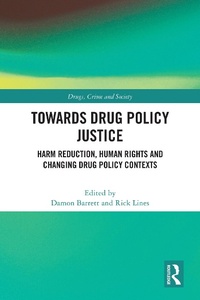
Towards Drug Policy Justice
Harm Reduction, Human Rights and Changing Drug Policy Contexts
1st Edition
Published on 19. December 2023
218 pages
978-1-003-82960-7 (ISBN)
Description

Taking the shifting global drug policy terrain as a starting point, this collection moves beyond debates about whether to reform drug policies to a focus on delivering 'drug policy justice' - repairing the damage caused by the war on drugs as a component of reform efforts and safeguarding against future harms in legal markets.
This book brings together some of the leading international thinkers and advocates on harm reduction and drug policy to introduce key questions in contemporary drug policy. Across five themes, and with contributions from different regions and disciplines, it explores ethical, legal, empirical and historical perspectives on delivering 'drug policy justice' from supply through to use. Essays cover a wide range of issues, from the effects of COVID on drug policy to securing economic and environmental justice, and from human rights in Asian drug policy to questions of race and equity in cannabis reforms, providing diverse insights on both prominent and overlooked drug policy challenges.
Towards Drug Policy Justice is a benchmark text for scholars, students, advocates and policymakers as the book explores new models of global drug policy reform.
This book brings together some of the leading international thinkers and advocates on harm reduction and drug policy to introduce key questions in contemporary drug policy. Across five themes, and with contributions from different regions and disciplines, it explores ethical, legal, empirical and historical perspectives on delivering 'drug policy justice' from supply through to use. Essays cover a wide range of issues, from the effects of COVID on drug policy to securing economic and environmental justice, and from human rights in Asian drug policy to questions of race and equity in cannabis reforms, providing diverse insights on both prominent and overlooked drug policy challenges.
Towards Drug Policy Justice is a benchmark text for scholars, students, advocates and policymakers as the book explores new models of global drug policy reform.
More details
Series
Edition
1. Auflage
Language
English
Place of publication
London
United Kingdom
Publishing group
Taylor & Francis Ebooks
Target group
College/higher education
Product notice
Reflowable
Illustrations
1 Tables, black and white; 5 Line drawings, black and white; 5 Illustrations, black and white
ISBN-13
978-1-003-82960-7 (9781003829607)
Copyright in bibliographic data and cover images is held by Nielsen Book Services Limited or by the publishers or by their respective licensors: all rights reserved.
Schweitzer Classification
Other editions
Additional editions
Damon Barrett | Rick Lines
Towards Drug Policy Justice
Harm Reduction, Human Rights and Changing Drug Policy Contexts
Book
05/2025
1st Edition
Routledge
€67.20
Shipment within 15-20 days
Damon Barrett | Rick Lines
Towards Drug Policy Justice
Harm Reduction, Human Rights and Changing Drug Policy Contexts
Book
12/2023
1st Edition
Routledge
€206.20
Shipment within 15-20 days
Persons
Damon Barrett is a senior lecturer in human rights at the School of Global Studies, University of Gothenburg, Sweden. He is Co-Director of the International Centre on Human Rights and Drug Policy, based at the Human Rights Centre, University of Essex. His work has focused on what it means to adopt a human rights-based approach to drugs, with a particular focus on the rights of the child.
Rick Lines is Professor of Criminology in the Faculty of Social Sciences at Swansea University in Wales, where he is Co-Director of Global Drug Policy Observatory. He has been called 'a key figure in the emerging field of human rights and drug policy' and is Chair of the International Centre of Human Rights and Drug Policy at the University of Essex and author of Drug Control and Human Rights in International Law. In 2022, he joined Public Health Wales where he leads national policy, programming and research on drug use and harm reduction.
Rick Lines is Professor of Criminology in the Faculty of Social Sciences at Swansea University in Wales, where he is Co-Director of Global Drug Policy Observatory. He has been called 'a key figure in the emerging field of human rights and drug policy' and is Chair of the International Centre of Human Rights and Drug Policy at the University of Essex and author of Drug Control and Human Rights in International Law. In 2022, he joined Public Health Wales where he leads national policy, programming and research on drug use and harm reduction.
Content
Introduction: Towards Drug Policy Justice
Damon Barrett and Rick Lines
Part I: The evolving drug policy space
Chapter 1: Towards Transformative Drug Policy Reform
Laura Garius, Imani Mason Jordan, Niamh Eastwood
Chapter 2: Drug Policy Reform and Human Rights Post-COVID-19
Kasia Malinowksa and Diederik Lohman
Chapter 3: Debunking the Three Myths About Reforming Asian Drug Policies
Michelle Miao and Gloria Lai
Part II: Tracking progress
Chapter 4: Lessons Learned from Legal Regulation of Cannabis
Zara Snapp, Jorge Herrera Valderrabano and Luis Daniel Santiago Vidargas
Chapter 5: The Regulation of Legal Drug Markets: Key Lessons from Alcohol Control Policy in Africa
Ediomo-Ubong E. Nelson and Isidore S. Obot
Chapter 6: Legal Epidemiology in Post-Prohibition Scenarios
Scott Burris, Corey S. Davis and Elizabeth Platt
Part III: Harm reduction in the changing landscape
Chapter 7: Harm Reduction Post-Prohibition
Naomi Burke-Shyne and Ajeng Larasati
Chapter 8: Can Darknet Drug Markets Be Harm Reducing? Building Decriminalised Spaces in Central and Eastern Europe and Central Asia
Eliza Kurcevic
Chapter 9: Prisoner to Patient: The Pathologisation of People Who Use Drugs
Shaun Shelly and Sonja Pasche
Part IV: Emerging rights issues at the supply side
Chapter 10: Peasants' Rights after the War on Drugs: The Case for Transformative Cannabis Regulations
Alejandro Rodriguez, Isabel Pereira and Luis Felipe Cruz
Chapter 11: Are Coca Crops Causing Deforestation in Colombia? Would a Future Regulated Market Impact the Environment?
Maria Alejandra Velez
Part V: Reckoning with the past
Chapter 12: Consensus Breakdown and Recalcitrancy in the Drug Control System - Towards Disintegration or Re-Integration?
John Collins
Chapter 13: The Last Drug Warrior in the West: UK Drug policy and shifting material interests from the Nineteenth to the Twenty-first Century
Kojo Koram
Damon Barrett and Rick Lines
Part I: The evolving drug policy space
Chapter 1: Towards Transformative Drug Policy Reform
Laura Garius, Imani Mason Jordan, Niamh Eastwood
Chapter 2: Drug Policy Reform and Human Rights Post-COVID-19
Kasia Malinowksa and Diederik Lohman
Chapter 3: Debunking the Three Myths About Reforming Asian Drug Policies
Michelle Miao and Gloria Lai
Part II: Tracking progress
Chapter 4: Lessons Learned from Legal Regulation of Cannabis
Zara Snapp, Jorge Herrera Valderrabano and Luis Daniel Santiago Vidargas
Chapter 5: The Regulation of Legal Drug Markets: Key Lessons from Alcohol Control Policy in Africa
Ediomo-Ubong E. Nelson and Isidore S. Obot
Chapter 6: Legal Epidemiology in Post-Prohibition Scenarios
Scott Burris, Corey S. Davis and Elizabeth Platt
Part III: Harm reduction in the changing landscape
Chapter 7: Harm Reduction Post-Prohibition
Naomi Burke-Shyne and Ajeng Larasati
Chapter 8: Can Darknet Drug Markets Be Harm Reducing? Building Decriminalised Spaces in Central and Eastern Europe and Central Asia
Eliza Kurcevic
Chapter 9: Prisoner to Patient: The Pathologisation of People Who Use Drugs
Shaun Shelly and Sonja Pasche
Part IV: Emerging rights issues at the supply side
Chapter 10: Peasants' Rights after the War on Drugs: The Case for Transformative Cannabis Regulations
Alejandro Rodriguez, Isabel Pereira and Luis Felipe Cruz
Chapter 11: Are Coca Crops Causing Deforestation in Colombia? Would a Future Regulated Market Impact the Environment?
Maria Alejandra Velez
Part V: Reckoning with the past
Chapter 12: Consensus Breakdown and Recalcitrancy in the Drug Control System - Towards Disintegration or Re-Integration?
John Collins
Chapter 13: The Last Drug Warrior in the West: UK Drug policy and shifting material interests from the Nineteenth to the Twenty-first Century
Kojo Koram
