

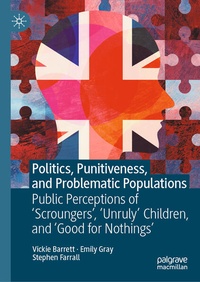
Politics, Punitiveness, and Problematic Populations
Description

This book speaks to those interested in topics related to punitiveness and public attitudes to crime and punishment. Punitiveness has been the focus of increasing criminological attention in recent decades. This book extends this focus by taking a multi-disciplinary approach to examining punitiveness in the criminal justice system, the welfare system, and the education system in British society today. In doing so, this study uses new survey data (n=5,781) applying ordinal and linear regression and structural equation modelling to examine the relationship between public punitiveness towards 'rulebreakers' and political values. This is explored through assessing punitive attitudes towards the treatment of i) school pupils who break school rules, ii) towards the treatment of benefit recipients who fail to comply with the rules, and iii) towards people who break the law. It examines the relationship between political attitudes (neo-conservative values, neo-liberal values), nostalgic values (social, economic, and political), and public punitive attitudes towards the three rule-breaking groups. This book's appeal may extend to an interdisciplinary audience including welfare, education, and social policy disciplines.
More details
Other editions
Additional editions
Persons
Vickie Barrett is Lecturer in Criminology in the Department of Behavioural and Social Sciences at the University of Huddersfield, UK. She worked as a teacher and a probation officer before returning to academia to undertake her PhD at the University of Sheffield.
Emily Gray
is Assistant Professor of Criminology at the University of Warwick in the Sociology Department, UK. She is a mixed methods researcher who specialises in examining long-term trends in relation to crime, politics and society.
Stephen Farrall is Professor of Criminology in the School of Sociology & Social Policy at the University of Nottingham, UK. His recent book Respectable Citizens - Shady Practices (OUP, 2020) won the Outstanding Book Award from the American Society of Criminology's Division of White-Collar and Corporate Crime.
Content
Chapter 1: What Do We Know About Punitiveness?.- Chapter 2: Exploring Trends in Punitiveness.- Chapter 3: Generational effects of attitudes towards rulebreakers.- Chapter 4: Using cognitive interviewing to explore contemporary attitudes towards 'rulebreakers'.- Chapter 5: A Quantitative Framework.- Chapter 6: The Need to Punish? Punitive attitudes towards Rulebreaking School Pupils.- Chapter 7: Cheating the System? Punitive attitudes towards Rulebreaking Welfare Claimants.- Chapter 7: Cheating the System? Punitive attitudes towards Rulebreaking Welfare Claimants.- Chapter 9: The Relationship between Social and Political Attitudes and Punitiveness.- Chapter 10: Conclusion.
