

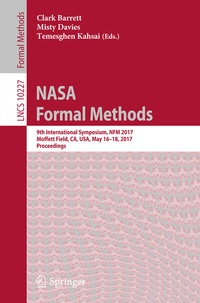
NASA Formal Methods
9th International Symposium, NFM 2017, Moffett Field, CA, USA, May 16-18, 2017, Proceedings
Published on 8. April 2017
XI, 436 pages
978-3-319-57288-8 (ISBN)
Description

This book constitutes the proceedings of the 9th International Symposium on NASA Formal Methods, NFM 2017, held in Moffett Field, CA, USA, in May 2017.
The 23 full and 8 short papers presented in this volume were carefully reviewed and selected from 77 submissions. The papers focus on formal techniques and other approaches for software assurance, their theory, current capabilities and limitations, as well as their potential application to aerospace, robotics, and other NASA-relevant safety-critical systems during all stages of the software life-cycle.
The 23 full and 8 short papers presented in this volume were carefully reviewed and selected from 77 submissions. The papers focus on formal techniques and other approaches for software assurance, their theory, current capabilities and limitations, as well as their potential application to aerospace, robotics, and other NASA-relevant safety-critical systems during all stages of the software life-cycle.
More details
Series
Edition
1st ed. 2017
Language
English
Place of publication
Cham
Switzerland
Publishing group
Springer International Publishing
Target group
Professional and scholarly
Product notice
Reflowable
Illustrations
XI, 436 p. 124 illus.
File size
20,33 MB
ISBN-13
978-3-319-57288-8 (9783319572888)
DOI
10.1007/978-3-319-57288-8
Schweitzer Classification
Other editions
Additional editions
Clark Barrett | Misty Davies | Temesghen Kahsai
NASA Formal Methods
9th International Symposium, NFM 2017, Moffett Field, CA, USA, May 16-18, 2017, Proceedings
Book
04/2017
Springer
€53.49
Shipment within 10-15 days
Content
- Intro
- Preface
- Organization
- Contents
- An Automata-Theoretic Approach to Modeling Systems and Specifications over Infinite Data
- 1 Introduction
- 2 Preliminaries
- 3 Variable Automata: Non-determinism Vs. Alternation
- 3.1 NVBWs Are Not Expressive Enough for *-VLTL
- 3.2 Alternating Variable Büchi Automata
- 3.3 AVBWs Can Express All of *-VLTL
- 3.4 AVBWs Are Not Complementable
- 3.5 Variable Automata: From AVBW to NVBW
- 4 Fragments of *-VLTL Expressible by NVBWs
- 5 Model Checking in Practice
- 6 Conclusions and Future Work
- References
- Learning from Faults: Mutation Testing in Active Automata Learning
- 1 Introduction
- 2 Related Work
- 3 Preliminaries
- 3.1 Mealy Machines
- 3.2 Active Automata Learning
- 4 Test-Suite Generation
- 4.1 Test-Case Generation
- 4.2 Test-Case Selection
- 4.3 Mutation-Based Selection
- 5 Evaluation
- 5.1 Measurement Setup
- 6 Conclusion
- References
- Parametric Model Checking Timed Automata Under Non-Zenoness Assumption
- 1 Introduction
- 2 Preliminaries
- 3 Undecidability of the Non-Zeno Emptiness Problem
- 4 CUB-Parametric Timed Automata
- 4.1 Parametric Clock Upper Bounds
- 4.2 CUB Parametric Timed Automata
- 4.3 CUB PTA Detection
- 4.4 Transforming a PTA into a Disjunctive CUB-PTA
- 5 Zeno-Free Cycle Synthesis in CUB-PTAs
- 6 Experiments
- 7 Conclusion
- References
- Multi-timed Bisimulation for Distributed Timed Automata
- 1 Introduction
- 2 Preliminaries
- 3 An Alternative Semantics for DTA
- 3.1 Multi-timed Actions
- 3.2 Multi-timed Labeled Transition Systems
- 3.3 A Multi-timed Semantics for icTA
- 4 Multi-timed Bisimulation
- 4.1 Strong Multi-timed Bisimulation
- 4.2 Decidability
- 5 Related Work
- 6 Conclusions
- References
- Auto-Active Proof of Red-Black Trees in SPARK
- 1 Introduction
- 2 Preliminaries
- 2.1 SPARK 2014
- 2.2 Auto-Active Verification
- 2.3 Red-Black Trees
- 3 Red-Black Trees in SPARK
- 3.1 Invariants and Models
- 3.2 Implementation
- 3.3 Specification
- 3.4 Proof Principles
- 3.5 Ghost Code
- 4 Development and Verification Data
- 5 Related Work
- 6 Conclusion
- References
- Analysing Security Protocols Using Refinement in iUML-B
- 1 Introduction
- 2 Background
- 2.1 VLAN Tagging
- 2.2 Event-B
- 2.3 iUML-B
- 2.4 Validation and Verification
- 3 Development
- 3.1 M0: An Abstract Model of VLAN Security
- 3.2 M1: Introducing Switches and Devices
- 3.3 M2: Introducing Tagging
- 3.4 Analysis
- 4 Summary of Approach
- 5 Conclusion
- References
- On Learning Sparse Boolean Formulae for Explaining AI Decisions
- 1 Introduction
- 2 Motivating Example
- 3 Problem Definition
- 4 Learning Explanations as Sparse Boolean Formula
- 5 Experiments
- 6 Related Work
- 7 Conclusion and Future Work
- References
- Event-Based Runtime Verification of Temporal Properties Using Time Basic Petri Nets
- 1 Introduction
- 2 Background on Time Basic Nets
- 3 Event-Based Runtime Verification
- 4 The MahaRAJA Framework
- 5 Experimental Validation
- 6 Related Work and Comparative Evaluation
- 7 Conclusion
- References
- Model-Counting Approaches for Nonlinear Numerical Constraints
- 1 Introduction
- 1.1 Symbolic Execution and SPF
- 1.2 Quantification of Information Leaks
- 2 Model Counting Techniques and Tools
- 3 Evaluation
- 4 Conclusion
- References
- Input Space Partitioning to Enable Massively Parallel Proof
- 1 Introduction
- 2 Input Space Partitioning and Parallel Proof
- 3 Reducing Per-Slice Proof Time
- 4 Case Study
- 5 Conclusion
- References
- Compositional Model Checking of Interlocking Systems for Lines with Multiple Stations
- 1 Introduction
- 2 The New Danish Route-Based Interlocking Systems
- 2.1 Specification of Interlocking Systems
- 2.2 The RobustRailS Verification Method and Toolkit
- 3 Method
- 3.1 Linear Cuts on Multiple Station Lines
- 3.2 A Compositional Model Checking Approach
- 4 Soundness and Completeness of the Approach
- 4.1 Soundness
- 4.2 Completeness
- 5 Experiments
- 5.1 Experimental Approach
- 5.2 Two Stations Case Study
- 5.3 EDL: The Real World Case Study
- 6 Conclusion
- References
- Modular Model-Checking of a Byzantine Fault-Tolerant Protocol
- 1 Introduction
- 2 Formal Model
- 2.1 Calendar Automata
- 2.2 Symbolic Fault Injection: A Synchronous Kibitzer
- 2.3 Abstract Transition Systems
- 3 Modeling and Verification for Oral Messages
- 3.1 OMH (m) Algorithm
- 3.2 Model Sketch
- 3.3 Invariants
- 4 Experimental Results
- 4.1 Scalability
- 4.2 Modular Verification
- 4.3 Proof Effort Remarks
- 5 Related Work
- 6 Conclusions
- References
- Improved Learning for Stochastic Timed Models by State-Merging Algorithms
- 1 Introduction
- 2 Related Works
- 3 Background
- 3.1 Deterministic Real-Time Automata (DRTA)
- 3.2 Stochastic Interpretation of a DRTA
- 4 The RTI+ Learning Procedure
- 4.1 Building the APTA
- 4.2 The Learning Process
- 4.3 Compatibility Evaluation
- 4.4 Shortcomings
- 5 Learning More Accurate Models
- 5.1 Unfolded APTA
- 5.2 Constructive-Bound APTA
- 5.3 Tightened-Bound APTA
- 5.4 Evaluation
- 6 Experiments
- 6.1 Evaluation Procedure
- 6.2 Benchmarks
- 6.3 Results
- 7 Conclusion
- References
- Verifying Safety and Persistence Properties of Hybrid Systems Using Flowpipes and Continuous Invariants
- 1 Introduction
- 2 Safety and Persistence for Hybrid Automata
- 2.1 Preliminaries
- 2.2 Bounded Time Safety and Eventuality
- 2.3 Unbounded Time Safety
- 2.4 Combining Unbounded Time Safety with Eventuality to Prove Persistence
- 2.5 Using Persistence to Prove Safety
- 3 An Example Persistence Verification Problem
- 4 Verifying Persistence
- 4.1 Continuous Invariant
- 4.2 Verified Integration
- 5 Outlook and Challenges to Automation
- 6 Related Work
- 7 Conclusion
- References
- A Relational Shape Abstract Domain
- 1 Introduction
- 2 Overview and Motivating Example
- 3 Concrete Semantics
- 4 Abstraction
- 5 Analysis Algorithms
- 5.1 Basic Abstract Post-conditions
- 5.2 Materialization and General Abstract Post-conditions
- 5.3 Folding and Lattice Operations
- 5.4 Analysis
- 6 Experimental Evaluation
- 7 Related Works
- 8 Conclusion
- References
- Floating-Point Format Inference in Mixed-Precision
- 1 Introduction
- 2 Preliminary Elements
- 2.1 Elements of Floating-Point Arithmetic
- 2.2 Overview of Our Method
- 2.3 Related Work
- 3 Abstract Semantics
- 3.1 Abstract Domain
- 3.2 Transfer Functions
- 4 Constraint Generation
- 4.1 Constraints for Arithmetic Expressions
- 4.2 Systematic Constraint Generation
- 5 Experimental Results
- 6 Conclusion
- References
- A Verification Technique for Deterministic Parallel Programs
- 1 Introduction
- 2 Background
- 2.1 OpenMP
- 2.2 Permission-Based Separation Logic
- 2.3 Iteration Contract
- 3 Syntax and Semantics of Deterministic Parallelism
- 3.1 Syntax
- 3.2 Semantics
- 4 Verification Approach
- 4.1 Verification
- 4.2 Soundness
- 5 Verification of OpenMP Programs
- 6 Related Work
- 7 Conclusion and Future Work
- References
- Systematic Predicate Abstraction Using Variable Roles
- 1 Introduction
- 1.1 Introductory Examples of Domain-Specific Abstraction
- 2 Predicate Abstraction and Refinement
- 2.1 Solving Horn Clauses with Predicate Abstraction
- 2.2 Craig Interpolation with Templates
- 3 Role-Based Predicates and Templates
- 3.1 Definition of Roles
- 3.2 Role-Based Predicates and Templates
- 4 Evaluation
- References
- specgen: A Tool for Modeling Statecharts in CSP
- 1 Introduction
- 2 The Dining Philosophers: An Example
- 2.1 The Generated Model
- 2.2 Finding the Deadlock
- 2.3 More Complicated Properties
- 2.4 Performance
- 3 Translation Enhancements
- 4 Conclusion and Future Work
- References
- HYPRO: A C++ Library of State Set Representations for Hybrid Systems Reachability Analysis
- 1 Introduction
- 2 Hybrid Systems Reachability Analysis
- 3 The HYPRO Library
- 4 Experimental Evaluation
- References
- Asm2C++: A Tool for Code Generation from Abstract State Machines to Arduino
- 1 Introduction
- 2 Abstract State Machine Methodology
- 3 Code Generation Process
- 4 Illustrative Example
- 5 Related Work
- 6 Conclusions and Future Work
- References
- SPEN: A Solver for Separation Logic
- 1 Introduction
- 2 Logic Fragment
- 3 Satisfiability Checking
- 4 Entailment Checking
- 5 Experimental Results
- References
- From Hazard Analysis to Hazard Mitigation Planning: The Automated Driving Case
- 1 Challenges, Background, and Contribution
- 2 Related Work
- 3 Abstraction for Run-Time Hazard Mitigation
- 4 Concepts for Run-Time Hazard Mitigation
- 5 Construction of Risk Structures
- 6 Example: Fail-Operational Driver Assistance
- 7 Discussion of Limitations, Applicability, and Strengths
- 8 Conclusion and Future Work
- References
- Event-B at Work: Some Lessons Learnt from an Application to a Robot Anti-collision Function
- Abstract
- 1 Introduction
- 2 Formal Refinement in an Industrial Development Process
- 3 The Case Study
- 3.1 The TwIRTee Rover and the ARP Function
- 3.2 Rodin and Event-B
- 4 From System-Level Requirements to High-Level Requirements
- 4.1 Building a Refinement Strategy
- 4.2 Formalization of Requirements
- 4.3 Verification of Refinements
- 4.4 Validation of Formal Requirements
- 4.5 Model Review
- 5 Related Works
- 6 Conclusion
- References
- Reasoning About Safety-Critical Information Flow Between Pilot and Computer
- 1 Introduction
- 2 Dynamic Agent Safety Logic
- 2.1 Syntax and Semantics
- 2.2 Hilbert System
- 2.3 Soundness
- 3 Case Study and Mechanization
- 3.1 Air France 447
- 3.2 Mechanization in Coq
- 4 Future Work
- 5 Conclusion
- References
- Compositional Falsification of Cyber-Physical Systems with Machine Learning Components
- 1 Introduction
- 2 Background
- 2.1 CPSML Models
- 2.2 Signal Temporal Logic
- 3 Compositional Falsification Framework
- 4 Machine Learning Analyzer
- 4.1 Feature Space Abstraction
- 4.2 Approximation of Learning Components
- 5 Experimental Results
- 5.1 Implementation Details
- 5.2 Case Studies
- 6 Conclusion
- References
- Verifying a Class of Certifying Distributed Programs
- 1 Introduction
- 1.1 Structure of this Paper
- 2 Preliminaries
- 2.1 Certifying Sequential Programs
- 2.2 Verification of Certifying Sequential Programs
- 3 Verification Method for a Class of Certifying Distributed Programs
- 3.1 Distributed Programs
- 3.2 Challenges of Certifying Distributed Programs
- 3.3 A Class of Certifying Distributed Programs
- 3.4 Verification Method for Class C
- 3.5 Further Classes of Certifying Distributed Programs
- 4 Case Study: Leader Election
- 4.1 Certifying Leader Election
- 4.2 Verification in Coq
- 5 Related Work
- 6 Conclusion
- 7 Future Work
- References
- Compact Proof Witnesses
- 1 Introduction
- 2 Background
- 3 Proof Witnesses and Weakenings
- 4 Variable-Separate Analyses
- 5 Experiments
- 6 Conclusion
- References
- Qualification of a Model Checker for Avionics Software Verification
- 1 Introduction
- 2 Aircraft Software and Certification
- 3 Qualification
- 3.1 Tool Qualification Level
- 3.2 DO-330 and Tool Qualification Objectives
- 4 Case Study: Kind 2 Model Checker
- 4.1 Need for Tool Qualification
- 4.2 Tool Qualification Objectives
- 4.3 Results
- 5 Case Study: Proof-Generating Model Checker
- 5.1 Development of a Proof-Generating Version of Kind 2
- 5.2 Qualification of Check-It
- 5.3 Results
- 6 Conclusions
- References
- SpeAR v2.0: Formalized Past LTL Specification and Analysis of Requirements
- 1 Introduction
- 2 Related Work
- 3 Formal Requirements Capture
- 3.1 SpeAR File Stucture
- 3.2 SpeAR Formal Semantics
- 4 Analysis
- 4.1 Logical Entailment
- 4.2 Logical Consistency
- 5 Conclusion and Future Work
- References
- Just Formal Enough? Automated Analysis of EARS Requirements
- 1 Introduction
- 2 Running Example
- 3 Expressing and Analyzing Requirements
- 3.1 Well-Formedness by Construction
- 3.2 Realizability Analysis
- 3.3 The EARS-CTRL Tool
- 4 Related Work
- 5 Conclusions and Future Work
- References
- Author Index
