

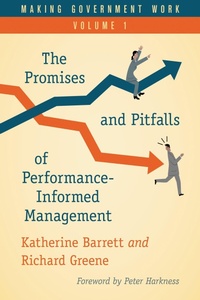
Making Government Work
The Promises and Pitfalls of Performance-Informed Management, Volume 1
1st Edition
Published on 24. December 2019
190 pages
979-8-7651-7518-7 (ISBN)
Description

In this book, Barrett and Greene present evolving theories of performance management, the practices necessary for a good performance-based government, and the pitfalls that can easily be encountered along the way-andhow to avoid them.
As performance management has evolved, it has encompassed many different tools and approaches including measurement, data analysis, evidence-based management, process improvement, research and evaluation. In the past, many of the efforts to improve performance in government have been fragmented, separated into silos and labeled with a variety of different names including performance-based budgeting, performance-informed management, managing for results and so on.
Making Government Work: The Promises and Pitfalls of Performance-Informed Management by Katherine Barrett and Rich Greene is loaded with dozens of stories of what practitioners are currently working on-what's working and what's not. The benefits are ample, so are the challenges. This book describes both, along with practical steps taken by practitioners to make government work better. Readers will discover that while the authors strive to meet the documentation standards of carefully vetted academic papers, the approach they take is journalistic. Over the last year, Barrett and Greene talked to scores of state and local officials, as well as academics and other national experts to find out how performance management tools and approaches have changed, and what is coming in the near-term future.
Performance management has been in a state of evolution for decades now, and so Barrett and Greene have endeavored to capture the state of the world as it is today. By detailing both the challenges and conquests of performance management in Making Government Work: The Promises and Pitfalls of Performance-Informed Management, Barrett and Greene ensure readers will find the kind of balanced information that is helpful to both academics and practitioners-and that can move the field forward.
As performance management has evolved, it has encompassed many different tools and approaches including measurement, data analysis, evidence-based management, process improvement, research and evaluation. In the past, many of the efforts to improve performance in government have been fragmented, separated into silos and labeled with a variety of different names including performance-based budgeting, performance-informed management, managing for results and so on.
Making Government Work: The Promises and Pitfalls of Performance-Informed Management by Katherine Barrett and Rich Greene is loaded with dozens of stories of what practitioners are currently working on-what's working and what's not. The benefits are ample, so are the challenges. This book describes both, along with practical steps taken by practitioners to make government work better. Readers will discover that while the authors strive to meet the documentation standards of carefully vetted academic papers, the approach they take is journalistic. Over the last year, Barrett and Greene talked to scores of state and local officials, as well as academics and other national experts to find out how performance management tools and approaches have changed, and what is coming in the near-term future.
Performance management has been in a state of evolution for decades now, and so Barrett and Greene have endeavored to capture the state of the world as it is today. By detailing both the challenges and conquests of performance management in Making Government Work: The Promises and Pitfalls of Performance-Informed Management, Barrett and Greene ensure readers will find the kind of balanced information that is helpful to both academics and practitioners-and that can move the field forward.
More details
Other editions
Additional editions
Katherine Barrett | Richard Greene
Making Government Work
The Promises and Pitfalls of Performance-Informed Management, Volume 1
Book
12/2019
Rowman & Littlefield Publishers
€65.60
Shipment within 3-4 weeks
Persons
Described by Peter Harkness, founder of Governing magazine, as "by far the most experienced journalists in the country covering public performance," Katherine Barrett and Richard Greene are senior advisors and columnists for Route Fifty, visiting fellows at the IBM Center for the Business of Government, special project consultants to the Volcker Alliance, senior advisors with the Government Finance Research Center at the University of Illinois, Chicago, and more.
Greene is chair of the Center for Accountability and Performance at the American Society for Public Administration and they are both fellows in the National Academy of Public Administration. In the recent past, they have also worked as senior fellows with the Council of State Governments and senior fellows at the Fels Institute of Government at the University of Pennsylvania, and have served as long-time consultants to the Pew Charitable Trusts. Over more than twenty years, they were the management columnists for Governing magazine, and were senior fellows at the Governing Institute since its inception. The couple has worked for multiple other public sector organizations and have been researching and writing about performance management for nearly thirty years.
Greene is chair of the Center for Accountability and Performance at the American Society for Public Administration and they are both fellows in the National Academy of Public Administration. In the recent past, they have also worked as senior fellows with the Council of State Governments and senior fellows at the Fels Institute of Government at the University of Pennsylvania, and have served as long-time consultants to the Pew Charitable Trusts. Over more than twenty years, they were the management columnists for Governing magazine, and were senior fellows at the Governing Institute since its inception. The couple has worked for multiple other public sector organizations and have been researching and writing about performance management for nearly thirty years.
Content
Acknowledgements
Preface
About the Authors
1. Overview
2. Challenges
Sustainability
The human element
Differing perspectives
3. Benefits
Exhibit A: Montgomery County
A catalogue of benefits
San Jose, California
Minnesota
Wisconsin
Indiana
Denver, Colorado
King County, Washington
Case Study - New Orleans: Shock Therapy
4. History
Progress at the state level
Our ringside view
Federal advances
Box: Building the federal performance infrastructure
Ups and downs
Alternate approaches
Box: Five major changes over the last thirty years
Case study - Service Efforts and Accomplishments
5. Outcomes
Knowing the goal
Box: The demise of Oregon Benchmarks
Striving for efficiency
Selecting top-level measures
Citizen surveys
Connecting to national measures
Case study - Washington: Cross-agency collaboration
6. Performance Budgeting
Performance budgeting legislation
Impediments
Attention to evidence
Budget execution
The environment matters
Case study - Austin: A budget with a vision
Case study - Illinois: Unrealistic expectations
7. Pitfalls
Insufficient resources
Lack of data expertise
Weak internal training
Counterproductive incentives
Slow response
Lack of sustainability
The practitioner-academic disconnect
Fear of adverse reaction
Too much hype
Flaws with targets
A limited focus
Neglect of intractable problems
Legislative indifference
Politics trumps management
Checklist: Rx for Pitfalls
8. Buy-In
Resisters
Accountability vs. performance improvement
Agency ownership
Stat evolution
A collaborative approach
Case study -- Colorado Q&A on achieving buy-in
9. Validation
Consequences of bad data
Bad data and drugs
Inconsistent comparisons
Data fudging and outright cheating
Verification
A path forward
Box: The roots of inaccuracy
Sloppy data
Ineffective system controls
Inconsistent information and changing definitions
Privatization/contractor/third party issues
Case study - New York: Changing the definitions
10. Data progress
Service delivery
Open data
Data sharing
Data governance
The push for more helpful data
Box - Outdated technology
Box: The path forward
Case study - Little Rock, Arkansas: Of data and human beings
11. Evaluation
Evaluation on the frontlines
Shifting the paradigm
Box: The evidence movement
Box: A cost-benefit approach
Case study -- Los Angeles: Solving a police recruiting puzzle
Resources
Glossary
Index
Preface
About the Authors
1. Overview
2. Challenges
Sustainability
The human element
Differing perspectives
3. Benefits
Exhibit A: Montgomery County
A catalogue of benefits
San Jose, California
Minnesota
Wisconsin
Indiana
Denver, Colorado
King County, Washington
Case Study - New Orleans: Shock Therapy
4. History
Progress at the state level
Our ringside view
Federal advances
Box: Building the federal performance infrastructure
Ups and downs
Alternate approaches
Box: Five major changes over the last thirty years
Case study - Service Efforts and Accomplishments
5. Outcomes
Knowing the goal
Box: The demise of Oregon Benchmarks
Striving for efficiency
Selecting top-level measures
Citizen surveys
Connecting to national measures
Case study - Washington: Cross-agency collaboration
6. Performance Budgeting
Performance budgeting legislation
Impediments
Attention to evidence
Budget execution
The environment matters
Case study - Austin: A budget with a vision
Case study - Illinois: Unrealistic expectations
7. Pitfalls
Insufficient resources
Lack of data expertise
Weak internal training
Counterproductive incentives
Slow response
Lack of sustainability
The practitioner-academic disconnect
Fear of adverse reaction
Too much hype
Flaws with targets
A limited focus
Neglect of intractable problems
Legislative indifference
Politics trumps management
Checklist: Rx for Pitfalls
8. Buy-In
Resisters
Accountability vs. performance improvement
Agency ownership
Stat evolution
A collaborative approach
Case study -- Colorado Q&A on achieving buy-in
9. Validation
Consequences of bad data
Bad data and drugs
Inconsistent comparisons
Data fudging and outright cheating
Verification
A path forward
Box: The roots of inaccuracy
Sloppy data
Ineffective system controls
Inconsistent information and changing definitions
Privatization/contractor/third party issues
Case study - New York: Changing the definitions
10. Data progress
Service delivery
Open data
Data sharing
Data governance
The push for more helpful data
Box - Outdated technology
Box: The path forward
Case study - Little Rock, Arkansas: Of data and human beings
11. Evaluation
Evaluation on the frontlines
Shifting the paradigm
Box: The evidence movement
Box: A cost-benefit approach
Case study -- Los Angeles: Solving a police recruiting puzzle
Resources
Glossary
Index
