

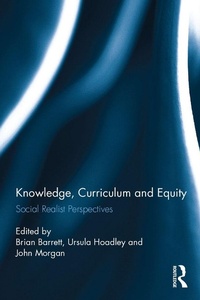
Knowledge, Curriculum and Equity
Social Realist Perspectives
Published on 20. July 2017
240 pages
978-1-351-61883-0 (ISBN)
Description

In 2008 the first in a series of symposia established a 'social realist' case for 'knowledge' as an alternative to the relativist tendencies of the constructivist, post-structuralist and postmodernist approaches dominant in the sociology of education. The second symposium focused on curriculum, and the development of a theoretical language grounded in social realism to talk about issues of knowledge and curriculum. Finally, the third symposium brought together researchers in a broad range of contexts to build on these ideas and arguments and, with a concerted empirical focus, bring these social realist ideas and arguments into conversation with data.
Knowledge, Curriculum and Equity: Social Realist Perspectives contains the work of the third symposium, where the strengths and gaps in the social realist approach are identified and where there is critical recognition of the need to incrementally extend the theories through empirical study. Fundamentally, the problem that social realism is seeking to address is about understanding the social conditions of knowledge production and exchange as well as its structuring in the curriculum and in pedagogy. The central concern is with the on-going social reproduction of inequality through schooling, and exploring whether and how foregrounding specialised knowledge and its access holds the possibility for interrupting it.
This book consists of 13 chapters by different authors working in Oceania, Asia, Europe, Africa and North America. From very different vantage points the authors focus their theoretical and empirical sights on the assumptions about knowledge that underpin educational processes and the pursuit of more equitable schooling for all.
Knowledge, Curriculum and Equity: Social Realist Perspectives contains the work of the third symposium, where the strengths and gaps in the social realist approach are identified and where there is critical recognition of the need to incrementally extend the theories through empirical study. Fundamentally, the problem that social realism is seeking to address is about understanding the social conditions of knowledge production and exchange as well as its structuring in the curriculum and in pedagogy. The central concern is with the on-going social reproduction of inequality through schooling, and exploring whether and how foregrounding specialised knowledge and its access holds the possibility for interrupting it.
This book consists of 13 chapters by different authors working in Oceania, Asia, Europe, Africa and North America. From very different vantage points the authors focus their theoretical and empirical sights on the assumptions about knowledge that underpin educational processes and the pursuit of more equitable schooling for all.
Reviews / Votes
What is knowledge, how does it transform into a curriculum, and how can this be best done in a socially just way? These are three key questions facing sociology of education today. Knowledge, Curriculum and Equity seriously interrogates the relationship between these vital questions and then gives answers based on careful theorization and detailed empirical labour that lifts the field of sociology of education to a new level.Prof Wayne Hugo, School of Education and Development, UKZN
Does it matter which knowledge schools and universities teach, or is the curriculum epiphenomenal? This collection represents the most important body of critical curriculum scholarship on this question today. Groundbreaking, incisive, learned, it dares not to conflate knowledge with knowers and, therefore, is able to bring curriculum directly to the struggle for democracy and justice.
Walter Parker, Professor of Education, University of Washington, Seattle
This book shows why knowledge matters in curriculum, and the difficulties in building a knowledge rich and socially inclusive curriculum and pedagogy. It engages with real problems teachers experience in classrooms in ensuring that all students have access to knowledge. I hope that it becomes a core text in teacher education programs and in the sociology of education.
Leesa Wheelahan, William G. Davis Chair in Community College Leadership, Ontario Institute for Studies in Education, University of Toronto.
More details
Language
English
Place of publication
London
United Kingdom
Publishing group
Taylor & Francis Ltd
Target group
College/higher education
Illustrations
11 s/w Tabellen, 6 s/w Zeichnungen, 6 s/w Abbildungen
11 Tables, black and white; 6 Line drawings, black and white; 6 Illustrations, black and white
File size
1,41 MB
ISBN-13
978-1-351-61883-0 (9781351618830)
Copyright in bibliographic data and cover images is held by Nielsen Book Services Limited or by the publishers or by their respective licensors: all rights reserved.
Schweitzer Classification
Other editions
Additional editions
Brian Barrett | Ursula Hoadley | John Morgan
Knowledge, Curriculum and Equity
Social Realist Perspectives
Book
08/2020
1st Edition
Routledge
€63.30
Shipment within 15-20 days
Brian Barrett | Ursula Hoadley | John Morgan
Knowledge, Curriculum and Equity
Social Realist Perspectives
Book
07/2017
1st Edition
Routledge
€217.50
Shipment within 10-20 days
Persons
Brian Barrett is associate professor in the Foundations and Social Advocacy Department and graduate research coordinator with SUNY Cortland's Urban Recruitment of Educators program.
Ursula Hoadley is an Associate Professor working in the School of Education at the University of Cape Town. Her work focuses on pedagogy, curriculum and school organisation at the primary level, and she has published extensively both locally and internationally in these areas.
John Morgan is Professor of Education at the University of Auckland. His research interests are in geographical education, the politics of the school curriculum and the cultural politics of schooling.
Ursula Hoadley is an Associate Professor working in the School of Education at the University of Cape Town. Her work focuses on pedagogy, curriculum and school organisation at the primary level, and she has published extensively both locally and internationally in these areas.
John Morgan is Professor of Education at the University of Auckland. His research interests are in geographical education, the politics of the school curriculum and the cultural politics of schooling.
Content
Foreword From 'social realism' to 'knowledge in education' Michael Young
Chapter 1. Introduction: social realist perspectives on knowledge, curriculum and equity John Morgan, Ursula Hoadley and Brian Barrett
Section 1. Knowledge, curriculum and the social realist project
Chapter 2. Connecting knowledge to democracy Elizabeth Rata
Chapter 3. For knowledge - but what knowledge? Confronting social realism's curriculum problem John Morgan and David Lambert
Chapter 4. History as knowledge: humanities challenges for a knowledge-based curriculum Lyn Yates
Section 2. Knowledge and the structuring of the curriculum
Chapter 5. A theoretical model of curriculum design: 'Powerful Knowledge' and '21st Century Learning' Graham McPhail and Elizabeth Rata
Chapter 6. Pedagogic modality and structure in the recontextualising field of curriculum studies: the South African case Johan Muller and Ursula Hoadley
Chapter 7. Conceptions of knowledge in history teaching Barbara Ormond
Section 3. Curriculum structure and its effects
Chapter 8. Teacher change in a changing moral order: learning from Durkheim Lynne Slonimsky
Chapter 9. Delocating and relocating knowledge: the dynamics of curriculum change in Singapore Leonel Lim
Chapter 10. Recontextualisation and professionalising regions Jim Hordern
Section 4. Pedagogy and the structuring of knowedge
Chapter 11. Flipping the script: teachers' perceptions of tensions and possibilities within a scripted curriculum Brian Barrett, Anne Burns Thomas and Maria Timberlake
Chapter 12. Scripted lesson plans - what is visible and invisible in visible pedagogy? Yael Shalem
Chapter 13. Pedagogic modalities and the ritualising of pedagogy Zain Davis and Paula Ensor
Chapter 1. Introduction: social realist perspectives on knowledge, curriculum and equity John Morgan, Ursula Hoadley and Brian Barrett
Section 1. Knowledge, curriculum and the social realist project
Chapter 2. Connecting knowledge to democracy Elizabeth Rata
Chapter 3. For knowledge - but what knowledge? Confronting social realism's curriculum problem John Morgan and David Lambert
Chapter 4. History as knowledge: humanities challenges for a knowledge-based curriculum Lyn Yates
Section 2. Knowledge and the structuring of the curriculum
Chapter 5. A theoretical model of curriculum design: 'Powerful Knowledge' and '21st Century Learning' Graham McPhail and Elizabeth Rata
Chapter 6. Pedagogic modality and structure in the recontextualising field of curriculum studies: the South African case Johan Muller and Ursula Hoadley
Chapter 7. Conceptions of knowledge in history teaching Barbara Ormond
Section 3. Curriculum structure and its effects
Chapter 8. Teacher change in a changing moral order: learning from Durkheim Lynne Slonimsky
Chapter 9. Delocating and relocating knowledge: the dynamics of curriculum change in Singapore Leonel Lim
Chapter 10. Recontextualisation and professionalising regions Jim Hordern
Section 4. Pedagogy and the structuring of knowedge
Chapter 11. Flipping the script: teachers' perceptions of tensions and possibilities within a scripted curriculum Brian Barrett, Anne Burns Thomas and Maria Timberlake
Chapter 12. Scripted lesson plans - what is visible and invisible in visible pedagogy? Yael Shalem
Chapter 13. Pedagogic modalities and the ritualising of pedagogy Zain Davis and Paula Ensor
