

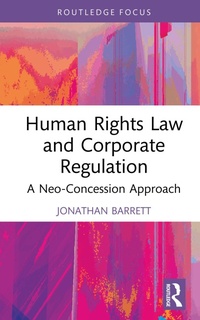
Human Rights Law and Corporate Regulation
A Neo-Concession Approach
1st Edition
Published on 24. October 2024
130 pages
978-1-040-26523-9 (ISBN)
Description

This book argues for an intensely humanist engagement with the company and presents a model of company regulation that is compatible with the protection, respect for and fulfilment of human rights.
Dr Barrett provides a theoretical framing for corporate regulation in the context of human rights States. He argues that States which have ratified the fundamental human rights instruments should, on principle, exclude bodies corporate from the human rights ecosystem, except to the degree necessary to respect property rights of humans and human rights in business. He therefore develops a 'neo-concession' account of the corporation as the basis for a model of corporate regulation to protect human rights. The book outlines and recommends the principal features of a company under a neo-concession model, and the role of regulators in furthering the State's human right obligations. It also delves into the potential issues of technological developments, including decentralised autonomous organisations, and the lessons policymakers can gain from First Nations' approaches to business.
This is a thought-provoking volume that will appeal to scholars in the disciplines of human rights law and corporate governance, as well as policymakers and regulators interested in regulating business for greater societal good.
Dr Barrett provides a theoretical framing for corporate regulation in the context of human rights States. He argues that States which have ratified the fundamental human rights instruments should, on principle, exclude bodies corporate from the human rights ecosystem, except to the degree necessary to respect property rights of humans and human rights in business. He therefore develops a 'neo-concession' account of the corporation as the basis for a model of corporate regulation to protect human rights. The book outlines and recommends the principal features of a company under a neo-concession model, and the role of regulators in furthering the State's human right obligations. It also delves into the potential issues of technological developments, including decentralised autonomous organisations, and the lessons policymakers can gain from First Nations' approaches to business.
This is a thought-provoking volume that will appeal to scholars in the disciplines of human rights law and corporate governance, as well as policymakers and regulators interested in regulating business for greater societal good.
More details
Series
Edition
1. Auflage
Language
English
Place of publication
London
United Kingdom
Publishing group
Taylor & Francis Ltd
Target group
College/higher education
Illustrations
3 Tables, black and white; 1 Line drawings, black and white; 1 Illustrations, black and white
File size
0,36 MB
ISBN-13
978-1-040-26523-9 (9781040265239)
Copyright in bibliographic data and cover images is held by Nielsen Book Services Limited or by the publishers or by their respective licensors: all rights reserved.
Schweitzer Classification
Other editions
Additional editions
Book
approx. 07/2026
1st Edition
Routledge
€30.00
Not yet published
Book
10/2024
1st Edition
Routledge
€75.20
Shipment within 10-20 days
Person
Jonathan Barrett is an Associate Professor in the School of Accounting and Commercial Law, Victoria University of Wellington Te Herenga Waka, New Zealand. He teaches company law and taxation and researches the practical application of human rights.
Content
1 Introduction
1.1 Aim
1.2 A neo-concessionist model
1.3 Structure
1.3.1 Human rights and duties, and corporations
1.3.2 Concession to neo-concession
1.3.3 Companies Acts and legislative considerateness
1.3.4 The role of the corporate regulator - regulatory considerateness
1.3.5. Towards regulatory confederation
1.3.6 Corporate regulation and technology
1.4 Concluding comments
2 Human rights and corporations
2.1 Introduction
2.1.1 Humanism
2.1.2 Rights and duties
2.1.3 Universal human rights
2.2 Human rights in law
2.3 Property
2.4 Corporate claims to human rights
2.4.1 Practical problems
2.4.2 Interpretive problems
2.4.3 Learning from the United States
2.4.4 Rule of law
2.5 Concluding comments
3 Concession to neo-concession
3.1 Introduction
3.2 Some theories of the company
3.2.1 Concession
3.2.2 Organic
3.2.3 Contract
3.2.4 Real entity
3.3 The company untheorised
3.4 Neo-concession
3.5 Concluding comments
4 Law and legislative considerateness
4.1 Introduction
4.1.1 Legislative considerateness
4.1.2 Directors' duties
4.1.3 Piercing the corporate veil
4.2 Legislative considerateness
4.2.1 General principles
4.2.2 Legislative considerateness and SMEs
4.3 Directors' duties
4.3.2 Shareholders
4.5 General anti-abuse provision
4.6 Concluding comments
5 The role of the corporate regulator
5.1 Introduction
5.1.1 General principles
5.1.2 Key issues
5.2 Institutional competence
5.3 Regulatory considerateness
5.3.1 Competent and cooperative actors
5.3.2 Potentially competent and cooperative actors
5.3.3 Recalcitrant actors
5.4 International issues
5.4.1 Recognition of out-of-jurisdiction registered companies
5.5 Concluding comments
6 Towards regulatory confederation
6.1 Introduction
6.2 Colonial experience and UNDRIP
6.2.1 Australia
6.2.2 Canada
6.2.3 New Zealand
6.3 Indigenous corporations
6.3.1 Australia
6.3.2 Canada
6.3.3 New Zealand
6.4 Towards regulatory confederation
6.5 Concluding comments
7 Corporate regulation and technology
7.1 Introduction
7.2 Regulating cyberutopia
7.2.1 The DAO - a failed CBE
7.2.2 Algorithmic entities
7.3 AI
7.4 Regulating the unregulable
7.5 Concluding comments
8 Conclusion
Bibliography
Index
1.1 Aim
1.2 A neo-concessionist model
1.3 Structure
1.3.1 Human rights and duties, and corporations
1.3.2 Concession to neo-concession
1.3.3 Companies Acts and legislative considerateness
1.3.4 The role of the corporate regulator - regulatory considerateness
1.3.5. Towards regulatory confederation
1.3.6 Corporate regulation and technology
1.4 Concluding comments
2 Human rights and corporations
2.1 Introduction
2.1.1 Humanism
2.1.2 Rights and duties
2.1.3 Universal human rights
2.2 Human rights in law
2.3 Property
2.4 Corporate claims to human rights
2.4.1 Practical problems
2.4.2 Interpretive problems
2.4.3 Learning from the United States
2.4.4 Rule of law
2.5 Concluding comments
3 Concession to neo-concession
3.1 Introduction
3.2 Some theories of the company
3.2.1 Concession
3.2.2 Organic
3.2.3 Contract
3.2.4 Real entity
3.3 The company untheorised
3.4 Neo-concession
3.5 Concluding comments
4 Law and legislative considerateness
4.1 Introduction
4.1.1 Legislative considerateness
4.1.2 Directors' duties
4.1.3 Piercing the corporate veil
4.2 Legislative considerateness
4.2.1 General principles
4.2.2 Legislative considerateness and SMEs
4.3 Directors' duties
4.3.2 Shareholders
4.5 General anti-abuse provision
4.6 Concluding comments
5 The role of the corporate regulator
5.1 Introduction
5.1.1 General principles
5.1.2 Key issues
5.2 Institutional competence
5.3 Regulatory considerateness
5.3.1 Competent and cooperative actors
5.3.2 Potentially competent and cooperative actors
5.3.3 Recalcitrant actors
5.4 International issues
5.4.1 Recognition of out-of-jurisdiction registered companies
5.5 Concluding comments
6 Towards regulatory confederation
6.1 Introduction
6.2 Colonial experience and UNDRIP
6.2.1 Australia
6.2.2 Canada
6.2.3 New Zealand
6.3 Indigenous corporations
6.3.1 Australia
6.3.2 Canada
6.3.3 New Zealand
6.4 Towards regulatory confederation
6.5 Concluding comments
7 Corporate regulation and technology
7.1 Introduction
7.2 Regulating cyberutopia
7.2.1 The DAO - a failed CBE
7.2.2 Algorithmic entities
7.3 AI
7.4 Regulating the unregulable
7.5 Concluding comments
8 Conclusion
Bibliography
Index
