

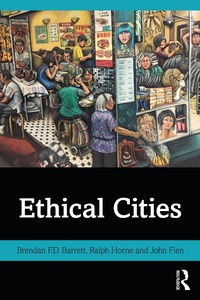
Ethical Cities
1st Edition
Published on 6. December 2020
218 pages
978-1-000-28049-4 (ISBN)
Description

Combining elements of sustainable and resilient cities agendas, together with those from social justice studies, and incorporating concerns about good governance, transparency and accountability, the book presents a coherent conceptual framework for the ethical city, in which to embed existing and new activities within cities so as to guide local action.
The authors' observations are derived from city-specific surveys and urban case studies. These reveal how progressive cities are promoting a diverse range of ethically informed approaches to urbanism, such as community wealth building, basic income initiatives, participatory budgeting and citizen assemblies. The text argues that the ethical city is a logical next step for critical urbanism in the era of late capitalism, characterised by divisive politics, burgeoning inequality, widespread technology-induced disruptions to every aspect of modern life and existential threats posed by climate change, sustainability imperatives and pandemics. Engaging with their communities in meaningful ways and promoting positive transformative change, ethical cities are well placed to deliver liveable and sustainable places for all, rather than only for wealthy elites. Likewise, the aftermath of shocks such as the 2008 Global Financial Crisis and the Covid-19 pandemic reveals that cities that are not purposeful in addressing inequalities, social problems, unsustainability and corruption face deepening difficulties.
Readers from across physical and social sciences, humanities and arts, as well as across policy, business and civil society, will find that the application of ethical principles is key to the pursuit of socially inclusive urban futures and the potential for cities and their communities to emerge from or, at least, ameliorate a diverse range of local, national and global challenges.
The authors' observations are derived from city-specific surveys and urban case studies. These reveal how progressive cities are promoting a diverse range of ethically informed approaches to urbanism, such as community wealth building, basic income initiatives, participatory budgeting and citizen assemblies. The text argues that the ethical city is a logical next step for critical urbanism in the era of late capitalism, characterised by divisive politics, burgeoning inequality, widespread technology-induced disruptions to every aspect of modern life and existential threats posed by climate change, sustainability imperatives and pandemics. Engaging with their communities in meaningful ways and promoting positive transformative change, ethical cities are well placed to deliver liveable and sustainable places for all, rather than only for wealthy elites. Likewise, the aftermath of shocks such as the 2008 Global Financial Crisis and the Covid-19 pandemic reveals that cities that are not purposeful in addressing inequalities, social problems, unsustainability and corruption face deepening difficulties.
Readers from across physical and social sciences, humanities and arts, as well as across policy, business and civil society, will find that the application of ethical principles is key to the pursuit of socially inclusive urban futures and the potential for cities and their communities to emerge from or, at least, ameliorate a diverse range of local, national and global challenges.
Reviews / Votes
'The attainment of sustainable urban futures is an imperative for humankind as ever more people will live in cities. Critical urban studies aim to achieve this goal. Barrett, Horne and Fien develop a strong case for an ethical framework to help cities re-orientate and more effectively respond to the major challenges facing the world today, including evolving patterns of economic competition, technological disruptions, climate change and pandemics. Examining and drawing insights from contemporary initiatives in cities across the globe, the book represents an important contribution to critical urban studies. It will be greatly appreciated by both urban practitioners and scholars.'Hans van Ginkel, Former Rector and Emeritus Professor of Geography, Utrecht University, Former United Nations Under-Secretary-General and Rector of the United Nations University
'This engaging book dives into the duality of cities as both collective and individualistic spaces. Drawing upon numerous examples from cities across the globe, it presents pathways for collective action that would help mitigate contemporary urban and global problems, including poverty and the climate crisis. The authors, though not shying away from the hard reality of life in many cities, present an optimistic perspective in the framing of an ethical city - one that is both deliberate and inclusive.'
Makena Coffman, Director, UH Manoa Institute for Sustainability and Resilience, Professor, Department of Urban and Regional Planning, University of Hawaii
More details
Edition
1. Auflage
Language
English
Place of publication
London
United Kingdom
Publishing group
Taylor & Francis Ltd
Target group
College/higher education
Illustrations
18 Tables, black and white; 17 Line drawings, black and white; 1 Halftones, black and white; 18 Illustrations, black and white
ISBN-13
978-1-000-28049-4 (9781000280494)
Copyright in bibliographic data and cover images is held by Nielsen Book Services Limited or by the publishers or by their respective licensors: all rights reserved.
Schweitzer Classification
Other editions
Additional editions
Brendan F.D. Barrett | Ralph Horne | John Fien
Ethical Cities
Book
12/2020
1st Edition
Routledge
€60.10
Shipment within 15-20 days

Brendan F.D. Barrett | Ralph Horne | John Fien
Ethical Cities
Book
12/2020
1st Edition
Routledge
€206.20
Shipment within 15-20 days
Brendan F. D. Barrett
Ethical Cities
Book
12/2020
Routledge
Unfortunately, price unknown
Available (delivery time upon request)
Persons
Brendan F.D. Barrett (FRSA) is Specially Appointed Professor in the Center for the Study of Co* Design, Osaka University, Japan. He has worked in academia and environmental consultancy in the UK, Japan and Australia and as an official with UNEP and the United Nations University.
Ralph Horne is Professor of Geography and Deputy Pro-Vice Chancellor, Research and Innovation for the College of Design and Social Context at RMIT University, Australia. He combines research leadership and participation in research projects concerning the environmental, social and policy context of production and consumption in the urban environment.
John Fien is Professor of Practice in the School of Architecture and Urban Design at RMIT University, Australia. With an academic career spanning four decades, he was previously Executive Director and Professor at the Swinburne Leadership Institute, Professor of Sustainability at RMIT University and Professor of Environmental Education at Griffith University.
Ralph Horne is Professor of Geography and Deputy Pro-Vice Chancellor, Research and Innovation for the College of Design and Social Context at RMIT University, Australia. He combines research leadership and participation in research projects concerning the environmental, social and policy context of production and consumption in the urban environment.
John Fien is Professor of Practice in the School of Architecture and Urban Design at RMIT University, Australia. With an academic career spanning four decades, he was previously Executive Director and Professor at the Swinburne Leadership Institute, Professor of Sustainability at RMIT University and Professor of Environmental Education at Griffith University.
Content
1. Rationale for Ethical City 2. The Right to the City 3. Ethics and the City 4. Who Shapes the Ethical City? 5. Assessment of the Ethical City 6. Competitive, Liveable and Fragile Cities 7. Relentless Disruption 8. Building Ethical Cities 9. Transitioning to Ethical Cities
