

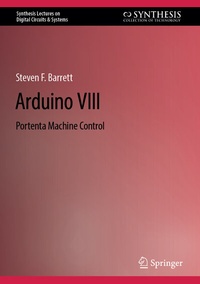
Arduino VIII
Description

This book is about the Arduino microcontroller and the Arduino concept. The visionary Arduino represented a new innovation in microcontroller hardware in 2005, the concept of open source hardware, making a broad range of computing accessible for all.
This book, "Arduino VIII: Portenta Machine Control," is an accessible primer on industrial control and programmable logic controller concepts for those without a deep instrumentation background. An understanding of basic circuit theory is an appropriate prerequisite for the book. The three main goals for the book are: explore accessible Arduino Portenta Machine Control industrial control products; learn the fundamentals of programming using ladder logic; and explore related sensors and interface concepts. We use multiple examples throughout the book and conclude with an instrumented greenhouse project.
More details
Other editions
Additional editions
Person
Steven F. Barrett, Ph.D., P.E. received the BS Electronic Engineering Technology from the University of Nebraska at Omaha in 1979, the M.E.E.E. from the University of Idaho at Moscow in 1986, and the Ph.D. Electrical Engineering from The University of Texas at Austin in 1993. He was formally an active duty faculty member at the United States Air Force Academy, Colorado and is now the Associate Dean for Undergraduate Programs, College of Engineering and Physical Sciences at the University of Wyoming and Professor of Electrical and Computer Engineering. He is a member of IEEE (Life Senior) and Tau Beta Pi (chief faculty advisor). His research interests include digital and analog image processing, computer-assisted laser surgery, and embedded controller systems. He is a registered Professional Engineer in Wyoming and Colorado. He co-wrote with Dr. Daniel Pack several textbooks on microcontrollers and embedded systems. In 2004, Barrett was named ``Wyoming Professor of the Year'' by the Carnegie Foundation for the Advancement ofTeaching and in 2008 was the recipient of the National Society of Professional Engineers (NSPE) Professional Engineers in Higher Education, Engineering Education Excellence Award.
Content
Operational Technology and the Arduino PMC.- Arduino PMC Features.- Connectivity.- PMC Peripheral Interfacing.- Arduino PLC IDE and Ladder Logic.- Application: IoT Greenhouse.
