

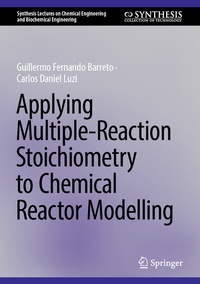
Applying Multiple-Reaction Stoichiometry to Chemical Reactor Modelling
Description

This book delves into the realm of Chemical Reaction Engineering (CRE) by showcasing the practical application of multiple-reaction stoichiometry. The authors critically assess various approaches commonly taught in undergraduate CRE courses to establish the relationships between changes in chemical species. In doing so, they propose an innovative conceptual alternative that is specifically tailored for undergraduate lectures. The book carefully selects composition measures that effectively harness the power of stoichiometric relationships in elementary reacting systems and models, which are typically covered in these courses. Going beyond the basics, it also offers a profound discussion on the value of chemical stoichiometry for tackling more intricate reaction systems and detailed models. Moreover, the book presents a simplified procedure that minimizes the reliance on complex linear algebra techniques, making the book accessible to a wider range of readers.
More details
Other editions
Additional editions
Persons
G.F. Barreto received his Chemical Engineer degree from the Universidad Nacional de La Plata (UNLP), Argentina, in 1974 and his Ph.D. degree from the University of London (U.K.) in 1984. As a full professor, he has been in charge of Chemical Reaction Engineering (CRE) undergraduate courses at the Faculty of Engineering of UNLP, from 1991 to 2020, a period in which he also lectured several post-graduate courses. Presently, G.F.B. is an emeritus professor of the UNLP and is a research member of the Consejo Nacional de Investigaciones Científicas y Técnicas (CONICET), Argentina.
C.D. Luzi obtained his Chemical Engineer degree in 2010 and his EngD degree in 2015, both from the Universidad Nacional de La Plata (UNLP), Argentina. He is an associate professor at Facultad de Ingeniería (UNLP), in Chemical Reaction Engineering (CRE) undergraduate courses, where he has developed most of his teaching career. He is also a research member of the Consejo Nacional de Investigaciones Científicas y Técnicas (CONICET), Argentina. While focusing his research on reverse flow reactors at the outset, his current research areas of interest are the modeling and simulation of different phenomena involved in packed bed reactors, such as radial velocity distribution and axial dispersion.
Content
1. Review of Alternatives for the Use of Stoichiometry in Multiple Reaction Systems.- 2. Use of Stoichiometric Relationships in Simple Reaction Systems.- 3. Use of Stoichiometric Relationships in Complex Reaction Systems Reaction Invariants.
