

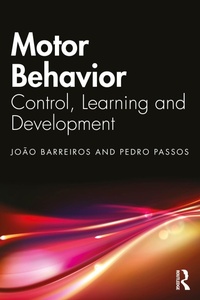
Motor Behavior
Control, Learning and Development
1st Edition
Published on 18. July 2025
374 pages
978-1-040-35075-1 (ISBN)
Description

Motor Behavior: Control, Learning and Development explores the realm of Motor Behavior, a field intricately examining human action and movement across a lifetime - from their initial acquisition to refinement and evolution. This discipline provides a profound lens through which we comprehend the complex dynamics of human physicality.
Presented across four sections, each progressively guiding the reader from fundamental insights into the workings of the human body to more intricate subjects pertaining to motor control and learning, Motor Behavior: Control, Learning and Development equips readers with a comprehensive understanding of the intricate mechanisms governing the human body during movement. Additionally, this book clarifies current perspectives on control and learning. Recognizing the perpetual evolution of science, there are short stories interspersed throughout the text. These narratives contextualize the unfolding tapestry of scientific knowledge, encouraging readers to adopt an open-minded stance toward the topic.
Tailored for students navigating the academic terrain in both bachelor's and master's degrees, this cutting-edge new textbook is essential reading for all students in Motor Control, Motor Learning, Motor Development, Skill Acquisition courses, and related modules.
Presented across four sections, each progressively guiding the reader from fundamental insights into the workings of the human body to more intricate subjects pertaining to motor control and learning, Motor Behavior: Control, Learning and Development equips readers with a comprehensive understanding of the intricate mechanisms governing the human body during movement. Additionally, this book clarifies current perspectives on control and learning. Recognizing the perpetual evolution of science, there are short stories interspersed throughout the text. These narratives contextualize the unfolding tapestry of scientific knowledge, encouraging readers to adopt an open-minded stance toward the topic.
Tailored for students navigating the academic terrain in both bachelor's and master's degrees, this cutting-edge new textbook is essential reading for all students in Motor Control, Motor Learning, Motor Development, Skill Acquisition courses, and related modules.
More details
Edition
1. Auflage
Language
English
Place of publication
London
United Kingdom
Publishing group
Taylor & Francis Ltd
Target group
College/higher education
Illustrations
76 Line drawings, black and white; 13 Halftones, black and white; 89 Illustrations, black and white
File size
18,28 MB
ISBN-13
978-1-040-35075-1 (9781040350751)
Copyright in bibliographic data and cover images is held by Nielsen Book Services Limited or by the publishers or by their respective licensors: all rights reserved.
Schweitzer Classification
Other editions
Additional editions
Book
07/2025
1st Edition
Routledge
€208.60
Shipment within 10-20 days
Book
07/2025
1st Edition
Routledge
€64.50
Shipment within 10-20 days
Persons
Joao Barreiros is a full professor at the Faculty of Human Kinetics at the University of Lisbon, Portugal. Throughout his academic career of over 40 years, he has taught and conducted research in the areas of motor learning and human motor development.
Pedro Passos is an associate professor at the Faculty of Human Kinetics, University of Lisbon, Portugal, where he teaches motor learning and conducts research on learning in collective behavior, especially in team sports. He is currently the Director of the Motor Behavior Laboratory at his faculty
Pedro Passos is an associate professor at the Faculty of Human Kinetics, University of Lisbon, Portugal, where he teaches motor learning and conducts research on learning in collective behavior, especially in team sports. He is currently the Director of the Motor Behavior Laboratory at his faculty
Content
Introduction
Section 1: Learning and Behavior
1. What Is Motor Learning?
2. Memory and Learning
3. Learning as a Process of Change - The Learning Curve
4. The Complexity of Motor Behavior
Section 2: Control and Learning of Voluntary Movements
5. The Control of Voluntary Movements
6. Perceptual Information and Motor Learning
7. Lateral Asymmetry
8. Emotion, Motor Behavior and Learning
Section 3: Managing Information and Learning
9. Managing Information
10. The Ecological Approach to Motor Control
11. A Schema Theory of Motor Learning
12. Learning And Interpersonal Coordination
13. Guiding Learning
14. Creative Behavior
Section 4: Learning Throughout Life
15. Motor Learning, Development and Aging
16. Aging: A Continuous Learning Process
Section 1: Learning and Behavior
1. What Is Motor Learning?
2. Memory and Learning
3. Learning as a Process of Change - The Learning Curve
4. The Complexity of Motor Behavior
Section 2: Control and Learning of Voluntary Movements
5. The Control of Voluntary Movements
6. Perceptual Information and Motor Learning
7. Lateral Asymmetry
8. Emotion, Motor Behavior and Learning
Section 3: Managing Information and Learning
9. Managing Information
10. The Ecological Approach to Motor Control
11. A Schema Theory of Motor Learning
12. Learning And Interpersonal Coordination
13. Guiding Learning
14. Creative Behavior
Section 4: Learning Throughout Life
15. Motor Learning, Development and Aging
16. Aging: A Continuous Learning Process
