

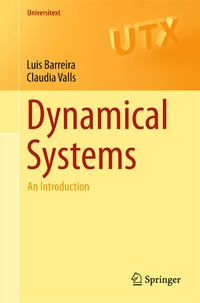
Dynamical Systems
Description

The theory of dynamical systems is a broad and active research subject with connections to most parts of mathematics. Dynamical Systems: An Introduction undertakes the difficult task to provide a self-contained and compact introduction.
Topics covered include topological, low-dimensional, hyperbolic and symbolic dynamics, as well as a brief introduction to ergodic theory. In particular, the authors consider topological recurrence, topological entropy, homeomorphisms and diffeomorphisms of the circle, Sharkovski's ordering, the Poincaré-Bendixson theory, and the construction of stable manifolds, as well as an introduction to geodesic flows and the study of hyperbolicity (the latter is often absent in a first introduction). Moreover, the authors introduce the basics of symbolic dynamics, the construction of symbolic codings, invariant measures, Poincaré's recurrence theorem and Birkhoff's ergodic theorem.
The exposition is mathematically rigorous, concise and direct: all statements (except for some results from other areas) are proven. At the same time, the text illustrates the theory with many examples and 140 exercises of variable levels of difficulty. The only prerequisites are a background in linear algebra, analysis and elementary topology.
This is a textbook primarily designed for a one-semester or two-semesters course at the advanced undergraduate or beginning graduate levels. It can also be used for self-study and as a starting point for more advanced topics.
Reviews / Votes
From the reviews:
"The volume is organized into eight chapters, with the first introductory chapter briefly summarizing the contents of the remaining chapters. . the book does cover the topic of dynamical systems thoroughly and from both the discrete dynamics and the continuous dynamics points of view, including topologic and symbolic dynamics and ergodic theory. Summing Up: Recommended. Upper-division undergraduates, graduate students, and researchers/faculty." (M. D. Sanford, Choice, Vol. 51 (3), November, 2013)
"This book is an introductory text to the modern theory of dynamical systems, with particular focus on discrete time systems. It is written as a text book for undergraduate or beginning graduate courses. The book is almost self contained: it includes all the definitions, with examples, and the proofs of the presented results, as well as the majority of the tools in the proofs. The last section of each chapter consists of a list of exercises." (Pau Martin de la Torre, zbMATH, Vol. 1269, 2013)More details
Other editions
Additional editions
Content
Introduction.- Basic Notions and Examples.- Topological Dynamics.- Low-Dimensional Dynamics.- Hyperbolic Dynamics I.- Hyperbolic Dynamics II.- Symbolic Dynamics.- Ergodic Theory.
