

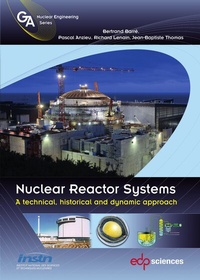
Nuclear Reactor Systems
A technical, historical and dynamic approach
1st Edition
Published on 11. February 2021
432 pages
978-2-7598-1985-0 (ISBN)
Description

No detailed description available for "Nuclear Reactor Systems".
More details
Language
English
Place of publication
Les Ulis
France
Target group
Professional and scholarly
US School Grade: College Graduate Student
Edition type
Digital original
File size
45,25 MB
ISBN-13
978-2-7598-1985-0 (9782759819850)
Copyright in bibliographic data and cover images is held by Nielsen Book Services Limited or by the publishers or by their respective licensors: all rights reserved.
Schweitzer Classification
Other editions
Additional editions
Bertrand Barre | Pascal Anzieu | Richarch Lenain
Nuclear Reactor Systems
A technical, historical and dynamic approach
Book
02/2016
1st Edition
EDP Sciences
€183.50
Shipment within 3-4 weeks
Persons
Barré Bertrand :
Graduated from École des Mines de Nancy, retired from CEA and AREVA, Bertrand Barré teaches Nuclear Engineering at Institut National des Sciences et Techniques Nucléaires, and Sciences-Po. He was Nuclear Attaché in Washington DC, Director of Engineering at Technicatome, Head of the Nuclear Reactors Directorate at CEA, R&D Vice-president at COGEMA, Scientific Advisor to AREVA, and Member of many Scientific Committees in France and abroad.Anzieu Pascal :
Graduated from the École Centrale de Paris, France, Pascal Anzieu made his career at CEA on nuclear reactors design and safety. He led the Superphenix research program from 1994 to 1998 and then conducted research programs on future nuclear systems: sodium, gas, molten salt reactors, accelerator-driven systems, etc. He currently teaches at the National Institute for Nuclear Science and Technology and several engineering schools and universities.Lenain Richarch :
Doctor of Orsay University 1982, currently coordinator of a CEA PWR expert group, Richard Lenain teaches Reactor Physics and Nuclear Engineering at INSTN, École Polytechnique and École Centrale de Paris. He was formerly head of Applied Mathematics and Reactor Studies Section in CEA/Saclay.Thomas Jean-Baptiste :
Graduated from École Centrale de Paris with a postgraduate degree in Theoretical Physics (atomic and nuclear) at Orsay University, currently scientific advisor to the Nuclear Energy Director in CEA, Jean-Baptiste Thomas teaches Reactor Physics and Nuclear Engineering as a professor at INSTN (in charge of the Nuclear Reactor Systems course created by Bertrand Barré). He was formerly Director for ADS studies in CEA and Director for Simulation and Experimental Facilities in the Nuclear Energy Directorate.
Graduated from École des Mines de Nancy, retired from CEA and AREVA, Bertrand Barré teaches Nuclear Engineering at Institut National des Sciences et Techniques Nucléaires, and Sciences-Po. He was Nuclear Attaché in Washington DC, Director of Engineering at Technicatome, Head of the Nuclear Reactors Directorate at CEA, R&D Vice-president at COGEMA, Scientific Advisor to AREVA, and Member of many Scientific Committees in France and abroad.Anzieu Pascal :
Graduated from the École Centrale de Paris, France, Pascal Anzieu made his career at CEA on nuclear reactors design and safety. He led the Superphenix research program from 1994 to 1998 and then conducted research programs on future nuclear systems: sodium, gas, molten salt reactors, accelerator-driven systems, etc. He currently teaches at the National Institute for Nuclear Science and Technology and several engineering schools and universities.Lenain Richarch :
Doctor of Orsay University 1982, currently coordinator of a CEA PWR expert group, Richard Lenain teaches Reactor Physics and Nuclear Engineering at INSTN, École Polytechnique and École Centrale de Paris. He was formerly head of Applied Mathematics and Reactor Studies Section in CEA/Saclay.Thomas Jean-Baptiste :
Graduated from École Centrale de Paris with a postgraduate degree in Theoretical Physics (atomic and nuclear) at Orsay University, currently scientific advisor to the Nuclear Energy Director in CEA, Jean-Baptiste Thomas teaches Reactor Physics and Nuclear Engineering as a professor at INSTN (in charge of the Nuclear Reactor Systems course created by Bertrand Barré). He was formerly Director for ADS studies in CEA and Director for Simulation and Experimental Facilities in the Nuclear Energy Directorate.
Content
- Intro
- Introduction to the Nuclear Engineering books series
- Authors
- Contents
- Foreword
- References
- Chapter 1. Introduction
- 1.1. General introduction
- 1.2. The ebullient beginnings
- 1.2.1. Prehistory [1-10]
- 1.2.2. Uranium enrichment, the deus ex machina
- 1.3. Bases for comparison [12, 13]
- 1.3.1. Fertile and fissile isotopes
- 1.3.2. Moderators
- 1.3.3. Coolants
- 1.4. The driving forces of selection
- 1.5. Today (and tomorrow)
- 1.5.1. Gas-cooled reactors
- 1.5.2. Graphite-moderated and boiling water-cooled reactors RBMK
- 1.5.3. Heavy water reactors CANDU
- 1.5.4. Light water reactors PWR, BWR and VVER
- 1.5.5. High temperature reactors
- 1.5.6. Fast breeders [14]
- 1.5.7. Molten salt reactors [1]
- 1.6. Biotope, domination and selection
- 1.7. From spontaneous selection to a formalized process [14, 15]
- 1.7.1. GIF, the Generation IV International Forum
- 1.7.2. INPRO, International Project on Innovative Nuclear Reactors & Fuel Cycles
- 1.8. Fusion
- 1.9. Conclusion
- References
- Chapter 2. CO2 gas cooled reactors
- 2.1. Introduction
- 2.2. General architecture
- 2.3. General features of graphite-moderated reactors
- 2.3.1. Fuel: natural uranium and magnesium clad (UNGG & Magnox)
- 2.3.2. Graphite moderator
- 2.3.3. General physical properties of graphite moderated reactors
- 2.4. UNGG
- 2.4.1. The French UNGG program
- 2.4.2. St Laurent A example
- Caisson
- Core
- 2.5. Magnox
- 2.6. Advanced gas cooled reactor AGR
- Reference
- Chapter 3. RBMK (Reactor Bolchoi Mochtnosti Kanali)
- 3.1. General
- 3.2. General description
- Overall design
- Cooling
- Core
- 3.3. Core physics
- Principle of RBMK core design
- Void and density effects
- Instabilities
- Analysis of initial RBMK control rod design
- Cavity overpressure protection system
- 3.4. Chernobyl accident
- Scenario
- Accident sequence and analysis
- Initial conditions
- 3.5. Changes made to improve RBMK core behavior
- References
- Chapter 4. Heavy water moderated nuclear reactors
- 4.1. Introduction
- 4.2. General
- 4.2.1. Heavy-water
- 4.2.2. Natural uranium
- 4.2.3. Pressure tubes
- 4.3. Description of a CANDU 6
- 4.3.1. Reactor
- 4.3.2. Primary system
- 4.3.3. Moderator system
- 4.3.4. Fuel
- 4.3.5. Reactivity control systems
- 4.3.6. Safety systems
- 4.3.7. Fuel cycle
- 4.3.8. The vacuum building
- 4.3.9. Difficulties and incidents in the Canadian programme
- 4.3.10. Economy
- 4.4. Fuel cycle possibilities
- 4.4.1. CANFLEX fuel
- 4.4.2. Slightly enriched uranium
- 4.4.3. Recycling of the LWR fuel
- 4.4.4. Perspectives
- References
- Appendix 1: Heavy-water production
- Appendix 2: A Heavy-water reactor with a reactor pressure vessel
- Chapter 5. Nuclear marine propulsion
- 5.1. Introduction
- 5.2. Main properties required for propulsion
- Electricity production on land-based reactors
- Navy Applications
- 5.3. History and development
- USA
- USSR
- UK
- FRANCE
- China
- 5.4. Naval reactor development [2]
- 5.5. Civilian fleet
- References
- Chapter 6. Experimental reactors
- 6.1. Different types of experimental or research reactors
- 6.2. Materials irradiation reactors (MTR, TRIGA.)
- 6.2.1. OSIRIS, in Saclay
- 6.2.2. TRIGA
- 6.3. MTR Fuel, RERTR Programme
- 6.4. Neutron source reactors
- 6.5. Spallation sources
- 6.6. Materials irradiation facilities in Europe, the JHR project
- 6.7. Myrrha, Pallas
- References
- Chapter 7. Advanced "Generation III" reactors
- 7.1. Introduction: Genesis of "Generation III"
- 7.2. Evolutionary or Revolutionary?
- 7.3. EPR, the Evolutionary Power Reactor [1-6]
- 7.3.1. Genesis of the EPR
- 7.3.2. EPR General Characteristics
- 7.3.3. Primary and secondary circuits
- 7.3.4. Systems architecture
- 7.3.5. Mitigation of severe accidents
- 7.3.6. Future economics of the EPR
- 7.3.7. EPR status in 2014
- 7.4. The Korean APR 1400
- 7.4.1. S 80+ basic options
- 7.4.2. General characteristics
- 7.4.3. Primary circuit
- 7.4.4. The APR 1400
- 7.5. The AP 600 and AP 1000 by Toshiba-Westinghouse [12-14]
- 7.5.1. General characteristics
- 7.5.2. Core and primary circuit
- 7.5.3. Emergency systems
- 7.5.4. From the AP 600 to the AP 1000
- 7.6. Other generation III PWRs
- 7.6.1. The ATMEA
- 7.6.2. The APWR
- 7.6.3. The AES 92
- 7.7. Japanese and American ABWRs [17-22]
- 7.7.1. General characteristics
- 7.7.2. Architecture simplification
- 7.7.3. Simplification of the primary circuit
- 7.7.4. Additional improvements
- 7.8. General Electric Simplified BWRs [24-29]
- 7.8.1. General characteristics
- 7.8.2. The SBWR (600-670 MWe)
- 7.8.3. The ESBWR (1300-1550 MWe)
- 7.9. The KERENA [30, 31]
- 7.10. SMRs [32, 33]
- 7.10.1. SMRs' potential advantages and drawbacks
- 7.10.2. Short description of four SMRs
- 7.10.3. Prospects for SMRs?
- References
- Chapter 8. High Temperature Reactor
- 8.1. Obsolete or futuristic
- 8.2. HTR fuel [1-3]
- 8.3. HTR demos: Dragon, AVR, Peach bottom
- 8.3.1. Dragon
- 8.3.2. The AVR
- 8.3.3. Peach bottom
- 8.4. The "Astronuclear" Saga [6, 7]
- 8.5. Fort St Vrain and THTR Prototypes, the Thorium Cycle
- 8.5.1. Fort St Vrain
- 8.5.2. The Schmehausen (or Uentrop) THTR
- 8.5.3. The thorium cycle [8-10]
- 8.6. False start in the USA
- 8.6.1. General atomic's 1160 and 770 project
- 8.6.2. The French HTR programme (first period)
- 8.6.3. An assessment of HTR programmes, as seen from 1980
- 8.7. Why a renewed interest for HTRs?
- 8.7.1. A changing environment
- 8.7.2. The GT-MHR, Gas turbine modular high temperature reactor [11-14]
- 8.7.3. ESKOM PBMR pebble bed modular reactor [15]
- 8.7.4. The VHTR and ANTARES
- 8.7.5. The Chinese HTR-PM
- References
- Chapter 9. Molten Salt Reactors
- 9.1. Liquid fuel reactors [1-6]
- 9.2. MSRE, Molten Salt Reactor Experiment
- 9.3. The Breeder MSR Projects
- 9.4. Generation IV MSRs
- 9.5. AHTR
- References
- Chapter 10. Liquid metal cooled fast neutron reactors
- 10.1. Introduction
- 10.1.1. Breeding
- 10.1.2. Waste incineration
- 10.1.3. Situation of the industry
- 10.2. Description of Superphenix
- 10.2.1. Principles
- 10.2.2. General design
- 10.2.3. Core and fuel
- 10.2.4. Handling the assemblies
- 10.2.5. Reactor block
- 10.2.6. Sodium circuits
- 10.2.7. Steam generators
- 10.2.8. Decay Heat Removal systems
- 10.2.9. Main Superphenix characteristics
- 10.3. Fast reactor fuel
- 10.3.1. Special characteristics
- 10.3.2. Operating criteria
- 10.3.3. Stresses in service
- 10.3.4. Fuel material
- 10.3.5. Clad materials and effects of irradiation
- 10.3.6. Characteristics of fuel elements and behaviour problems
- 10.3.7. Fuel behaviour
- 10.3.8. Reprocessing
- 10.4. Fast reactor safety
- 10.4.1. Containment
- 10.4.2. Reactivity control
- 10.4.3. Decay Heat Removal
- 10.4.4. Considering accidents involving fuel melting
- 10.5. Sodium technology
- 10.5.1. Sodium
- 10.5.2. The choice of sodium
- 10.5.3. Sodium chemistry and purification
- 10.5.4. Compatibility of sodium with materials
- 10.5.5. Circuits and instrumentation
- 10.5.6. Interventions, inspection, repair
- 10.5.7. Safety
- 10.5.8. Overall assessment of the use of sodium
- 10.6. Alternatives to sodium
- 10.6.1. Liquid metals
- 10.6.2. Corrosion by heavy liquid metals
- 10.6.3. Lead-bismuth reactor feedback experience
- 10.6.4. Lead-cooled reactors
- 10.6.5. Conclusion
- 10.7. Development prospects
- 10.7.1. Current context
- 10.7.2. Economy of sodium-cooled FRs
- 10.7.3. FR plutonium burner and radioactive waste transmuter
- 10.8. Conclusion
- References
- Chapter 11. The gas-cooled fast reactor
- 11.1. Introduction
- 11.2. History
- 11.3. The GFR, a Generation-IV system
- 11.4. GFR design options
- 11.4.1. Fuel element
- 11.4.2. Core design and performance
- 11.4.3. Primary system
- 11.4.4. Power conversion system
- 11.4.5. Towards a demonstration reactor
- References
- Chapter 12. BWR: specific features, trends
- 12.1. History, principles and architecture
- 12.2. Neutronics, absorbers, fuel
- 12.2.1. BWR vs. PWR: moderation ratio
- 12.2.2. Core structures and fuel assemblies, Reactor Pressure Vessel (RPV)
- 12.2.3. Distribution of enrichment and of poisons
- 12.3. Thermal-hydraulics and its tight coupling with neutronics
- 12.3.1. Recirculation ratio
- 12.3.2. Coupling between neutronics and thermal-hydraulics
- 12.3.3. Thermal-hydraulic instability
- 12.3.4. Stability loops
- conceptual scheme of a sequence of feedback effects
- 12.4. Operation
- 12.4.1. Principles
- 12.4.2. Operating envelope
- 12.4.3. Operation, fuel and plutonium
- 12.5. Chemistry of water and materials
- 12.5.1. Radiolysis
- 12.5.2. Cladding
- 12.5.3. Intergranular stress corrosion
- 12.5.4. Activation and gamma-emitting deposits, radiation protection in the turbine hall
- 12.6. Safety
- 12.6.1. Containment barriers
- 12.6.2. Containment pressure reduction
- 12.6.3. Safety injection, core meltdown and long-term containment
- 12.7. Trends
- 12.7.1. Safety, in the aftermath of Fukushima
- 12.7.2. Fuel cycle improvements
- Chapter 13. The place and the potential of LightWater Reactors in the transition from Gen-III to Gen-IV
- 13.1. Introduction
- 13.2. The stable and plentiful ground of physics and a changing world
- 13.3. The Gen-IV vs Gen-III specification gap: the specifications for sustainable nuclear power
- 13.3.1. Introduction
- 13.3.2. The basic specifications: formulation and discussion
- 13.4. The physical basis of sustainable nuclear power: high nuclear efficiency and the conditions required to achieve it
- 13.5. Fast spectrum: the main constraints and specific issues
- 13.5.1. The design constraints related to the fast neutron spectrum
- 13.5.2. From the past to the future
- 13.6. "Smart" plutonium multi-recycling in LWR: The natural uranium saving context issue
- 13.7. Energy scenarios and nuclear power worldwide: a prospective framework for the century
- 13.8. Affordable natural uranium resources
- 13.8.1. Rising natural uranium prices as ore of decreasing uranium concentration has to be used
- 13.8.2. The strategic risk of preclusion of access to natural uranium is latent and may take form for a number of reasons
- 13.8.3. Shortages and price fluctuations in the short and long term uranium market
- 13.9. Light Water Reactors, the current situation: Strengths, Weaknesses, Opportunities, Threats
- 13.9.1. Current situation
- 13.9.2. LWR strengths: robust options, wealth of experience
- 13.9.3. Weaknesses
- 13.9.4. Opportunities
- 13.9.5. Threats
- 13.10. LWR: further improvements in fuel cycle efficiency by spectral hardening
- 13.10.1. LWR: an overview of the present fuel cycle performances, of the trends and of some possible improvements
- 13.10.2. The last decades: fluctuations in the objectives, shooting on a mobile target
- 13.10.3. The state of the art regarding the limits and the trends for the burn-up and for the recycling of plutonium
- 13.10.4. What could be the next step?
- Useful conversion ratio performance targets
- References
- Annex 1
- A typical once-through cycle: simple calculations using basic physical data and a conversion ratio approximation
- Annex 2
- Definition and simplified calculation of a few concepts leading stepwise to the evaluation of the breeding doubling time of a FBR fleet ([1.3])
- 13.11. A stepwise transition, a synergistic cohabitation: defining a flexible scheme for a sustainable nuclear fleet growth rate, worldwide, and transferring fissile material to the future through continuous valorisation
- 13.11.1. Introduction
- 13.11.2. How to manage, from the uranium extraction rate viewpoint and from the nuclear plant type viewpoint, a strong nuclear energy growth after 2025/2030?
- 13.11.3. Competing options around 2040-2050 for the utilities and for the countries launching a large fleet of nuclear reactors
- 13.11.4. Best available technologies for "thrifty" Gen-3+NSSS
- 13.11.5. Thorium and related strategies (basically, it is a 233U issue)
- 13.11.6. An "exotic" enabler from "Nuclear Energy Synergetics": fusion-fission hybrid as fissile plutonium (and 233U) factories
- 13.11.7. FBR fleet breeding doubling time: estimates and sensitivity analysis
- 13.11.8. Conclusion
- Chapter 14. Nuclear fusion
- 14.1. Introduction
- 14.2. Principles and basic data
- 14.2.1. General
- 14.2.2. More on physical principles and basic data
- 14.2.3. Plasma
- 14.2.4. The ignition criterion
- 14.3. Fusion by magnetic confinement
- 14.3.1. Principles
- 14.3.2. Confinement and the Tokamak principle
- 14.3.3. Heating of magnetized plasma
- 14.3.4. Findings: principles and noteworthy facts
- 14.4. Fusion by inertial confinement
- 14.4.1. Introduction: orders of magnitude
- 14.4.2. Target ignition by hot point
- 14.4.3. Instabilities
- 14.4.4. Findings
- 14.5. Reactor and associated technology
- 14.5.1. Reactor principle
- 14.5.2. Tritium production
- 14.5.3. Materials
- 14.6. The reactor: magnetic fusion
- 14.6.1. Energy efficiency
- 14.6.2. Superconducting electromagnets
- 14.6.3. Divertor
- 14.7. The reactor: inertial fusion
- 14.7.1. The positive energy balance criterion
- 14.7.2. Energy source
- 14.7.3. Reaction chamber
- 14.7.4. Targets
- 14.7.5. In summary
- 14.8. Nuclear safety
- 14.8.1. Normal operation: containment of toxic substances
- 14.8.2. Accident situations: a few remarks
- 14.9. Waste
- 14.10. Costs
- 14.10.1. Composition of costs and orders of magnitude
- 14.10.2. Ecological impact and external costs
- 14.11. Historical trends, current challenges
- R&D ways and needs
- 14.11.1. Historical trends and current challenges
- 14.11.2. R&D trends and needs [2]
- 14.12. Conclusion
- Reference
- Chapter 15. Futuristic systems: ADS, Space Nuclear propulsion
- 15.1. Accelerator Driven Systems (ADS)
- 15.1.1. Introduction
- 15.1.2. The physics of ADS. Basic principles and first design consequences
- 15.1.3. Technology and design: main specific components, challenges, and key points for feasibility
- 15.1.4. Preliminary techno-economic assessment
- 15.1.5. Defining a role for the ADS in the nuclear fleet: elements for a rationale
- 15.1.6. The R&D programs
- 15.1.7. The future in the world, in Europe, in France
- 15.2. Nuclear space power and propulsion
- 15.3. Advanced neutron irradiation sources (NIS)
- References
- Chapter 16. A few questions fostering further thought on some key issues
- 16.1. The designer's carrousel
- 16.2. Entering a new era or circling around a carrousel?
- 16.3. Main questions to be addressed (combining innovation, design, marketing and acceptance issues)
- 16.4. Some answers coming from past and recent history
- What can be learned from the diverse visions of the reactor systems issue?
- The main tools for a successful management of nuclear reactor fleet development
- 16.5. Design as a conceptual approach: design wheel and "helix"
- 16.6. Beyond the incremental improvement of LWRs (safety, flexibility, fuel cycle (plutonium), lifetime, availability, uprating), what are the main achievements of recent (in the last three decades) design and operational qualification for power reactors?
- 16.7. Other examples
- 16.8. The coolant issue: updating some questions
- 16.9. As for the coolant choice, there is no single merit index
- 16.10. Main topics involved in the coolant issue
- 16.11. Multi-criteria assessment: the representation and computation issue
- a tentative representation diagram
- 16.12. Making a positive contribution to the qualification of Gen-IV "enablers"
- 16.13. Knowledge bases and tools
- 16.14. "War" is (or should be) over
- 16.15. Optimisation of a multi-strata nuclear fleet achieving "smart recycling" is the new frontier
- 16.16. Qualification (including substantial operation feedback) of all efficient enablers, with an updated design fulfilling the post-Fukushima requirements, must be started ASAP
