

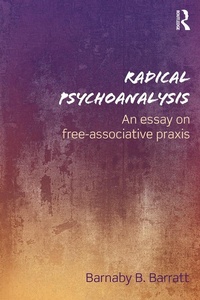
Radical Psychoanalysis
An essay on free-associative praxis
Published on 20. May 2016
242 pages
978-1-317-35597-7 (ISBN)
Description

2020 American Board & Academy of Psychoanalysis (ABAPsa) book award winner!
Only by the method of free-association could Sigmund Freud have demonstrated how human consciousness is formed by the repression of thoughts and feelings that we consider dangerous. Yet today most therapists ignore this truth about our psychic life. This book offers a critique of the many brands of contemporary psychoanalysis and psychotherapy that have forgotten Freud's revolutionary discovery.
Barnaby B. Barratt offers a fresh and compelling vision of the structure and function of the human psyche, building on the pioneering work of theorists such as Andre Green and Jean Laplanche, as well as contemporary deconstruction, feminism, and liberation philosophy. He explores how 'drive' or desire operates dynamically between our biological body and our mental representations of ourselves, of others, and of the world we inhabit. This dynamic vision not only demonstrates how the only authentic freedom from our internal imprisonments comes through free-associative praxis, it also shows the extent to which other models of psychoanalysis (such as ego-psychology, object-relations, self-psychology and interpersonal-relations) tend to stray disastrously from Freud's original and revolutionary insights. This is a vision that understands the central issues that imprison our psychic lives - the way in which the reflections of consciousness are based on the repression of our innermost desires, the way in which our erotic vitality is so often repudiated, and the way in which our socialization oppressively stifles our human spirit.
Radical Psychoanalysis restores to the discipline of psychoanalysis the revolutionary impetus that has so often been lost. It will be essential reading for psychoanalysts, psychoanalytic psychotherapists, mental health practitioners and students and academics with an interest in the history of psychoanalysis.
Only by the method of free-association could Sigmund Freud have demonstrated how human consciousness is formed by the repression of thoughts and feelings that we consider dangerous. Yet today most therapists ignore this truth about our psychic life. This book offers a critique of the many brands of contemporary psychoanalysis and psychotherapy that have forgotten Freud's revolutionary discovery.
Barnaby B. Barratt offers a fresh and compelling vision of the structure and function of the human psyche, building on the pioneering work of theorists such as Andre Green and Jean Laplanche, as well as contemporary deconstruction, feminism, and liberation philosophy. He explores how 'drive' or desire operates dynamically between our biological body and our mental representations of ourselves, of others, and of the world we inhabit. This dynamic vision not only demonstrates how the only authentic freedom from our internal imprisonments comes through free-associative praxis, it also shows the extent to which other models of psychoanalysis (such as ego-psychology, object-relations, self-psychology and interpersonal-relations) tend to stray disastrously from Freud's original and revolutionary insights. This is a vision that understands the central issues that imprison our psychic lives - the way in which the reflections of consciousness are based on the repression of our innermost desires, the way in which our erotic vitality is so often repudiated, and the way in which our socialization oppressively stifles our human spirit.
Radical Psychoanalysis restores to the discipline of psychoanalysis the revolutionary impetus that has so often been lost. It will be essential reading for psychoanalysts, psychoanalytic psychotherapists, mental health practitioners and students and academics with an interest in the history of psychoanalysis.
Reviews / Votes
'This brilliantly conceptualized and carefully constructed argument that psychoanalysis must return to Freud's most revolutionary method is not simply timely, but essential to the growth of psychoanalytical theory and practice.' - Christopher Bollas, from the foreword'This book is full of passion, a "cri de coeur" by a committed psychoanalyst. Dr Barratt advocates a return to Freud different from Lacan's. He goes further - searching for roots that even Freud forgot because of his need for scientific respectability. Barratt reminds us that the cornerstone of psychoanalysis is Freud's method of free-association, which opens and exposes the repressed unconscious that is rooted in the flesh - the way of listening to our drives, which are virtually infinite vectors of freedom of thought. One should read this book!' - Marilia Aisenstein, Paris Psychoanalytic Society
'Free-association is the radical psychoanalytic clinical position that Dr Barratt faces head on and with subtle complexity of technique, philosophy and history. Skillful descriptions of Freud's theory building and metapsychology together with a constant gaze on the ethics of psychoanalysis are woven together in a rethought history that becomes the reader's constant companion. For Barratt interpretation must always be subordinated to the ongoing quest for a free-associative matrix. This is a tour-de-force!' - Dr Jonathan Sklar, British Psychoanalytic Society
'Radical Psychoanalysis underlines Freud's emphasis on the method of free-association as what is essential, central and defining for psychoanalysis. It is, as the author puts it, "a method that uniquely discloses, and to a certain extent undoes, the repressiveness of human self-consciousness." Dr Barratt rightly calls his text a manifesto which urges us "to commit existentially to the method of free-association." Its liberatory intent succeeds - reading it moves us into the 'workplay' of lived experience at its center. Laplanche and Green to whom the book is dedicated would be pleased.' - Dr Jonathan House, American Psychoanalytic Association
More details
Language
English
Place of publication
London
United Kingdom
Publishing group
Taylor & Francis Ltd
Target group
College/higher education
Professional and scholarly
Illustrations
1 s/w Zeichnung, 1 s/w Abbildung
1 Line drawings, black and white; 1 Illustrations, black and white
File size
5,39 MB
ISBN-13
978-1-317-35597-7 (9781317355977)
Copyright in bibliographic data and cover images is held by Nielsen Book Services Limited or by the publishers or by their respective licensors: all rights reserved.
Schweitzer Classification
Other editions
Additional editions
Book
05/2016
1st Edition
Routledge
€236.50
Shipment within 10-20 days
Book
05/2016
1st Edition
Routledge
€72.40
Shipment within 10-20 days
Person
Barnaby B. Barratt has practiced psychoanalysis in Michigan and now in South Africa. He was Professor of Family Medicine and Psychiatry at Wayne State University, and is now Senior Research Associate at the University of Witwatersrand's Institute for Social and Economic Research. His previous work includes Psychic Reality and Psychoanalytic Knowing, Psychoanalysis and the Postmodern Impulse and What is Psychoanalysis? 100 Years after Freud's 'Secret Committee' (all Routledge).
Content
Foreword by Christopher Bollas. Introductory Note. What is Radical Psychoanalysis? Freudian Roots I. Freudian Roots II. Sampling Free-associative Discourse. Textual Analysis and the Dogma of Interpretation. The Lessons of the Method: Psychic Energy. The Lessons of the Method: Theorizing Praxis. The Lessons of the Method: Triebe and Psychic Reality. On the Paramount Significance of our Psychosexualities. The Necessity of the Psychoanalyst. Resisting Praxis: Notes on Clinical and Theoretical Retreats. What is Freeing about Free-Associative Praxis?
