

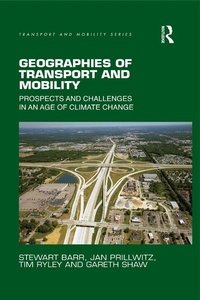
Geographies of Transport and Mobility
Prospects and Challenges in an Age of Climate Change
Published on 4. October 2017
198 pages
978-1-317-12894-6 (ISBN)
Description

Geographies of Transport and Mobility aims to provide a comprehensive and evidenced account of the intellectual and pragmatic challenges for personal mobility in the twenty-first century. In doing so, it argues that geographers have a key role to play in shaping academic and policy debates on how personal mobility can become more sustainable.
The book is structured in three parts. Part I explores how personal mobility has evolved since the mid-nineteenth century, plotting the intricate relationship between new forms of mobile technology, urban planning and design and social practices. Part II examines how researchers study transport and mobility, and outlines the different intellectual trajectories of transport geography and geographies of mobilities. Part III then outlines and discusses the discourse of sustainable mobility that has emerged in recent years; the ways in which social, economic and environmental sustainability can be promoted through different strategies, focusing on behavioural change and urban design.
Geographies of Transport and Mobility provides a unique perspective on personal mobility by demonstrating how the way we travel has developed through complex economic and social processes. It argues that this historical context is critical for considering how mobility in the twenty-first century can be more sustainable, not just environmentally, but also economically and socially. As such, it argues for a renewed focus on sustainable place making as a way to radically shift mobility practices. Geographies of Transport and Mobility is designed to appeal to advanced level undergraduate students and researchers in the fields of geography, anthropology, psychology, sociology and transport studies.
The book is structured in three parts. Part I explores how personal mobility has evolved since the mid-nineteenth century, plotting the intricate relationship between new forms of mobile technology, urban planning and design and social practices. Part II examines how researchers study transport and mobility, and outlines the different intellectual trajectories of transport geography and geographies of mobilities. Part III then outlines and discusses the discourse of sustainable mobility that has emerged in recent years; the ways in which social, economic and environmental sustainability can be promoted through different strategies, focusing on behavioural change and urban design.
Geographies of Transport and Mobility provides a unique perspective on personal mobility by demonstrating how the way we travel has developed through complex economic and social processes. It argues that this historical context is critical for considering how mobility in the twenty-first century can be more sustainable, not just environmentally, but also economically and socially. As such, it argues for a renewed focus on sustainable place making as a way to radically shift mobility practices. Geographies of Transport and Mobility is designed to appeal to advanced level undergraduate students and researchers in the fields of geography, anthropology, psychology, sociology and transport studies.
Reviews / Votes
'The authors draw on their wealth of research expertise to show that transport and mobility can't be understood in isolation from broader social, economic and environmental processes, and that geography has to be at the heart of any approach to making transport better and more sustainable. A thought-provoking text that is essential reading for anyone studying, planning or making policy for transport.' - Jon Shaw, Professor and Head of Geography, University of PlymouthMore details
Series
Language
English
Place of publication
London
United Kingdom
Publishing group
Taylor & Francis Ltd
Target group
College/higher education
Product notice
Reflowable
Illustrations
9 Tables, black and white; 9 Line drawings, black and white; 16 Halftones, black and white; 25 Illustrations, black and white
File size
3,57 MB
ISBN-13
978-1-317-12894-6 (9781317128946)
Copyright in bibliographic data and cover images is held by Nielsen Book Services Limited or by the publishers or by their respective licensors: all rights reserved.
Schweitzer Classification
Other editions
Additional editions
Stewart Barr | Jan Prillwitz | Tim Ryley
Geographies of Transport and Mobility
Prospects and Challenges in an Age of Climate Change
Book
07/2020
1st Edition
Routledge
€70.80
Shipment within 15-20 days
Stewart Barr | Jan Prillwitz | Tim Ryley
Geographies of Transport and Mobility
Prospects and Challenges in an Age of Climate Change
Book
10/2017
1st Edition
Routledge
€222.84
Shipment within 10-20 days
Persons
Stewart Barr is Professor of Geography and has worked as a researcher and lecturer at the University of Exeter since 2001. His current research focuses on critically understanding intellectual and policy discourses on behavioural change and sustainability.
Jan Prillwitz is an independent travel behaviour researcher who holds a PhD in Geography from Leipzig University. His main research interests are in sustainable travel, mobility styles, concepts of new mobilities and the role of socio-psychological factors for individual travel decisions.
Tim Ryley is Professor of Aviation at Griffith University, Brisbane, Australia, where he is head of the School of Natural Sciences. He has over 20 years' experience within transportation research and his expertise is in the fields of airport planning, airport surface access, airport operations and air travel demand, as well as the broader relationship between transport and climate change.
Gareth Shaw is Professor of Retail and Tourism Management at the University of Exeter Business School and is also currently an Innovation Fellow at the Advanced Institute of Management. He was formerly Professor of Human Geography at the University of Exeter and undertakes research on tourism innovation and tourist behaviour.
Jan Prillwitz is an independent travel behaviour researcher who holds a PhD in Geography from Leipzig University. His main research interests are in sustainable travel, mobility styles, concepts of new mobilities and the role of socio-psychological factors for individual travel decisions.
Tim Ryley is Professor of Aviation at Griffith University, Brisbane, Australia, where he is head of the School of Natural Sciences. He has over 20 years' experience within transportation research and his expertise is in the fields of airport planning, airport surface access, airport operations and air travel demand, as well as the broader relationship between transport and climate change.
Gareth Shaw is Professor of Retail and Tourism Management at the University of Exeter Business School and is also currently an Innovation Fellow at the Advanced Institute of Management. He was formerly Professor of Human Geography at the University of Exeter and undertakes research on tourism innovation and tourist behaviour.
Content
Part I: Contextualising Geographies of Transport and Mobility 1. Geographies of Transport; Geographies of Mobility 2. The 'Long Mobile Century': from streetcar suburbs to auto-mobility 3. Predict and Provide: technology, transport and planning in an age of climate change Part II: Approaches to Transport and Mobility 4. Transport Geography and Geographies of Mobility 5. Travel and Transport in Everyday Life 6. Consuming Places: leisure travel and the 'end of tourism' Part III: Sustainable Mobilities 7. Sustainable Mobility: the policy challenge 8. Sustainable Mobility: the challenge of behavioural change 9. Sustainable Mobility: planning better places to live and (not?) travel 10. Conclusion: what future for mobility?
