

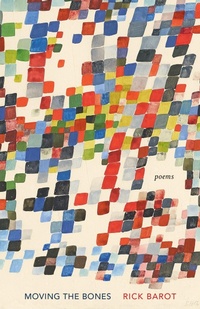
Moving the Bones
Description

A vulnerable and honest collection of poems exploring lineage, love, and the pandemic, from one of the most acclaimed poets of his generation.
?You are told to believe in one paradise / and then there is the paradise you come to know,? begins Rick Barot. What follows is an account of the rich and thorny valley between those poles. Moving the Bones dwells in liminal spaces?of love and memory, the pandemic's singular domesticity, a serene cemetery of ancestral plots, dawn. In precise and tender verse, Barot captures the particularities of being in the middle of one's life, reflecting on the joys and sorrows of the past and confronting the inevitabilities that lie ahead.
For Barot, this presence of mind is an art of being lost in thought. ?My mind has a slow metabolism, it is slow / to understand what anything means,? he confides, ?but understands that if you look at something / long enough, it will have something / to say to you.? Appreciating a Rembrandt, standing in a Goodwill, watching a boy with a flower behind his ear?we encounter ephemeral murmurs of meaning everywhere, but only by slowing down, listening. If we take time to notice the enduring insights of daily moments, if we praise cherry blossoms, lungs, and crying, we might find it easier to bear the loss of a loved one, the sting of solitude, the body's decline.
By laying bare his own experiences, Barot brings us close enough to witness the lyrical work of consciousness. Patient and attentive, this collection illuminates the everyday and invites us to find pleasure in doing the same, at every stage of life.
More details
Other editions
Additional editions
Person
Born in the Philippines, Rick Barot grew up in the San Francisco Bay Area, and attended Wesleyan University and The Writers' Workshop at the University of Iowa. His previous books are The Darker Fall, which received the Kathryn A. Morton Prize; Want, which was a finalist for the Lambda Literary Award and won the 2009 Grub Street Book Prize; and Chord, which was a finalist for the LA Times Book Prize and received the 2016 UNT Rilke Prize, the PEN Open Book Award, and the Publishing Triangle's Thom Gunn Award. His fourth book of poems The Galleons was published by Milkweed Editions in 2020. It was listed on the top ten poetry books for 2020 by the New York Public Library, was a finalist for the Pacific Northwest Book Awards, and was on the longlist for the National Book Award. Barot has received fellowships from the Guggenheim Foundation, the National Endowment for the Arts, the Artist Trust of Washington, the Civitella Ranieri Foundation, and Stanford University, where he was a Wallace E. Stegner Fellow and a Jones Lecturer in Poetry. In 2020, Barot received the Shelley Memorial Award from the Poetry Society of America. He teaches at Pacific Lutheran University and lives in Tacoma, Washington.
Content
Pleasure
The Lovers
Goodwill
The Boy With a Flower Behind His Ear
The Streets
To J.
Crosshatch 1
My Rembrandt
During the Pandemic
Moving the Bones
Abundance
Of Errands
The Singing
The Mussel
Satellite
Crosshatch 2
The Field
Acknowledgments
