

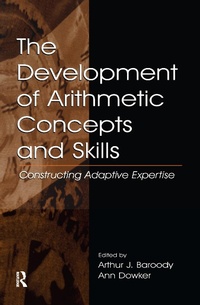
The Development of Arithmetic Concepts and Skills
Constructive Adaptive Expertise
Published on 17. June 2013
516 pages
978-1-135-67223-2 (ISBN)
Description

This volume focuses on two related questions that are central to both the psychology of mathematical thinking and learning and to the improvement of mathematics education:
What is the nature of arithmetic expertise?
How can instruction best promote it?
Contributors from a variety of specialities, including cognitive, developmental, educational, and neurological psychology; mathematics education; and special education offer theoretical perspectives and much needed empirical evidence about these issues.
As reported in this volume, both theory and research indicate that the nature of arithmetic expertise and how to best promote it are far more complex than conventional wisdom and many scholars, past and present, have suggested. The results of psychological, educational, and clinical studies using a wide range of arithmetic tasks and populations (including "normally" and atypically developing children, non-injured and brain-injured adults, and savants) all point to the same conclusion: The heart of arithmetic fluency, in general, and the flexible and creative use of strategies, in particular, is what is termed "adaptive expertise" (meaningful or conceptually based knowledge). The construction of adaptive expertise in mathematics is, for the first time, examined across various arithmetic topics and age groups.
This book will be an invaluable resource for researchers and graduate students interested in mathematical cognition and learning (including mathematics educators, developmental and educational psychologists, and neuropsychologists), educators (including teachers, curriculum supervisors, and school administrators), and others interested in improving arithmetic instruction (including officials in national and local education departments, the media, and parents).
What is the nature of arithmetic expertise?
How can instruction best promote it?
Contributors from a variety of specialities, including cognitive, developmental, educational, and neurological psychology; mathematics education; and special education offer theoretical perspectives and much needed empirical evidence about these issues.
As reported in this volume, both theory and research indicate that the nature of arithmetic expertise and how to best promote it are far more complex than conventional wisdom and many scholars, past and present, have suggested. The results of psychological, educational, and clinical studies using a wide range of arithmetic tasks and populations (including "normally" and atypically developing children, non-injured and brain-injured adults, and savants) all point to the same conclusion: The heart of arithmetic fluency, in general, and the flexible and creative use of strategies, in particular, is what is termed "adaptive expertise" (meaningful or conceptually based knowledge). The construction of adaptive expertise in mathematics is, for the first time, examined across various arithmetic topics and age groups.
This book will be an invaluable resource for researchers and graduate students interested in mathematical cognition and learning (including mathematics educators, developmental and educational psychologists, and neuropsychologists), educators (including teachers, curriculum supervisors, and school administrators), and others interested in improving arithmetic instruction (including officials in national and local education departments, the media, and parents).
Reviews / Votes
"The construction of adaptive expertise in mathematics is, for the first time, examined across various arithmetic topics and age groups. This book will be an invaluable resource for researchers and graduate students interested in mathematical cognition and learning (including mathematics educators, developmental and educational psychologists, and neuropsychologists), educators (including teachers, curriculum supervisors, and school administrators), and others interested in improving arithmetic instruction (including officials in national and local education departments, the media, and parents).-Zentralblatt fur Didaktik der Mathematik
"This is a valuable and important collection....Highly recommended"
-CHOICE
"The editors A.J. Baroody and A. Dowker have made a great job organising the materials. This will become a classical book on arithmetic concepts and skills."
-Zbl. MATH
"The Development of Arithmetic Concepts and Skills: Constructing Adaptive Expertise is a very informative book about the important construct of adaptive expertise in education and the everyday life: The ability to use knowledge flexibly. This book will be of much appeal to people who are interested in theoretical, methodological, and applied educational issues related to the development of flexible arithmetic reasoning and beyond."
-Contemporary Psychology
"This volume is set to become a standard text for anyone with an interest in ALT. Its chapters are research driven, and they severally make decent advances. Useful research reviews are included throughout..."
-American Journal of Psychology
More details
Series
Language
English
Place of publication
London
United Kingdom
Publishing group
Taylor & Francis Ltd
Target group
Professional and scholarly
File size
5,00 MB
ISBN-13
978-1-135-67223-2 (9781135672232)
Copyright in bibliographic data and cover images is held by Nielsen Book Services Limited or by the publishers or by their respective licensors: all rights reserved.
Schweitzer Classification
Other editions
Additional editions
Arthur J. Baroody | Ann Dowker
The Development of Arithmetic Concepts and Skills
Constructive Adaptive Expertise
Book
01/2003
Routledge
€222.84
Shipment within 10-20 days
Arthur J. Baroody | Ann Dowker
The Development of Arithmetic Concepts and Skills
Constructive Adaptive Expertise
Book
01/2003
Routledge
€110.80
Shipment within 10-20 days
Persons
Arthur J. Baroody (Edited by) , Ann Dowker (Edited by)
Content
Contents: G. Hatano, Foreword. A.J. Baroody, A. Dowker, Preface. A.J. Baroody, The Development of Adaptive Expertise and Flexibility: The Integration of Conceptual and Procedural Knowledge. R. Cowan, Does It All Add Up? Changes in Children's Knowledge of Addition Combinations, Strategies, and Principles. A.J. Baroody, S.H. Tiilikainen, Two Perspectives on Addition Development. A.J. Baroody, J.L.M. Wilkins, S.H. Tiilikainen, The Development of Children's Understanding of Additive Commutativity: From Protoquantitative Concept to General Concept? K-H. Seo, H.P. Ginsburg, "You've Got to Carefully Read the Math Sentence...": Classroom Context and Children's Interpretations of the Equals Sign. B. Butterworth, N. Marschesini, L. Girelli, Basic Multiplication Combinations: Passive Storage or Dynamic Reorganization? J-A. LeFevre, B.L. Smith-Chant, K. Hiscock, K.E. Daley, J. Morris, Young Adults' Strategic Choices in Simple Arithmetic: Implications for the Development of Mathematical Representations. I.T. Miura, Y. Okamoto, Language Supports for Mathematics Understanding and Performance. A. Dowker, Young Children's Estimates for Addition: The Zone of Partial Knowledge and Understanding. K.C. Fuson, B.H. Burghardt, Multidigit Addition and Subtraction Methods Invented in Small Groups and Teacher Support of Problem Solving and Reflection. R. Ambrose, J-M. Baek, T.P. Carpenter, Children's Invention of Multidigit Multiplication and Division Algorithms. C. Donlan, The Early Numeracy of Children With Specific Language Impairments. N. Jordan, L.B. Hanich, H.Z. Uberti, Mathematical Thinking and Learning Difficulties. M. Delazer, Neuropsychological Findings on Conceptual Knowledge of Arithmetic. L. Heavey, Arithmetical Savants. J. Bisanz, Arithmetical Development: Commentary on Chapters 1 through 8 and Reflections on Directions. D.C. Geary, Arithmetical Development: Commentary on Chapters 9 through 15 and Future Directions.
