

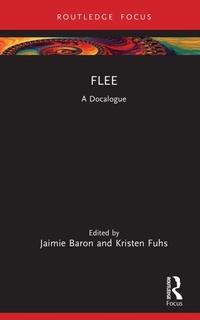
Flee
A Docalogue
1st Edition
Published on 10. March 2025
98 pages
978-1-040-33685-4 (ISBN)
Description

This sixth volume in the Docalogue series explores the significance of Flee, the award-winning and critically acclaimed 2021 animated documentary about one man's journey from child refugee in Afghanistan to building a stable home as an adult with his soon-to-be husband in Denmark.
The film is particularly notable in that it asks pressing questions about how stories of marginalized peoples come to be told, circulated, and consumed within contemporary culture. By combining five distinct perspectives on a single documentary, this book models different critical approaches to the same cinematic object, acting both as an intensive scholarly treatment of a film and as a pedagogical guide for how one might analyze, theorize, and contextualize a film. Through multiple voices, this book seeks to generate a complex and cumulative discourse about Flee's significance in multiple areas including but not limited to: its position within the traditions of contemporary European cinema and animated documentary, its role within the broader category of migrant media, exploring how cross-cultural audiences make sense of refugee narratives, examining important epistemological and ethical questions about what is and what is not shown in the documentary, and how film is situated within the contemporary documentary industry, with its reliance on the promotional efforts of celebrity personalities.
This book will be of interest to students and scholars of documentary studies, animation, migration theory, celebrity studies, queer theory, and global cinema.
The film is particularly notable in that it asks pressing questions about how stories of marginalized peoples come to be told, circulated, and consumed within contemporary culture. By combining five distinct perspectives on a single documentary, this book models different critical approaches to the same cinematic object, acting both as an intensive scholarly treatment of a film and as a pedagogical guide for how one might analyze, theorize, and contextualize a film. Through multiple voices, this book seeks to generate a complex and cumulative discourse about Flee's significance in multiple areas including but not limited to: its position within the traditions of contemporary European cinema and animated documentary, its role within the broader category of migrant media, exploring how cross-cultural audiences make sense of refugee narratives, examining important epistemological and ethical questions about what is and what is not shown in the documentary, and how film is situated within the contemporary documentary industry, with its reliance on the promotional efforts of celebrity personalities.
This book will be of interest to students and scholars of documentary studies, animation, migration theory, celebrity studies, queer theory, and global cinema.
More details
Series
Edition
1. Auflage
Language
English
Place of publication
London
United Kingdom
Publishing group
Taylor & Francis Ltd
Target group
College/higher education
Professional and scholarly
Illustrations
7 Halftones, black and white; 7 Illustrations, black and white
File size
2,02 MB
ISBN-13
978-1-040-33685-4 (9781040336854)
Copyright in bibliographic data and cover images is held by Nielsen Book Services Limited or by the publishers or by their respective licensors: all rights reserved.
Schweitzer Classification
Other editions
Additional editions
Book
approx. 07/2026
1st Edition
Routledge
€30.00
Not yet published
Book
03/2025
1st Edition
Routledge
€77.60
Shipment within 10-20 days

Book
01/2025
Routledge
Unfortunately, price unknown
Available (delivery time upon request)
Persons
Jaimie Baron currently lectures in Film and Media Studies at UC Berkeley. She is the author of two books, The Archive Effect: Found Footage and the Audiovisual Experience of History (2014) and Reuse, Misuse, Abuse: The Ethics of Audiovisual Appropriation in the Digital Era (2020), and numerous journal articles and book chapters. She is also the director of the Festival of (In)appropriation, a yearly international festival of short experimental found footage films and videos.
Kristen Fuhs is chair of the Media Arts department and director of the Filmmaking program at Woodbury University. Her work about documentary film, the American criminal justice system, and contemporary celebrity has appeared in journals such as Cultural Studies, The Historical Journal of Film, Radio, and Television, and the Journal of Sport & Social Issues, as well as collections such as Vocal Projections: Voices in Documentary (2018) and Women in Pop Docs (forthcoming).
Kristen Fuhs is chair of the Media Arts department and director of the Filmmaking program at Woodbury University. Her work about documentary film, the American criminal justice system, and contemporary celebrity has appeared in journals such as Cultural Studies, The Historical Journal of Film, Radio, and Television, and the Journal of Sport & Social Issues, as well as collections such as Vocal Projections: Voices in Documentary (2018) and Women in Pop Docs (forthcoming).
Content
List of Figures
Foreword
Introduction: Documentary attendance
Jaimie Baron
Chapter 1: Flee: a conventional contemporary European animated documentary
Cristina Formenti
Chapter 2: Narration, empathy, and the asylee body in Flee
Darshana Sreedhar Mini
Chapter 3: Fugitive sketches: Flee's charcoal smudges and the importance of ambiguity
Nea Ehrlich
Chapter 4: The currency of star power: celebrities as documentary producers
Kristen Fuhs
Chapter 5: A conversation with Flee's director, Jonas Poher Rasmussen
Steffen Moestrup and Jonas Poher Rasmussen
Bibliography
Filmography
Contributor Biographies
Index
Foreword
Introduction: Documentary attendance
Jaimie Baron
Chapter 1: Flee: a conventional contemporary European animated documentary
Cristina Formenti
Chapter 2: Narration, empathy, and the asylee body in Flee
Darshana Sreedhar Mini
Chapter 3: Fugitive sketches: Flee's charcoal smudges and the importance of ambiguity
Nea Ehrlich
Chapter 4: The currency of star power: celebrities as documentary producers
Kristen Fuhs
Chapter 5: A conversation with Flee's director, Jonas Poher Rasmussen
Steffen Moestrup and Jonas Poher Rasmussen
Bibliography
Filmography
Contributor Biographies
Index
